Black Is the Color of My True Love's Hair Sheet Music Preview

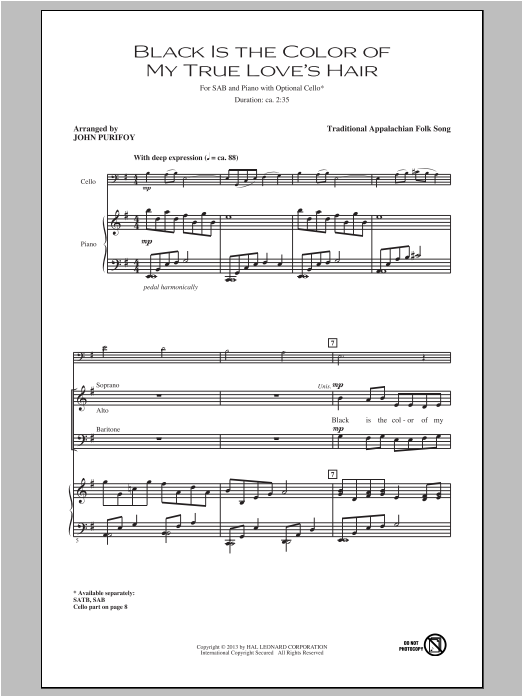
Black Is the Color of My True Love's Hair: SAB Choral Octavo

Arranged by John Purifoy

Item: 35-DS00259900

Digital Download
$2.99
Description

Black Is the Color of My True Love's Hair: SAB Choral Octavo isn't in MakeMusic Cloud just yet...but it could be. Let us know you'd like to see it, and you'll help shape what comes next. In the meantime, start a free trial and dive into thousands of interactive titles your students can play along with today.

Sample Audio
No sample audio found.
Sample Video
Additional Details
Publisher: Hal Leonard
Page Count: 4
SKU: 35-DS00259900

More about this title

About the Arranger: John Purifoy

John Purifoy is a respected choral arranger whose work spans traditional folk material, spirituals, and art song. His arrangements are known for honoring source material while opening new expressive possibilities for singers at various levels. Purifoy's pedagogical approach emphasizes clarity of voice leading and accessibility without sacrificing musical substance.

Why we love this

Purifoy's treatment of this Appalachian ballad respects its haunting simplicity while giving the SAB voicing genuine harmonic interest. The arrangement sits comfortably for mixed voices without requiring soloists, making it equally valuable for building ensemble cohesion or featuring a small group of singers.

What to expect

The piece carries the quiet heartbreak of a folk ballad, with modal harmonic touches that feel both ancient and carefully crafted. Singers experience an intimate, reflective quality that depends on restraint and attention to line rather than volume or drama.

Who it's for

This octavo works for concert choirs of intermediate ability and above, particularly ensembles exploring American traditional song or building SAB repertoire. It suits programs ranging from regional festivals to formal concert settings, and its modest page count makes it practical for festival preparation.

How to get the most out of it

  • Shape the melody with the accompaniment's tempo and dynamics rather than against them; the arrangement rewards a unified approach to phrasing across all three parts.
  • Balance the inner voices carefully during harmonically thick passages so the melody remains audible without requiring oversinging.
  • Consider how much vibrato serves the folk character; a lighter vibrato from all voices reinforces the traditional ballad quality.
  • Allow space and simplicity in the unaccompanied sections (if present) to highlight the arrangement's tonal architecture.

How to use it

Pair this with other art songs or folk arrangements to build a thematic concert exploring American roots material. Its four pages and moderate difficulty make it a reliable choice for winter or spring concert programming, offering your singers meaningful work without overshadowing longer choral works.

Skills your students will build

  • Singing in SAB voicing with clear part independence
  • Shaping lyrical melodies with sustained tone production
  • Balancing modal harmony across three-part texture
  • Responding to traditional music interpretation styles
  • Reading and performing from a concise score

You May Also Like