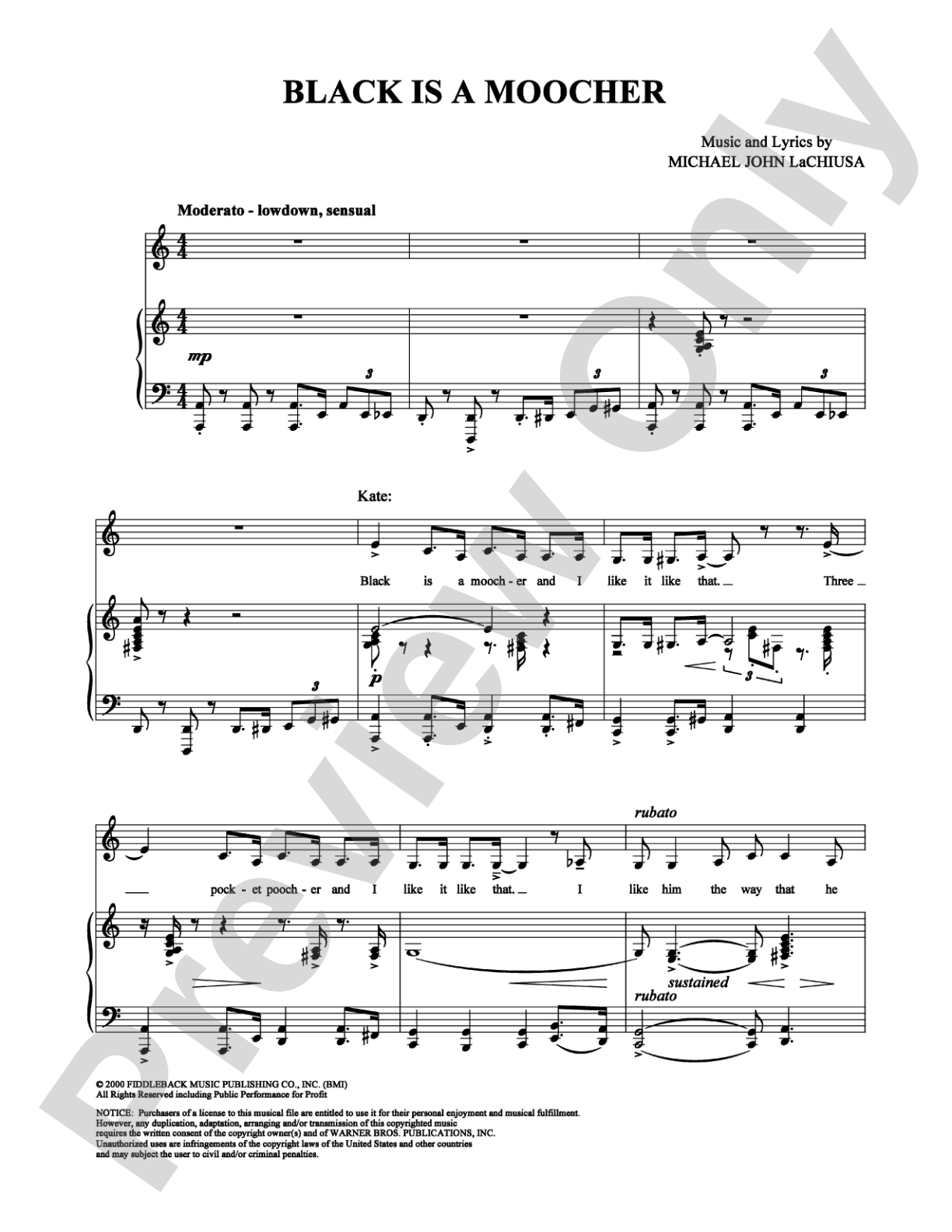
Black Is a Moocher: Piano/Vocal/Chords Digital Sheet Music

Black Is a Moocher: Piano/Vocal/Chords Digital Sheet Music

Michael John LaChiusa

Item: 00-PS-0005046

Digital Download
$3.99
Description

Black Is a Moocher: Piano/Vocal/Chords Digital Sheet Music isn't in MakeMusic Cloud just yet...but it could be. Let us know you'd like to see it, and you'll help shape what comes next. In the meantime, start a free trial and dive into thousands of interactive titles your students can play along with today.

Sample Audio
No sample audio found.
Sample Video
Additional Details
SKU: 00-PS-0005046

More about this title

About the Creator: Duke Ellington

Duke Ellington composed "Black Is a Moocher" as part of his extended work "Black, Brown and Beige," a suite that premiered at Carnegie Hall in 1943. The piece exemplifies Ellington's gift for orchestral color and sophisticated harmonic language, though it has become equally beloved in smaller ensemble and solo piano settings. Ellington's approach to composition prioritized the individual voices of his musicians, and this work showcases his ability to write memorable melodies within complex harmonic frameworks.

As a pianist and bandleader, Ellington fundamentally shaped American music by refusing to be confined to a single genre or idiom. His compositions span jazz standards, concert works, and sacred music, each demonstrating an uncompromising commitment to artistic depth. "Black Is a Moocher" remains a standard in both jazz and classical repertoire because it balances accessibility with harmonic richness.

Why we love this

This standard of American jazz offers pianists a chance to work with stride patterns and comping figures that define the era while a vocalist interprets a lyric rooted in the blues tradition. The chord chart invites improvisation and reharmonization, making it valuable for students developing their jazz vocabulary beyond lead sheet reading.

What to expect

A relaxed, conversational blues with wry humor embedded in its melody and lyric. The piano's stride work propels the song forward with a gentle, walking momentum that feels lived-in rather than precious.

Who it's for

Pianists and vocalists studying jazz standards, particularly those developing swing-era repertoire and learning to navigate chord charts with agency. Voice students exploring the American songbook will find a piece that sits well vocally while demanding rhythmic sophistication from their accompanist.

How to get the most out of it

  • Lock the stride left hand pattern early in rehearsal; the regularity of the bass figure anchors the vocalist's phrasing and gives the piano its rhythmic identity.
  • Explore the lyrical weight behind the title and melody. This isn't a novelty number; it's a character study that rewards interpretive depth from the vocalist.
  • Use the chord symbols to experiment with substitutions and reharmonization. The changes are stable enough to support creative comping without losing the song's bones.

How to use it

Pair this with other standards from the same era to build a jazz recital program that spans the Great American Songbook. It works equally well as a feature for a vocal student or as a teaching piece that demonstrates how piano and voice interact in the jazz idiom.

Skills your students will build

  • Reading and voicing chord symbols in a jazz context
  • Stride piano technique and left-hand independence
  • Swing phrasing and rhythmic flexibility for both voice and accompaniment
  • Improvisation and reharmonization within a blues-inflected standard

You May Also Like