
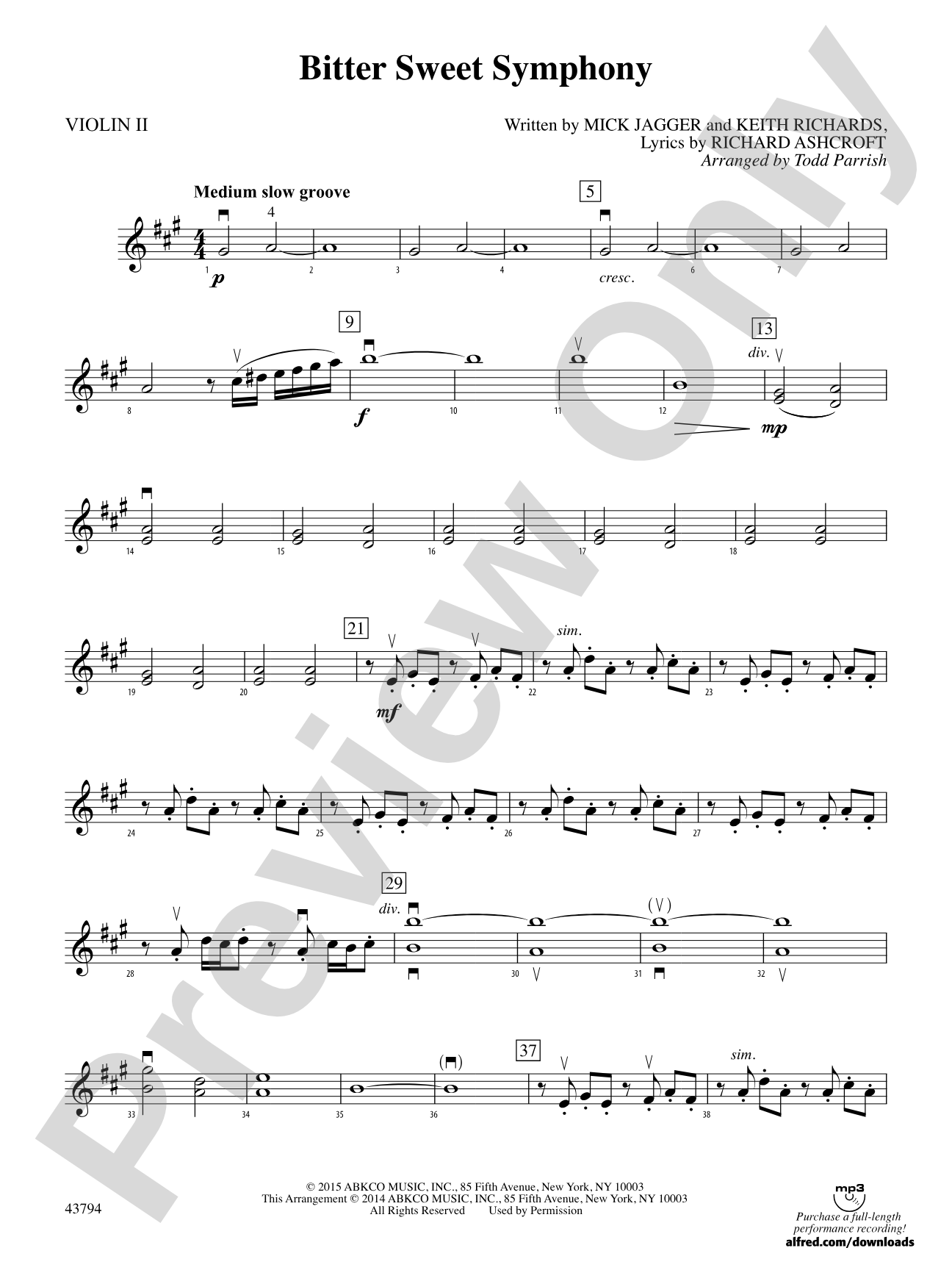

Bitter Sweet Symphony: 2nd Violin
As performed by The Rolling Stones
Written by Mick Jagger and Keith Richards, lyrics by Richard Ashcroft / arr. Todd Parrish
Grade: 3
Item: 00-PC-0016895_VN2
$5.99
Pickup currently not available
Description
Released in 1997, this timeless song became an instant success for The Rolling Stones and continues to be ranked among the top 400 songs of all time. This arrangement retains the power and beauty of the original, while giving all sections interesting contributions. (3:30)


Don't just read it, hear it, play along with it, and watch your students grow with it. In MakeMusic Cloud, Bitter Sweet Symphony: 2nd Violin comes alive with professional accompaniment, adjustable tempo, and built-in practice tools that turn solo practice into real progress.
Open in the Player
Jump straight in and assign it today.
Start Your Free Trial
Open this title and explore the full library in minutes.
Sample Audio
1
Audio File
--:--
0:00
0:00
Sample Video
No sample videos found.
Additional Details
Series:
Pop Concert String Orchestra
Publisher:
Alfred Music
Page Count:
126
SKU:
00-PC-0016895_VN2
More about this title
About the Composer: Mick Jagger
Mick Jagger co-wrote "Bitter Sweet Symphony" alongside Keith Richards and Richard Ashcroft, drawing on the orchestral textures and emotional depth that have defined The Rolling Stones' most enduring work. As the band's primary lyricist and frontman for over six decades, Jagger has shaped popular music through his ability to blend vulnerability with raw energy, creating songs that resonate across generations and genres.
For string orchestras, this composition offers a masterclass in how rock music can be reimagined through classical instrumentation without losing its essential character. The original recording's sweeping strings became iconic precisely because Jagger and Richards understood how orchestration could amplify emotional impact, a principle that makes this arrangement particularly valuable for young musicians studying how melody and harmony work together across different musical traditions.
Why we love this
Todd Parrish's arrangement refuses to shrink this song into something precious or overly refined. The Stones' original power remains intact while every section gets genuine musical work to do, which means your string players stay engaged and invested from start to finish. Programming a contemporary rock standard alongside traditional concert repertoire signals to your audience and your students that orchestral music is living, breathing, and still being written.
What to expect
Yearning and cinematic, with the kind of melodic inevitability that made the original unforgettable. The orchestration creates space for introspection while maintaining the restless energy that defines the Stones' sound, giving your students the experience of playing music that feels both timeless and immediate.
Who it's for
String orchestra conductors building programs that include contemporary music without sacrificing musical substance. This works equally well for ensembles with moderate technical facility who want material that feels current and relevant to their students' lives. Intermediate to advanced string orchestras will find the arrangement sits comfortably at Grade 3 while offering real interpretive challenges.
How to get the most out of it
- Balance the main melody line carefully between first violins and lower voices. The arrangement's strength comes from how it layers the theme rather than isolating it, so blend the sections to create one cohesive voice rather than highlighting soloists.
- Pay attention to the rhythmic drive underneath the lyrical passages. Unlike purely classical pieces, this arrangement uses rhythmic propulsion in the accompaniment to maintain forward momentum even in quieter moments.
- Bring out the textural changes that mark different sections. The arrangement differentiates verses, choruses, and bridges through orchestration, so slight dynamic shifts between these areas will clarify the song's structure without requiring dramatic tempo changes.
- Shape phrases with the emotional arc of the original recording in mind. This piece builds gradually, so resist the urge to play the climactic moments at full volume from the start. Let the intensity grow organically across the 3:30 duration.
How to use it
Pair this with a classical or contemporary chamber work to frame how different eras approach similar emotional content. It's particularly effective as a concert closer or as the anchor piece in a "Rock Reimagined" or "Popular Music in the Orchestra" themed concert. Students respond viscerally to material they know, and the 3:30 length fits neatly into traditional programming without requiring unusual scheduling adjustments.
Skills your students will build
- Phrasing across longer melodic arcs (maintaining line through sustained passages)
- Balance and blend in divisi passages (managing multiple harmonic layers within each section)
- Rhythmic precision in rock and pop contexts (feels different from classical notation)
- Reading contemporary string orchestration (understanding how Parrish reharmonizes and reimagines the original)
- Expressive interpretation of familiar material (avoiding mechanical readings of well-known songs)