
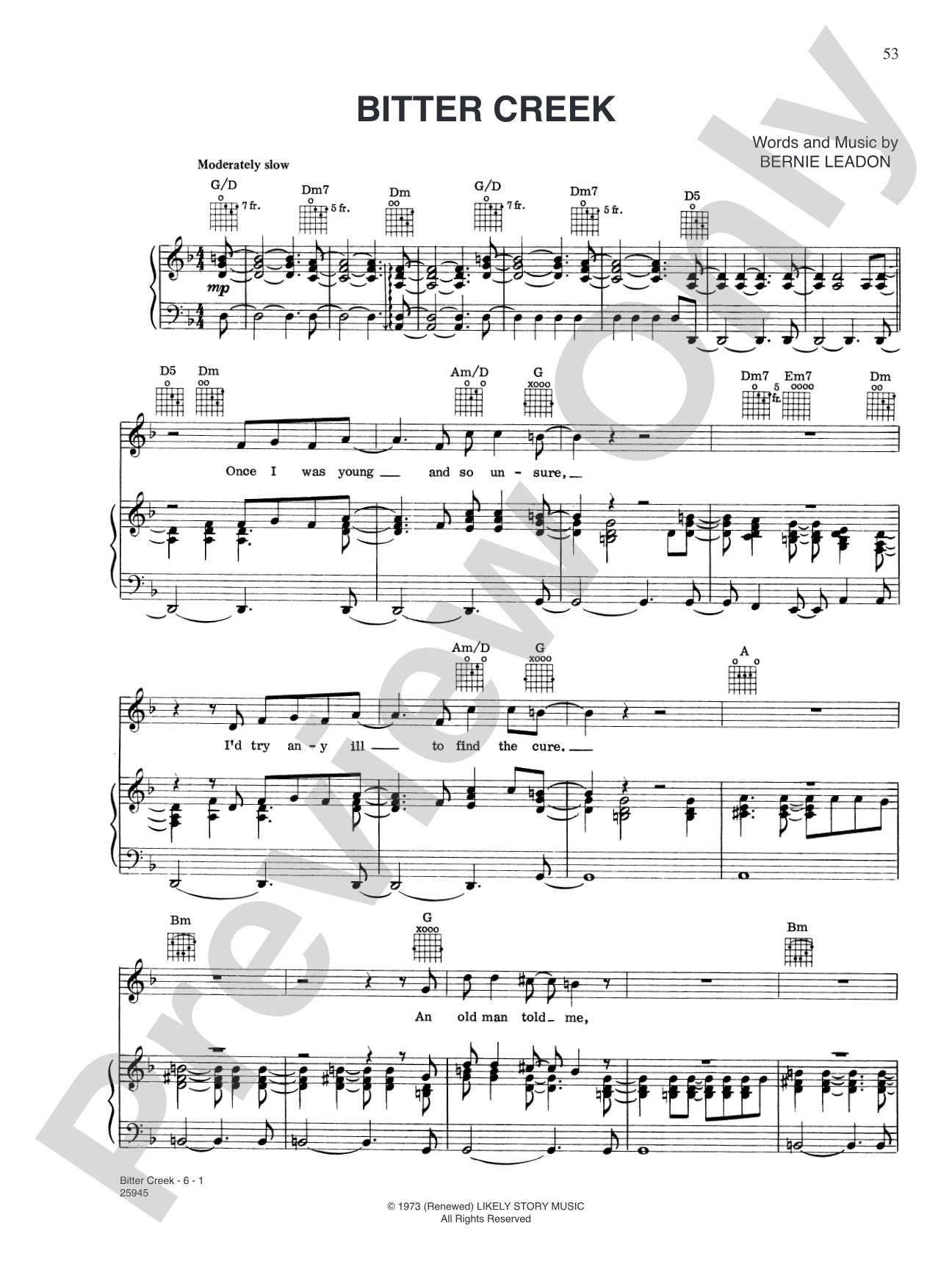
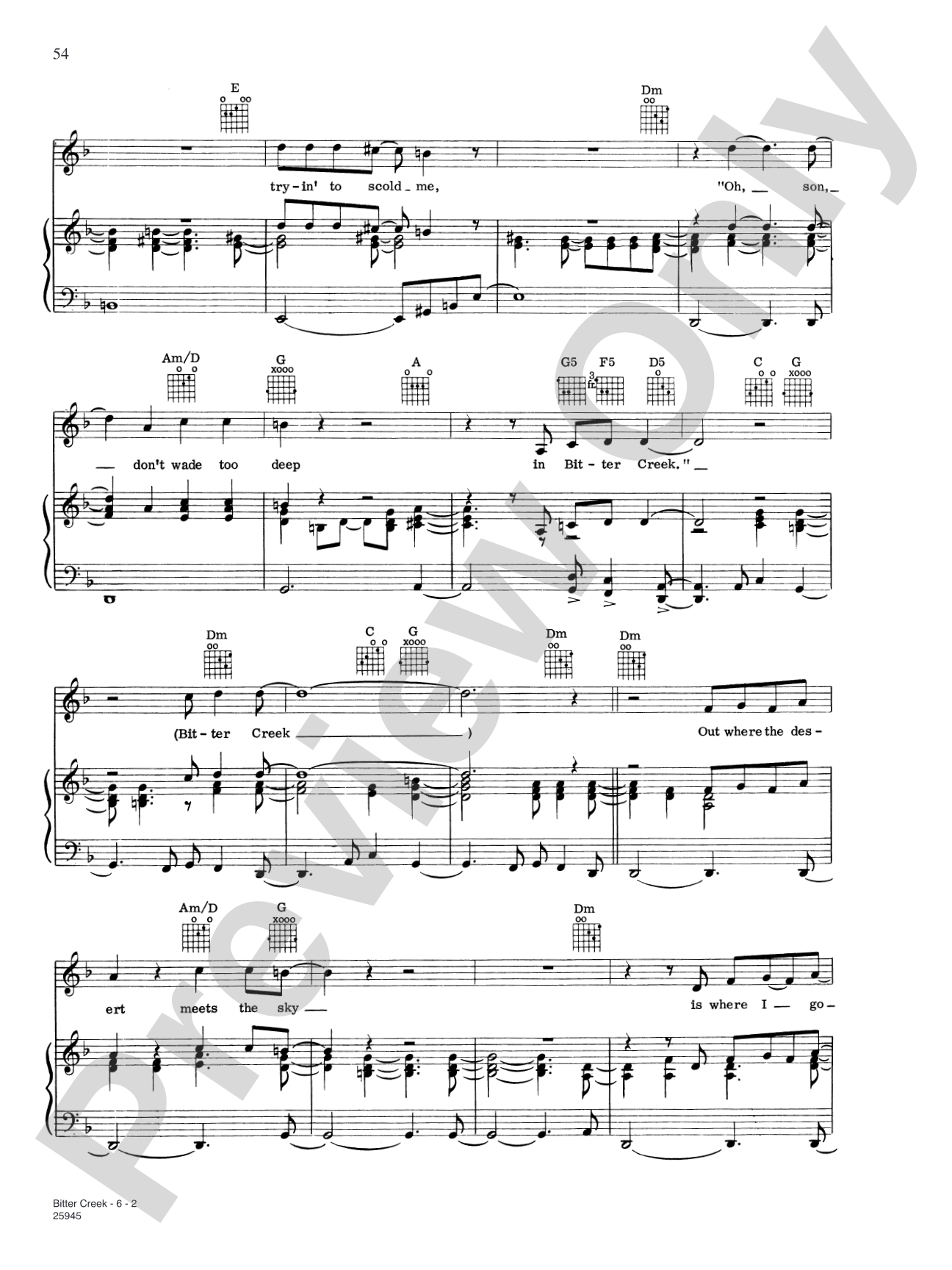

Bitter Creek: Piano/Vocal/Chords
Eagles
Item: 00-PSP-000096
$5.99
One moment…
Description
Alfred is pleased to expand the Classic Album Edition series to include the Eagles' legendary record Desperado.
Released in 1973, Desperado was the second record released by the Eagles. Hit songs from the album include "Peaceful Easy Feeling," "Take It Easy," "Tequila Sunrise," "Witchy Woman," and the title track, "Desperado." This book provides the lyrics along with piano and chord arrangements for all the songs on the record.
Titles are: Bitter Creek * Certain Kind of Fool * Chug All Night * Desperado * Desperado Part II * Doolin-Dalton * Doolin-Dalton Part II * Earlybird * Most of Us Are Sad * Nightingale * Out of Control * Outlaw Man * Peaceful Easy Feeling * Saturday Night * Take It Easy * Take the Devil * Tequila Sunrise * Train Leaves Here This Mornin' * Tryin' Twenty One * Witchy Woman.


Released in 1973, Desperado was the second record released by the Eagles. Hit songs from the album include "Peaceful Easy Feeling," "Take It Easy," "Tequila Sunrise," "Witchy Woman," and the title track, "Desperado." This book provides the lyrics along with piano and chord arrangements for all the songs on the record.
Titles are: Bitter Creek * Certain Kind of Fool * Chug All Night * Desperado * Desperado Part II * Doolin-Dalton * Doolin-Dalton Part II * Earlybird * Most of Us Are Sad * Nightingale * Out of Control * Outlaw Man * Peaceful Easy Feeling * Saturday Night * Take It Easy * Take the Devil * Tequila Sunrise * Train Leaves Here This Mornin' * Tryin' Twenty One * Witchy Woman.
Bitter Creek: Piano/Vocal/Chords isn't in MakeMusic Cloud just yet...but it could be. Let us know you'd like to see it, and you'll help shape what comes next. In the meantime, start a free trial and dive into thousands of interactive titles your students can play along with today.
Request This Title
Tell us you want it.
Start Your Free Trial
Explore everything that's ready to play right now.
Sample Audio
No sample audio found.
Sample Video
No sample videos found.
Additional Details
Series:
Alfred's Classic Album Editions
Publisher:
Alfred Music
Page Count:
64
SKU:
00-PSP-000096
More about this title
About the Artist: Eagles
The Eagles emerged from Los Angeles in the early 1970s to become one of the most commercially successful rock bands in history. Their mastery of harmony, sophisticated songwriting, and ability to blend rock with country and folk influences set them apart from their contemporaries. The band's core members—Glenn Frey, Don Henley, Bernie Leadon, and Randy Meisner—created a distinctive sound that defined the soft rock era and continues to influence musicians across genres.
Desperado, their 1973 sophomore album, showcased the Eagles at a creative peak, featuring intricate vocal arrangements, memorable melodies, and storytelling lyrics that resonate across generations. The album's sustained popularity and cultural significance make it essential repertoire for musicians studying popular music composition, arrangement, and performance practice.
Why we love this
These arrangements capture the harmonic sophistication and vocal layering that define the Eagles' signature sound, giving pianists and singers authentic material that rewards careful attention to detail. The songs balance accessibility with genuine musical substance, making them engaging for students while maintaining the integrity of the original recordings.
What to expect
Opening these arrangements transports you into the Eagles' warm, sophisticated world of close harmonies and thoughtful instrumentation. Each song breathes with restraint and emotional directness, from the melancholy of the title track to the luminous beauty of "Peaceful Easy Feeling." The music feels intimate and crafted, inviting both careful study and genuine musical enjoyment.
Who it's for
This collection serves pianists and singers performing in jazz ensembles, pop ensembles, or recital settings, as well as music students analyzing rock composition and arrangement. It works equally well for solo pianists exploring repertoire beyond classical traditions and for collaborative musicians building a contemporary performance library.
How to get the most out of it
- Pay close attention to the chord voicings; they often contain suspended and extended harmonies that create the band's lush sound. Don't simplify them for speed.
- Layer the vocal melody with the piano line thoughtfully. The arrangement's richness comes from the interplay between voice and accompaniment, not from the voice overshadowing it.
- Study the original recordings to understand the vocal harmonies and phrasing. This book provides the foundation, but the recorded versions reveal nuances in timing and emphasis that sheet music alone cannot convey.
- Experiment with tempo and dynamics within individual songs. The Eagles' arrangements often benefit from subtle rubato and expressive shaping rather than metronomic precision.
How to use it
These songs fit naturally into pop or contemporary music showcases, especially when grouping multiple Eagles numbers to showcase the album's thematic coherence. They also serve as excellent material for student recitals, providing pianists with recognizable, engaging repertoire that connects with audiences while developing serious musicianship skills.
Skills your students will build
- Reading and interpreting chord symbols in contemporary notation
- Playing compound chord voicings and extended harmonies on piano
- Coordinating vocal melody with piano accompaniment in ensemble contexts
- Analyzing and performing rock-era harmonic progressions and song structures
- Developing interpretive choices for contemporary popular music based on style understanding