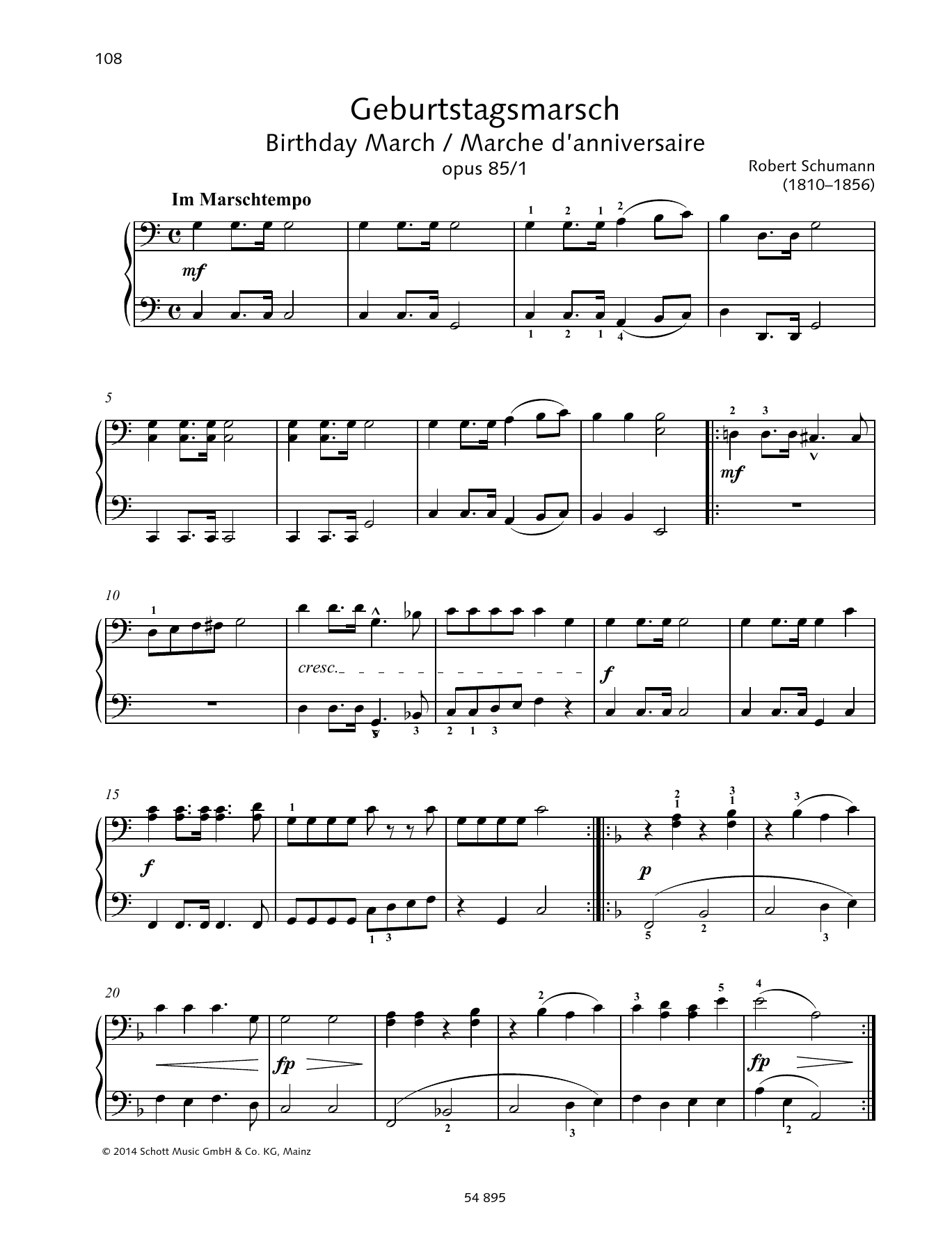
Birthday March op. 85 No. 1 Sheet Music Preview

Birthday March op. 85 No. 1: Piano Duet

By Robert Schumann / Edited by Monika Twelsiek

Item: 35-DS00370516

Digital Download
$4.99
Description

Discover MakeMusic Cloud: thousands of interactive titles your students can play along with today.

Sample Audio
No sample audio found.
Sample Video
Additional Details
Publisher: Hal Leonard
Page Count: 4
SKU: 35-DS00370516

More about this title

About the Composer: Robert Schumann

Robert Schumann (1810–1856) was a Romantic composer and pianist whose music sits at the intersection of chamber music intimacy and orchestral ambition. His gift for melody and harmonic richness made him a central figure in 19th-century music, and his prolific output across piano, vocal, and orchestral genres reflects deep engagement with both classical structure and Romantic expression.

Schumann's smaller piano works, including his character pieces and occasional compositions, reveal a composer attuned to domestic music-making. These pieces often carried programmatic or personal significance, serving both as teaching tools and as windows into his own artistic sensibility. His craftsmanship in miniature forms demonstrates why he remains essential to the piano repertoire.

Why we love this

This march strikes a balance between structural clarity and Romantic warmth that makes it genuinely rewarding to rehearse. Rather than resorting to bombast, Schumann builds momentum through melodic continuity and inventive voice leading, giving pianists real musical problems to solve without overwhelming them.

What to expect

Ceremonial yet intimate, this march possesses the dignity of a procession without pomposity. There is refinement in the phrasing and a distinctly Romantic sensibility beneath the formal structure, as if Schumann is offering a character sketch rather than a grand gesture.

Who it's for

Intermediate pianists ready to explore Schumann's miniature works will find this piece accessible yet musically substantive. Teachers seeking repertoire that combines technical modesty with artistic depth will appreciate its compact four-page format and clear pedagogical value.

How to get the most out of it

  • Shape the opening theme with a gentle forward motion; resist the urge to rush despite the march style. Let the character develop naturally from the harmonic progressions rather than relying on tempo alone.
  • Pay attention to Schumann's voice independence. Secondary voices often carry subtle motivic material that gives the texture depth and prevents mechanical rhythmic accompaniment.
  • Consider the dynamic arch across the entire piece. March form invites regularity, but breaking up phrase-to-phrase dynamics keeps the listener engaged.

How to use it

This works well in a recital devoted to Schumann's shorter forms, or as a palate-cleansing encore between weightier romantic works. Its brevity also makes it suitable for student showcase programs where you need substantial repertoire at an intermediate level.

Skills your students will build

  • Maintaining character-driven phrasing within a structured form
  • Voice independence and contrapuntal awareness in a homophonic texture
  • Dynamic shaping and architectural planning across a short work
  • Interpreting Romantic conventions within classical frameworks

You May Also Like