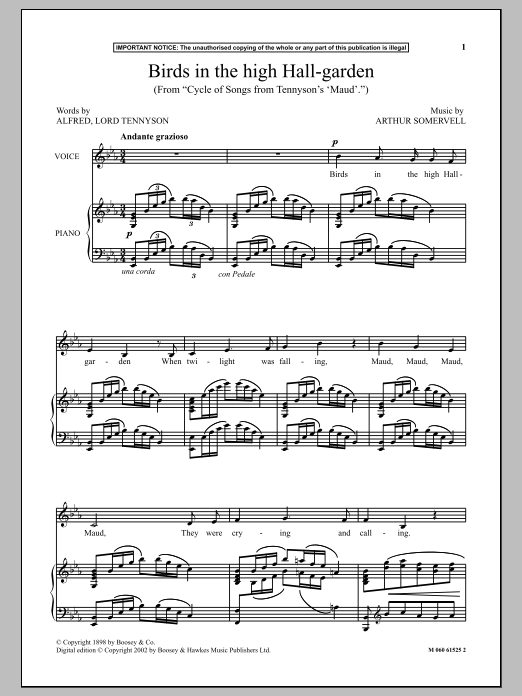
Birds In The High Hall Garden (from Cycle Of Songs From Tennyson's Maud) Sheet Music Preview

Birds In The High Hall Garden (from Cycle Of Songs From Tennyson's Maud): Piano Vocal

As performed by Arthur Somervell

Item: 35-DS00240689

Digital Download
$5.99
Description

Birds In The High Hall Garden (from Cycle Of Songs From Tennyson's Maud): Piano Vocal isn't in MakeMusic Cloud just yet...but it could be. Let us know you'd like to see it, and you'll help shape what comes next. In the meantime, start a free trial and dive into thousands of interactive titles your students can play along with today.

Sample Audio
No sample audio found.
Sample Video
Additional Details
Publisher: Hal Leonard
Page Count: 4
SKU: 35-DS00240689

More about this title

About the Artist: Arthur Somervell

Arthur Somervell (1863–1937) was an English composer and educator whose gift for setting poetry to music made him a defining voice in the English song tradition. His song cycles, built on texts by major Victorian poets, bridged the gap between concert hall sophistication and genuine lyricism that singers could live inside. Somervell's output includes over 100 songs, many of them settings of Tennyson, and his pedagogical instincts shaped how generations of singers approached the marriage of word and note.

Why we love this

Somervell's setting captures the painterly language of Tennyson's text with harmonic sophistication that never overwhelms the voice. The piano writing is conversational rather than ornamental, creating space for genuine interpretive choices while offering students a masterclass in how accompaniment can strengthen rather than compete with the vocal line.

What to expect

Intimate and reflective, with the quality of a memory being recounted. The music unfolds with gentle forward momentum, painting a scene of natural beauty through color and suggestion rather than dramatic assertion.

Who it's for

Intermediate to advanced singers preparing art song repertoire, particularly those building knowledge of the English song tradition. This work suits students developing facility with harmonic language and interpretive maturity beyond simpler vocal literature.

How to get the most out of it

  • Allow the text to drive phrasing and breath. Somervell's harmonic rhythm often supports natural speech patterns, so resist the impulse to impose symmetrical phrases.
  • Shape the piano line with sensitivity to dynamic contrast. The accompaniment has its own melodic interest that can easily overshadow the voice if not carefully balanced.
  • Explore rubato in the quieter passages, particularly where harmonic movement slows. This song rewards a lyrical approach that breathes with the text.

How to use it

Pair this with other Somervell or English art song settings to build a complete picture of vocal writing in the late Romantic period. It also works well as a lyrical interlude in a program of larger dramatic works, offering audiences a moment of quiet contemplation.

Skills your students will build

  • Interpreting harmonic movement to support vocal phrasing
  • Balancing voice and piano accompaniment
  • Setting English text with attention to natural speech patterns
  • Understanding the aesthetic of English art song in the late 19th century

You May Also Like