
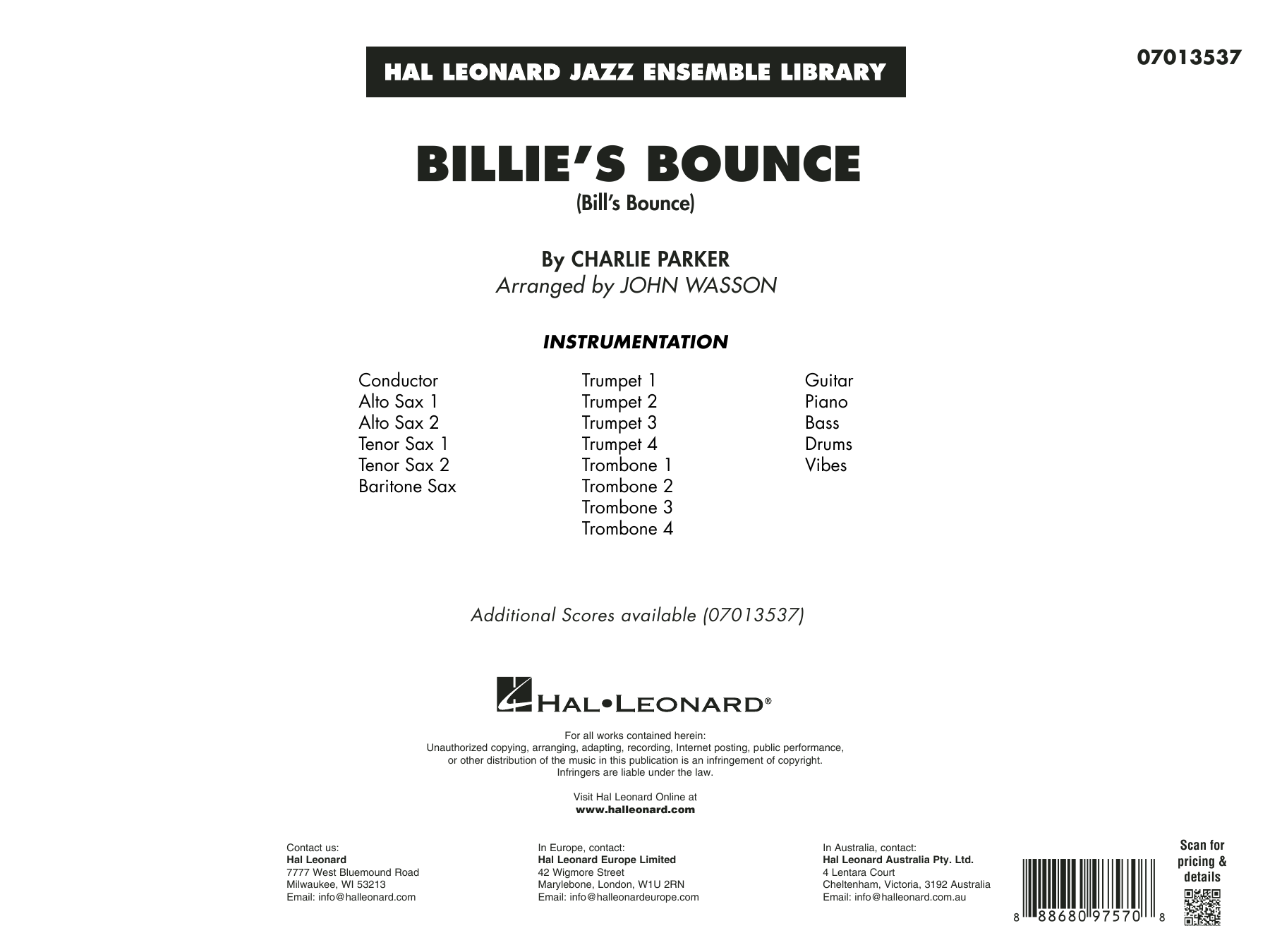

Billie's Bounce (arr. John Wasson): Jazz Ensemble Conductor Score & Parts
As performed by Charlie Parker / Arranged by John Wasson
Grade: 4
Item: 35-PK01266429
$55.00
Pickup currently not available
Buy Extra Parts (Digital PDF Download)
Parts Added to Cart!
Description
Here's an energetic big band treatment of one of jazz legend Charlie Parker's best-known tunes. John Wasson's wonderfully crafted medium up-tempo swing chart features an interplay between the sax and brass sections, along with solos for alto sax and trumpet. Much of ensemble writing is adapted from Bird's famous recorded solo.


Discover MakeMusic Cloud: thousands of interactive titles your students can play along with today.
Sample Audio
No sample audio found.
Sample Video
Additional Details
Publisher:
Hal Leonard
SKU:
35-PK01266429
More about this title
About the Artist: Charlie Parker
Charlie Parker revolutionized jazz improvisation in the 1940s, transforming alto saxophone technique and harmonic language in ways that still define jazz pedagogy today. His compositions, particularly those written during his bebop era, remain essential study material for understanding modern jazz phrasing, articulation, and solo construction.
Why we love this
Wasson's arrangement captures what makes Bird's original so musically infectious while building in accessible solo spots that encourage your soloists to find their voice within the bebop idiom. The interplay between sax and brass sections keeps ensemble energy high without overwhelming younger players, and the orchestration stays true to the tune's character while giving your band genuine swing repertoire they can take pride in.
What to expect
Propulsive and clean; the arrangement moves with the urgent energy of a mid-century bebop session without losing the warmth of a full ensemble sound. Your band will feel the drive and sophistication of Parker's melodic language the moment the opening statements hit.
Who it's for
Jazz ensembles at the intermediate level who are ready to tackle bebop changes and solo work without requiring extensive transcription study. This works equally well for high school groups developing their swing vocabulary and college ensembles seeking straightforward but rewarding big band material.
How to get the most out of it
- Lock the comping rhythm section into a relaxed swing feel first; once the drums and bass establish that pocket, everything else settles naturally into the groove.
- Shape the ensemble hits with consistency across sections. The sax and brass answers need rhythmic clarity and unified articulation to land the call-and-response writing effectively.
- Let your soloists breathe and find space in the changes rather than pushing them toward strict time. Jazz phrasing often sits slightly behind the beat, and Bird's solo adaptations showcase this quality.
- Balance the recorded accompaniment volume so it supports rather than overwhelms; your ensemble and soloists need to hear each other as much as the click.
How to use it
Pair this with other Parker compositions or classic bebop standards to build a jazz history concert, or feature it as your ensemble's anchor in a mixed repertoire program where you want a genuine jazz credential alongside concert band and pop selections.
Skills your students will build
- Swing articulation and phrasing in the bebop style
- Reading and executing section ensemble hits with rhythmic precision
- Improvising within chord changes and Parker-derived melodic contours
- Listening and responding to other ensemble voices during call-and-response passages
- Soloing over walking bass lines and comping rhythms
- Balancing individual voice within a full big band texture