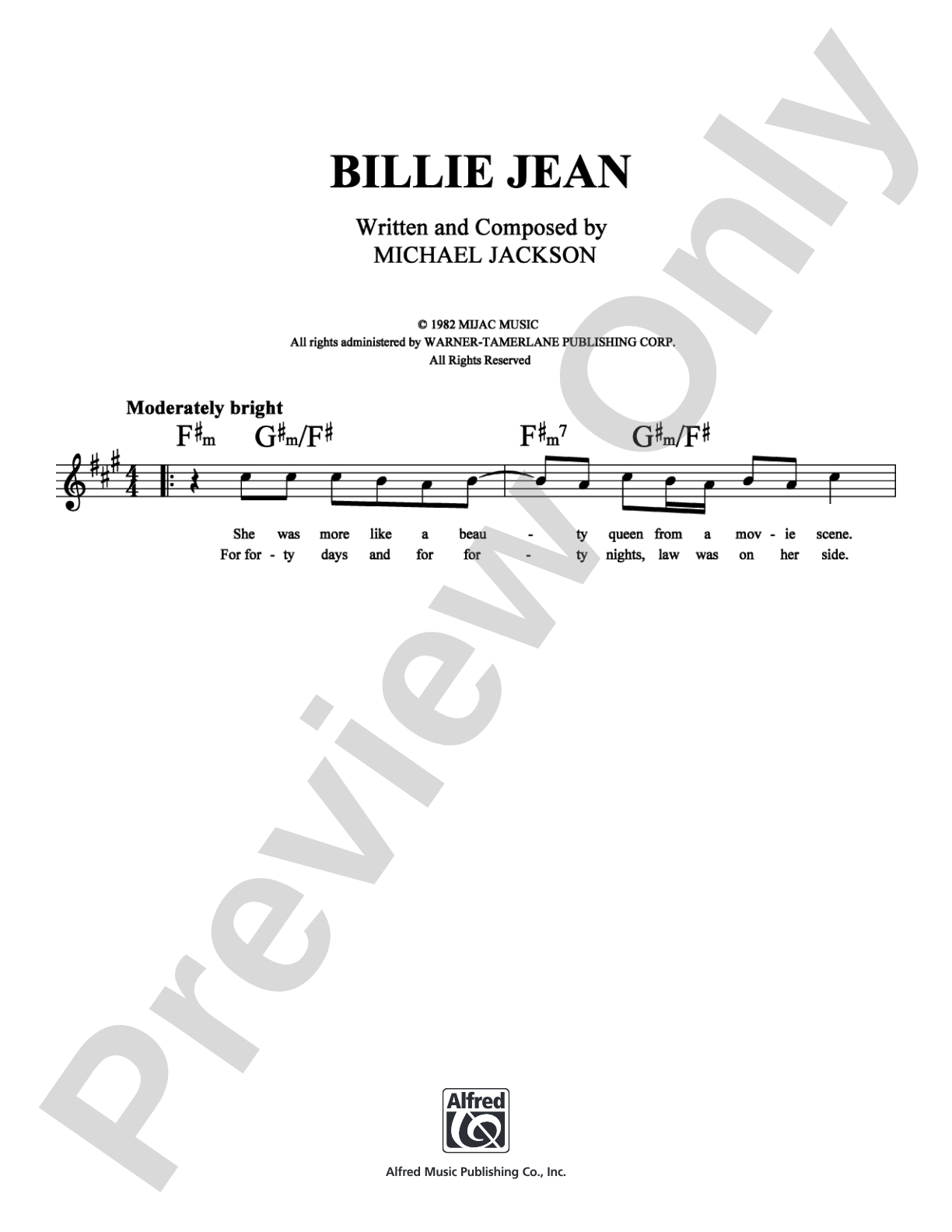
Billie Jean: Lead Sheet Digital Sheet Music

Billie Jean: Lead Sheet Digital Sheet Music

Michael Jackson

Item: 00-PS-0009009

Digital Download
$1.99
Description

Billie Jean: Lead Sheet Digital Sheet Music isn't in MakeMusic Cloud just yet...but it could be. Let us know you'd like to see it, and you'll help shape what comes next. In the meantime, start a free trial and dive into thousands of interactive titles your students can play along with today.

Sample Audio
No sample audio found.
Sample Video
Additional Details
SKU: 00-PS-0009009

More about this title

About the Artist: Michael Jackson

Michael Jackson (1958-2009) stands as one of the most influential recording artists of the 20th century. His contributions to pop music fundamentally shaped how contemporary music functions in education contexts, from rhythmic innovation to cross-genre accessibility. Jackson's work demonstrates how popular music can achieve both commercial success and genuine musical sophistication, making his catalog essential for educators introducing students to contemporary song structure and performance practice.

As a performer, Jackson redefined what it means to integrate melody, rhythm, and choreography into a unified artistic statement. His compositions and recordings have become touchstones in popular music education, offering students direct access to the harmonic language, groove-based songwriting, and structural clarity that define modern pop. Teachers use his work to engage students who might not otherwise connect with traditional repertoire, while maintaining genuine musical rigor.

Why we love this

"Billie Jean" gives students and performers an authentic entry point into studying contemporary song structure and groove-based composition. The lead sheet format strips away production elements and forces players to focus on melody, harmony, and the rhythmic foundation that makes the tune instantly recognizable. Musicians at any level can engage with one of the most analyzed pop songs of the 1980s and understand exactly why it works.

What to expect

Propulsive yet controlled. The tune has an almost weightless quality, with the hook sitting just ahead of or behind the beat depending on the phrase. There's an undeniable swagger in the melody, but it's understated and cool, never overplaying its hand. The harmonic movement feels modern and slightly unexpected, keeping listeners and performers engaged precisely because the chords don't follow the most obvious path.

Who it's for

Students and performers studying contemporary pop songwriting, harmonic analysis, or groove-based composition. Musicians preparing for jazz or contemporary music ensembles, singer-songwriters building covers into their sets, and music theory classes examining functional harmony in pop contexts.

How to get the most out of it

  • Center your interpretation around the syncopated kick drum pattern rather than playing straight on the beat; the pocket sits slightly behind, and your phrasing should reflect that
  • Keep the bass line driving but understated, even on solo piano or guitar. This tune thrives on restraint and space, not fullness
  • Study the original recording to hear how the vocals interact with the rhythm section, then bring that conversational quality to your chord voicings and accompanying figures
  • Balance the smoothness of the main melody against the angular, unexpected chord movements; let both elements breathe rather than forcing them to blend

How to use it

Program this alongside other 1980s pop standards when exploring the evolution of songwriting and production in contemporary music. Use it in a theory class to analyze functional harmony and rhythmic displacement in commercial contexts. Include it in recitals where students are developing their ability to interpret and arrange familiar material in personal ways.

Skills your students will build

  • Reading and interpreting lead sheet notation in a pop context
  • Understanding groove-based phrasing and syncopation
  • Analyzing functional harmony in contemporary song structure
  • Recognizing and performing rhythmic displacement and anticipation
  • Developing arrangement skills for familiar melodies

You May Also Like