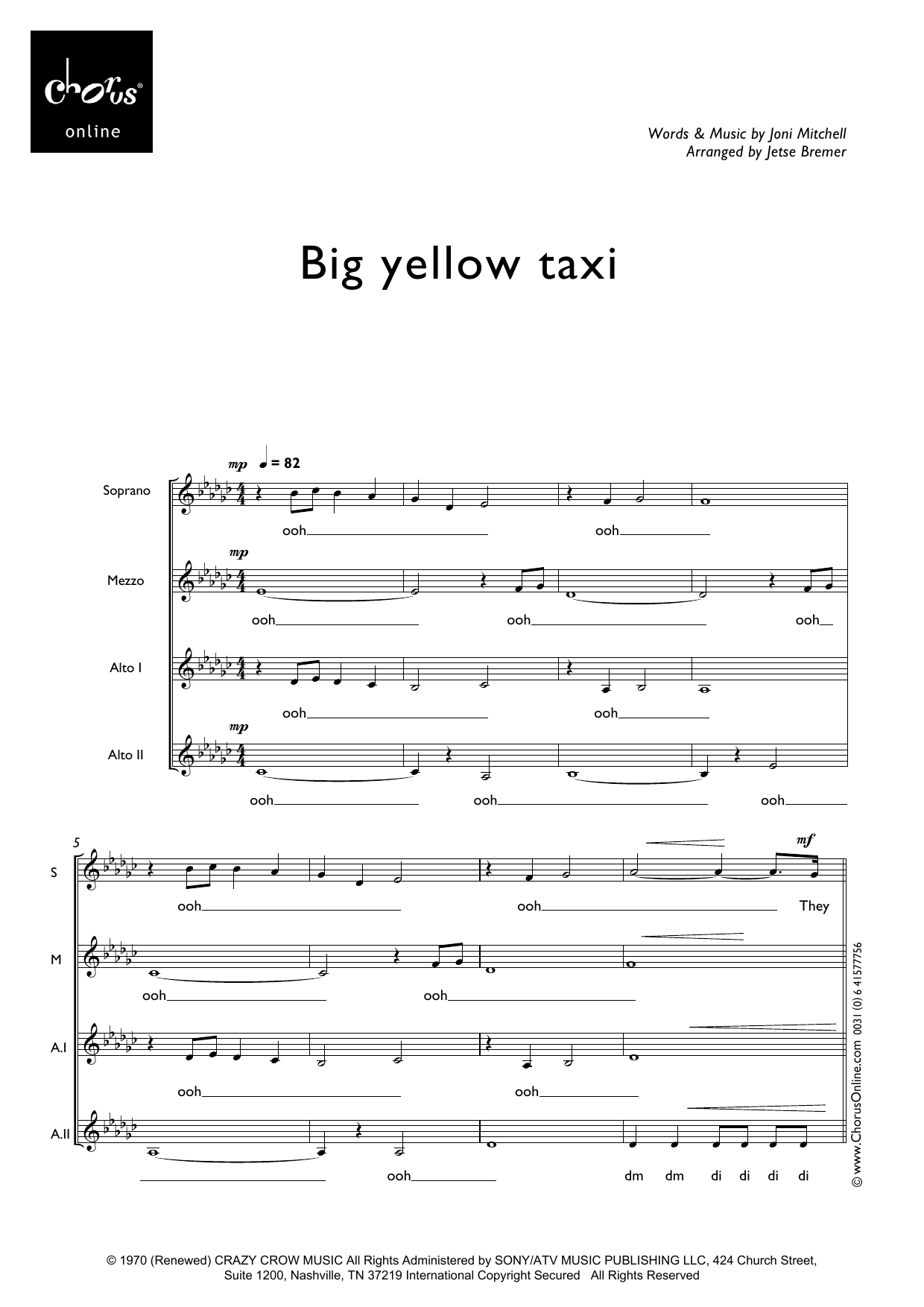
Big Yellow Taxi (arr. Jetse Bremer) Sheet Music Preview

Big Yellow Taxi (arr. Jetse Bremer): SSMAA Choral Octavo

As performed by Counting Crows / Arranged by Jetse Bremer

Item: 35-DS00481473

Digital Download
$2.99
Description

Big Yellow Taxi (arr. Jetse Bremer): SSMAA Choral Octavo isn't in MakeMusic Cloud just yet...but it could be. Let us know you'd like to see it, and you'll help shape what comes next. In the meantime, start a free trial and dive into thousands of interactive titles your students can play along with today.

Sample Audio
No sample audio found.
Sample Video
Additional Details
Publisher: Hal Leonard
Page Count: 9
SKU: 35-DS00481473

More about this title

About the Artist: Counting Crows

Counting Crows emerged from the San Francisco Bay Area in the early 1990s, building a devoted following through their introspective alt-rock sound and Adam Duritz's distinctive, conversational vocal style. The band's 1993 debut album established them as major players in the post-grunge era, and their music has remained a fixture in contemporary music education due to its emotional accessibility and sophisticated songwriting.

For choral arrangers, Counting Crows' catalog offers rich material because their songs prioritize lyrical storytelling and harmonic complexity over simple structures. This arrangement of "Big Yellow Taxi" demonstrates how a pop-rock sensibility can translate effectively into a cappella settings, preserving the song's contemplative character while opening it to choir classrooms.

Why we love this

Jetse Bremer's voicing for SSMAA makes this Joni Mitchell standard feel fresh without abandoning what makes the Counting Crows version resonate. The arrangement respects the melody's quiet power while creating genuine chord writing that engages all five parts, not just surrounding a soprano line. Directors get a piece that speaks to contemporary students because it arrives through a band they recognize, yet teaches genuine harmonic and textural awareness.

What to expect

The arrangement preserves the original's wistfulness and yearning quality, letting the lyrics about paved paradise and environmental consequence land with quiet force. Moving through the voicings feels meditative rather than showy; the harmonic movement unfolds thoughtfully, inviting listeners into the song's reflective space. This isn't a pop arrangement meant to dazzle; it's one built to make a room full of singers and listeners feel something together.

Who it's for

Choirs with solid intonation skills and comfort sustaining a cappella textures will find this arrangement rewarding without requiring extensive previous experience with contemporary vocal music. The piece works for concert choirs, show choirs seeking a more introspective moment, or any ensemble that wants to program something recognizable yet genuinely musical.

How to get the most out of it

  • Balance the sustains carefully in the verses; with five parts in a cappella texture, even one overly loud voice will muddy the harmonic clarity. Run sectionals on dynamics specifically.
  • Treat the alto II line as a true interior voice rather than a filler part. That voice often carries important harmonic weight and deserves attention in rehearsal.
  • Lock the syllable choices across all sections during consonants, especially on repeated or sustained notes where any slippage becomes audible.
  • Explore the arrangement's dynamics as emotional markers rather than technical exercises. The contrast between quieter and fuller sections should track the song's thematic arc about loss and environmental reckoning.

How to use it

Position this in the second half of a concert where you can pair it with other contemporary or environmental-themed repertoire for a thematic set. The piece also serves well as an encore that feels substantial rather than tacked-on, or as the opener to a pop-focused concert that sets a tone of musicality before moving into higher-energy selections. Its nine pages and moderate difficulty make it sustainable for mid-year learning without derailing your rehearsal calendar.

Skills your students will build

  • Maintaining intonation in close voicings without instrumental support
  • Reading five-part a cappella textures with independent melodic lines
  • Blending sustained vowels across multiple parts
  • Shaping phrasing in pop-influenced music that prioritizes lyrical meaning
  • Responding to dynamic and textural contrast as expressive tools

You May Also Like