Series:Wilfin String Orchestra: Young String Ensemble Series
Publisher:Wilfin Music
Page Count:66
SKU:76-PC-0000004_VC1
More about this title
About the Composer: Loreta Fin
Loreta Fin AM is an Australian violist, composer, and string educator who studied at the Sydney Conservatorium of Music and spent her early career as a performer, including service as first violinist with the Sydney Youth Orchestra. She has maintained a 25-year tenure as Principal Viola player with the Queensland Pops Orchestra while building a parallel career as a director of strings, adjudicator, and conference presenter.
Fin's contributions to music education extend across multiple roles: she directed the strings program at Somerville House School in Brisbane from 1993 onward, served as both state and national president of the Australian Strings Association, and has composed over 100 works for string orchestra published by Alfred Music. Her expertise in pedagogy has led to consulting roles with major Australian arts institutions, conducting responsibilities with state and national honours ensembles, and recognition through a National Award for Services to Music and String Teaching. In 2017, she released a Beginner String Ensemble Series addressing foundational instrumental instruction.
Why we love this
Written by a string educator who has spent decades training young ensembles, this piece strikes a genuine balance between accessibility and musical substance. The focus on extended bow technique means students develop practical skills within a work that sounds finished and satisfying, not like an etude in disguise.
What to expect
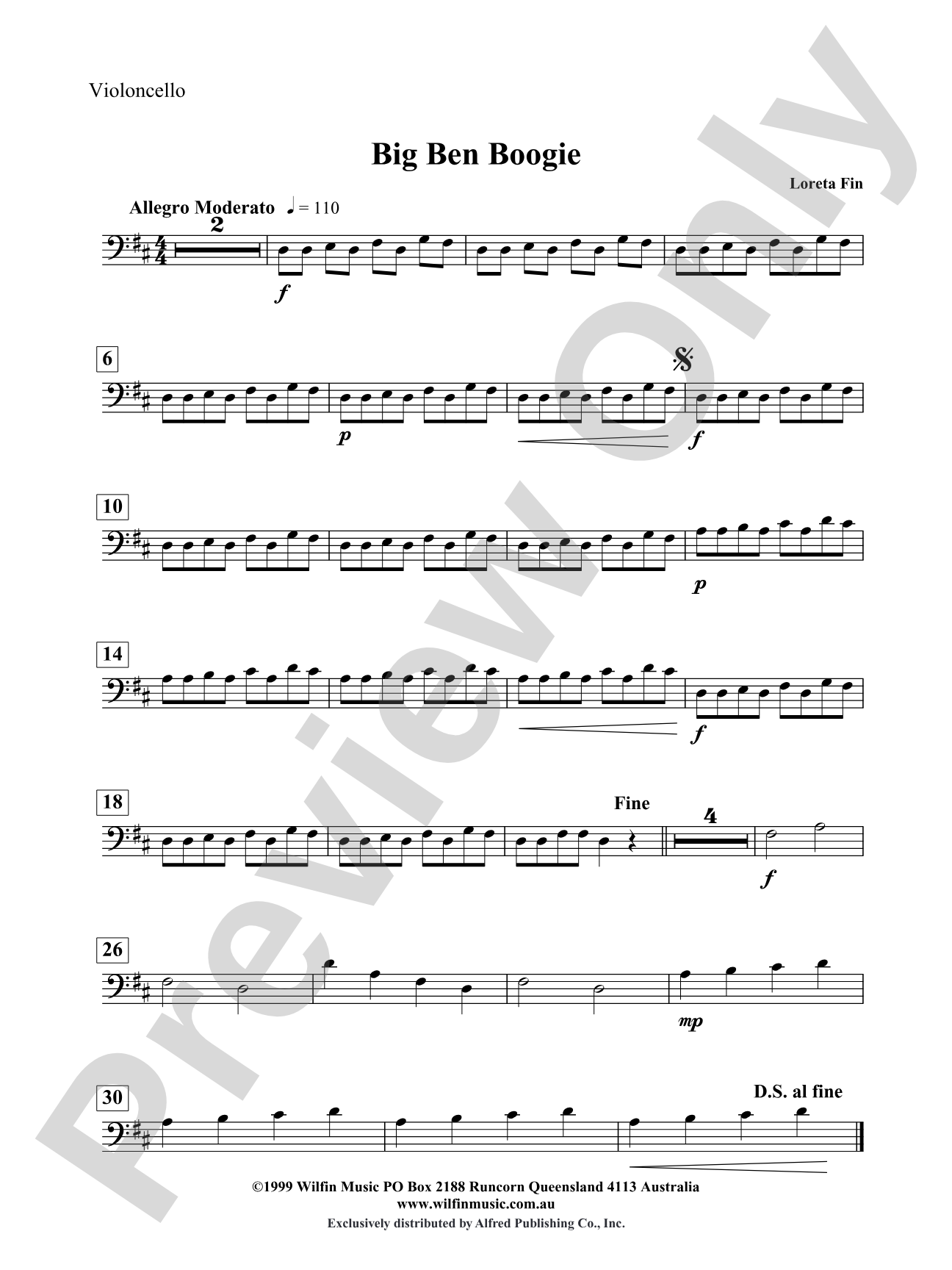
Big Ben Boogie captures the rhythmic bounce and infectious energy of British popular music, dressed in string orchestra colors. It has the swagger of a march filtered through a lighter touch, inviting audiences to tap along while the orchestra handles real technical work beneath the surface.
Who it's for
String orchestras in their second year of ensemble playing, or groups that have solid fundamentals but need a bridge to more sophisticated bow control. Directors managing mixed-ability sections will find this work scaffolds extended techniques without leaving anyone behind.
How to get the most out of it
Work the bow holds and extensions in isolation during early rehearsals so students understand the physical demand before adding it to ensemble coordination.
Use sectional rehearsals to establish consistent bow direction and weight distribution, especially where the parts diverge rhythmically.
Layer the parts gradually, starting with a foundation (cello and bass), then adding the harmony voices, and finally the melodic line once intonation is stable.
Record a rehearsal at the tempo you're targeting and listen as a group; ear training here accelerates their internal clock more than counting alone.
How to use it
Slot this as the anchor piece in a concert featuring other Wilfin Young String Ensemble Series works, where it showcases genuine growth in technique compared to earlier selections. It also works well as a closer to a concert mixing educational repertoire with crowd-friendly material, offering both the director's teaching payoff and an audience that leaves entertained.