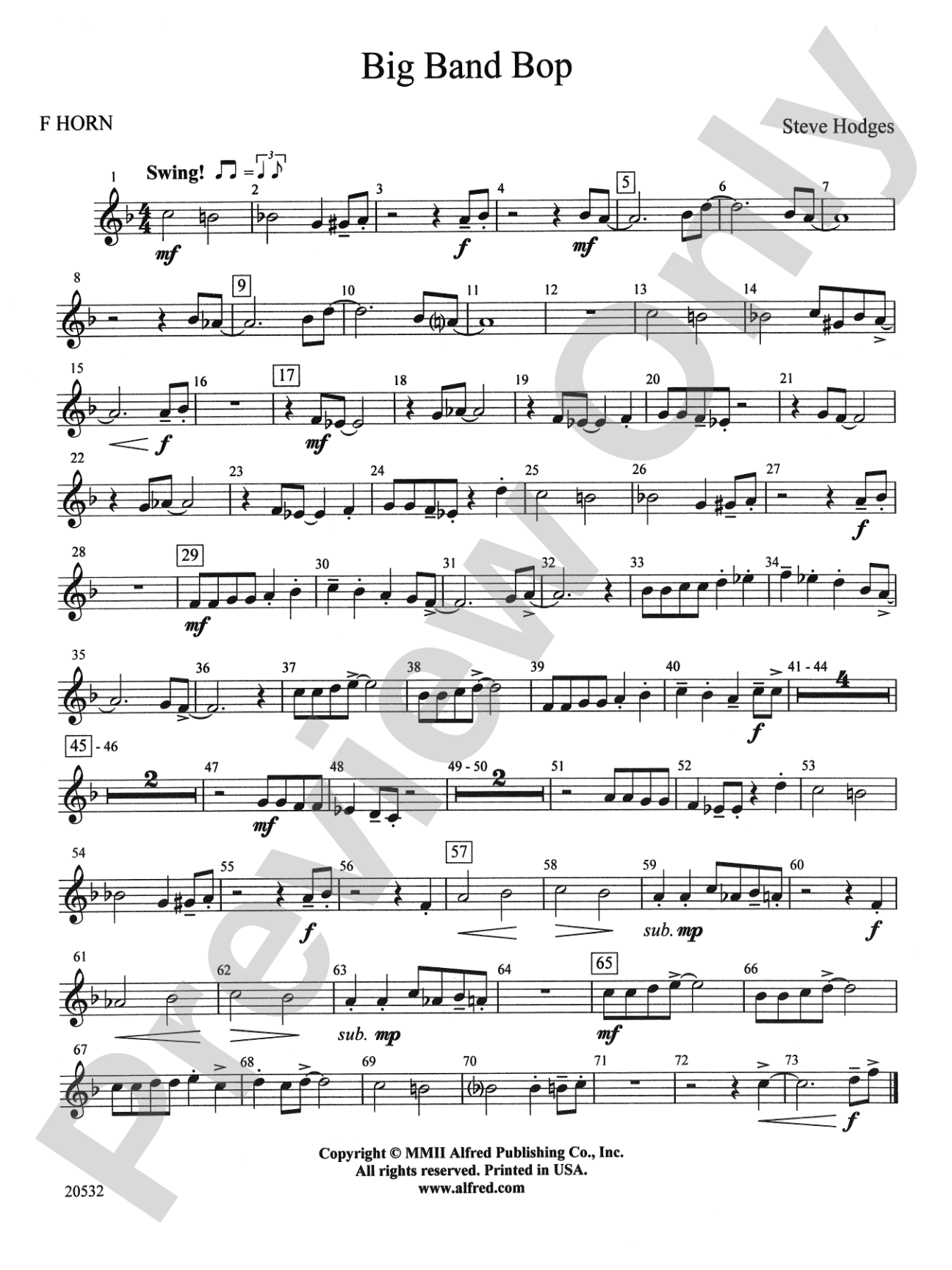
Big Band Bop: 1st F Horn Sheet Music Preview

Big Band Bop: 1st F Horn

By Steve Hodges

Grade: 1.5 (Easy)

Item: 00-PC-0000397_H1

Digital Download
$3.00
Description
Your whole band will be groovin' on your next concert when you program Big Band Bop. Steve Hodges has given us everything students love-a swing beat, jazzy harmonies and fun melodies. Show your students you're not "square" and program Big Band Bop on your next concert!

Don't just read it, hear it, play along with it, and watch your students grow with it. In MakeMusic Cloud, Big Band Bop: 1st F Horn comes alive with professional accompaniment, adjustable tempo, and built-in practice tools that turn solo practice into real progress.

Sample Audio
0:00
0:00
Sample Video
Additional Details
Series: Challenger Band Series
Publisher: Alfred Music
Page Count: 122
SKU: 00-PC-0000397_H1

More about this title

About the Composer: Steve Hodges

Steve Hodges

Steve Hodges holds degrees from Western Oregon University (Bachelor of Science) and Central Washington University (Master of Music Education). Over four decades, he directed concert and jazz bands, choirs, and chamber ensembles across public school systems, working with students at every level.

Since 1986, Hodges has composed more than 120 concert band works published by Alfred Music, along with choral arrangements issued by Staff Music and Shawnee Press. His compositions have appeared at festivals and state conventions worldwide, with commissions from honor bands and schools spanning Virginia, Iowa, British Columbia, Oregon, Washington, and North Carolina. His music has also been featured on TBS and ESPN programming. Hodges holds membership in ASCAP and resides in The Dalles, Oregon, where he remains active in community music alongside his family of five children and ten grandchildren.

Why we love this

Hodges understands what makes a Grade 1.5 piece genuinely engaging rather than simplistic. The swing feel and jazzy harmonies sit perfectly at this level, giving students immediate access to a style that feels grown-up without overwhelming inexperienced readers. This is the kind of repertoire that makes a band sound like a band and keeps rehearsals energized.

What to expect

Big Band Bop swings with infectious energy while staying grounded in a style that feels authentic, not cartoonish. The melodies sit comfortably in students' ranges and instrument capabilities, letting them focus on capturing the cool factor of a real jazz groove rather than wrestling with technical complexity.

Who it's for

Directors programming concert bands in Grades 5-8, or early high school ensembles building foundational chops. This works equally well for groups just discovering jazz vocabulary and for more experienced bands wanting accessible fun repertoire that doesn't sacrifice musicality.

How to get the most out of it

  • Balance the groove: keep the rhythm section locked and relaxed rather than aggressive. A laid-back feel at this level actually demands more precision from your section players, not less.
  • Shape the melodies with a gentle swing articulation throughout the ensemble. Avoid overemphasizing the dotted rhythms; let the rhythmic groove carry the phrasing naturally.
  • Attend to the jazz voicings in the harmonic sections. These chords ring differently than concert repertoire, so rehearse them until the intonation within each chord feels centered and warm.
  • Work the balance between melody and accompaniment voices. At Grade 1.5, clarifying these layers teaches students how to listen to ensemble texture, a skill that transfers to all future repertoire.

How to use it

Open a pops concert with this piece to set an upbeat tone, or program it mid-set as a stylistic pivot between concert and classical works. At Grade 1.5, it pairs well with one stronger concert work and one lyrical selection, giving your concert shape while staying achievable.

Skills your students will build

  • Swing articulation and rhythmic interpretation of jazz eighth notes
  • Reading and executing jazz voicings with accurate intonation
  • Balancing melody and rhythm section parts in an ensemble texture
  • Maintaining a relaxed, steady groove under tempo pressure
  • Listening for blend and balance across stylistically different harmonic textures

You May Also Like