
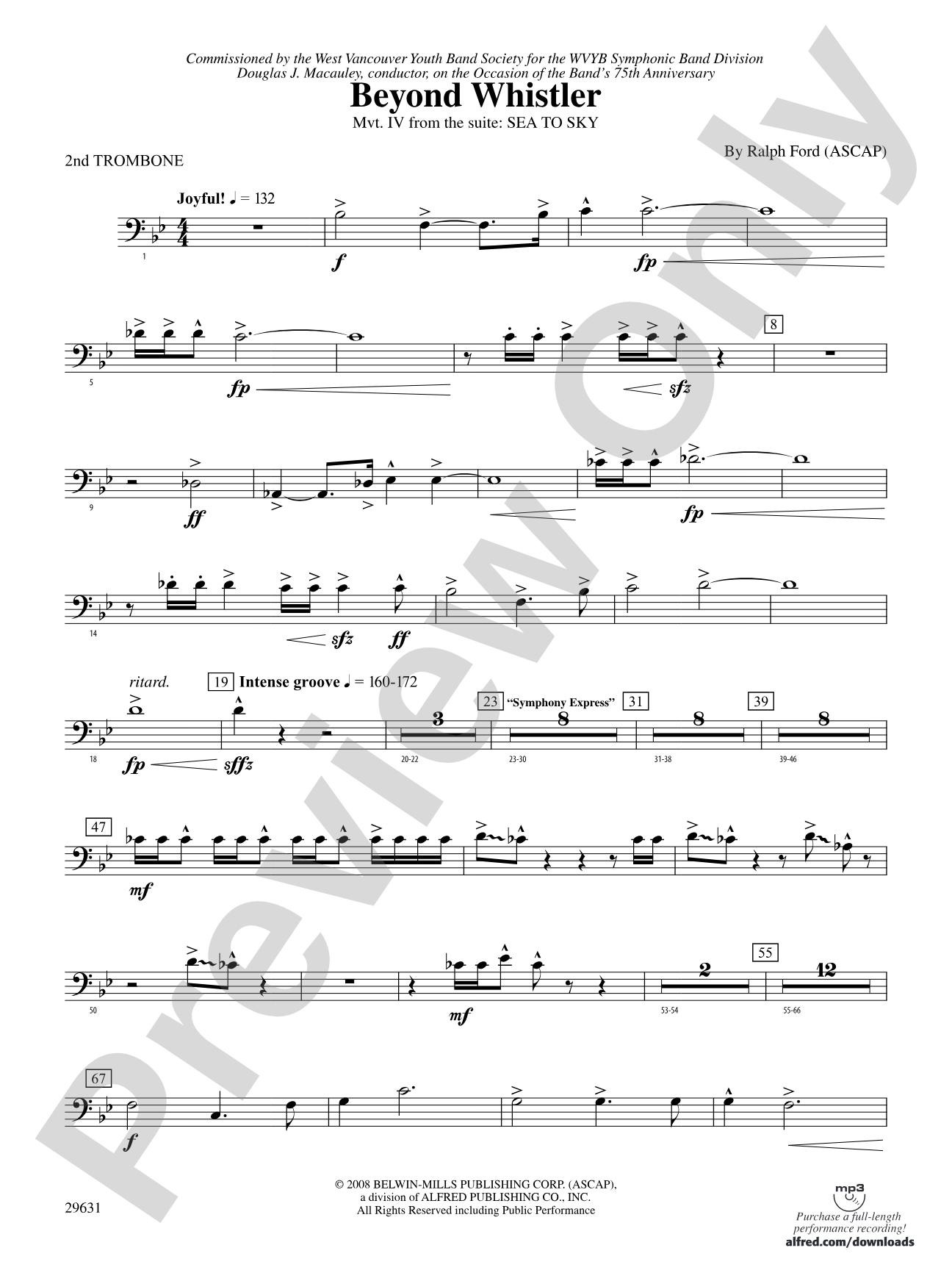

Beyond Whistler: 2nd Trombone
Mvt. IV from the Sea to Sky Suite
By Ralph Ford
Grade: 5 (Difficult)
Item: 00-PC-0001511_TN2
$3.00
Pickup currently not available
Description
The closing movement from the Sea to Sky Suite is "Beyond Whistler." After whisking down this highest and most treacherous of slopes, the listener stops to view what lies beyond. This movement is finalized with a long, slow build to the climax, again using the motif that is present throughout the entire suite. It is to be performed with a great sense of wonder and excitement, with a gradual build to the end. A grand conclusion to this dynamic suite. Also consider programming the first three movements: "March: The Lion's Gate" (26772), "Shannon Falls" (26773) and "Stawamus Chief" (29630). (7:10)


Don't just read it, hear it, play along with it, and watch your students grow with it. In MakeMusic Cloud, Beyond Whistler: 2nd Trombone comes alive with professional accompaniment, adjustable tempo, and built-in practice tools that turn solo practice into real progress.
Open in the Player
Jump straight in and assign it today.
Start Your Free Trial
Open this title and explore the full library in minutes.
Sample Audio
1
Audio File
--:--
0:00
0:00
Sample Video
No sample videos found.
Additional Details
Series:
Belwin Symphonic Band
Publisher:
Alfred Music
Page Count:
284
SKU:
00-PC-0001511_TN2
More about this title
About the Composer: Ralph Ford
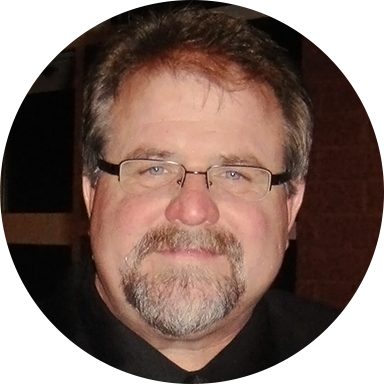
Ralph Ford has spent nearly three decades as a university instructor while maintaining a prolific career as a composer and arranger across multiple genres. His professional trajectory spans media production, broadcast work, and conducting, alongside his role as an exclusive composer for Belwin and Alfred Music, where over 250 of his titles are performed by orchestral, concert band, jazz, and marching ensembles worldwide.
Ford's arranging work began at fifteen and deepened during his undergraduate years at Troy State University, where he directed the jazz ensemble and served as staff arranger for the band program. He earned his Master of Science degree in 1988 while teaching full-time, and has since built a career handling commissions from university, military, professional, and school ensembles across the globe. His work extends into advertising, animation, live broadcast, and recording production.
Why we love this
This finale delivers the payoff that a programmatic suite promises. Ford constructs genuine dramatic tension through a gradual, sustained build that respects the journey of the preceding movements, and the recurring motif ties the entire arc together in a way that feels earned rather than imposed. The wonder and excitement he calls for in the score create a natural concert-closing moment that audiences remember.
What to expect
After the intensity of a descent, you arrive at a vantage point where wonder takes over. The music unfolds with a sense of inevitability, as if the landscape itself is drawing you upward toward revelation. By journey's end, the familiar motif emerges transformed, carrying the weight of everything that came before.
Who it's for
This movement demands a mature concert band with solid fundamentals in dynamic control and sectional balance. Grade 5 ensembles with experience sustaining long phrases and building extended crescendos will find the technical and musical demands rewarding without being prohibitive.
How to get the most out of it
- Shape the slow build with precision: establish a clear dynamic floor at the opening and commit to a methodical crescendo that doesn't rush or plateau midway. Each section should feel like it's reaching toward something.
- Balance the recurring motif across your ensemble so it cuts through as the music thickens. This isn't a buried melody; it's the connective tissue that unifies the entire suite.
- Conduct with deliberate clarity during the long acceleration to the climax. Your ensemble needs to feel the forward momentum you're creating, not just react to dynamic markings on the page.
- Program the full suite in order to maximize the impact of this movement. Hearing "March: The Lion's Gate," "Shannon Falls," and "Stawamus Chief" before this finale allows the returning motif to land with recognition and force.
How to use it
Reserve this as your final work on a concert where the full Sea to Sky Suite can precede it as a four-movement arc. The 7:10 duration and programmatic sweep make it a natural finale that leaves audiences thinking beyond the concert itself. If you're programming it separately, pair it with shorter opening works that won't dilute its dramatic impact.
Skills your students will build
- Sustaining and shaping extended crescendos across eight or more measures
- Balancing a recurring thematic element as accompanying texture thickens
- Controlling dynamic contrast and transition between discrete sections
- Responding to gradual tempo and intensity shifts with unified ensemble response