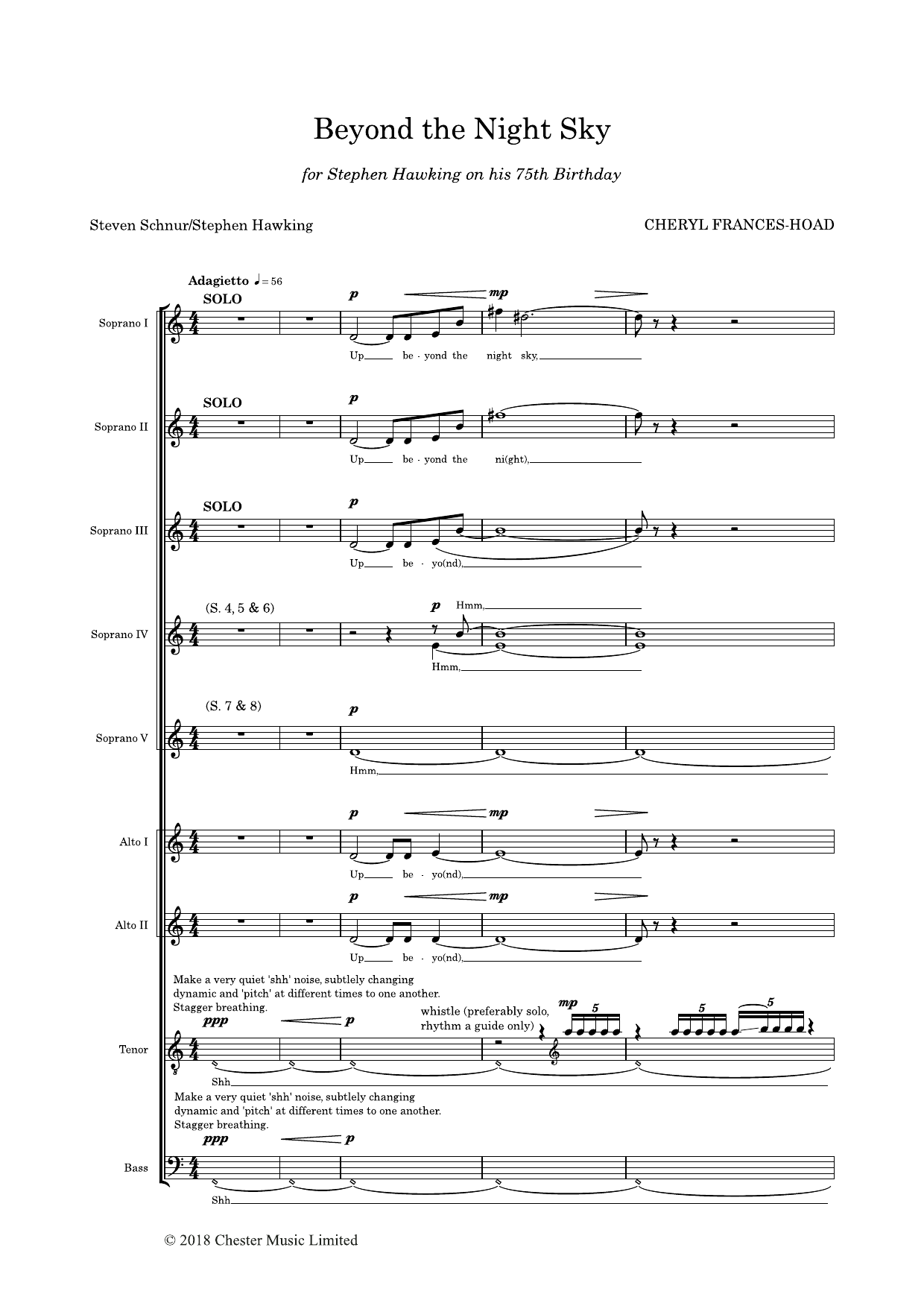
Cheryl Frances-Hoad is a British composer whose choral writing balances lyrical accessibility with harmonic sophistication. Her works for voices demonstrate a gift for setting text with natural phrasing and emotional clarity, making her music equally effective in educational and professional settings.
Why we love this
Frances-Hoad crafts a piece that sits comfortably within SATB ranges while refusing to sound generic. The 16-page score gives singers room to breathe and develop nuance, and the celestial imagery invites genuine musical expression rather than relying on technical flash.
What to expect
A nocturnal meditation rendered in four-part harmony. The piece unfolds with a sense of contemplation, inviting the listener into quiet wonder rather than pulling them through dramatic gesture. Harmonic color deepens as the night sky imagery develops, creating moments of genuine beauty alongside passages of intimate restraint.
Who it's for
This octavo suits intermediate to advanced community and collegiate choirs seeking concert repertoire with literary substance. Directors working with singers who respond well to lyrical material and evocative text will find a choir-friendly score that doesn't demand specialized training.
How to get the most out of it
Balance the divisi moments carefully; sopranos and altos may need reminders that lower notes don't automatically recede, especially when the poetry demands prominence.
Let the harmonic language breathe. Frances-Hoad's chord progressions reward slight ritardandi at key cadences without sounding manipulative.
Attend to vowel consistency across the sustains. A chorus that finds unified resonance on open vowels will unlock the piece's atmospheric quality.
How to use it
Pair this with other celestial or nature-themed texts for a thematic concert, or use it as a closing piece where its reflective mood can settle over the audience. The 16-page length makes it substantial enough to anchor a program section without overwhelming rehearsal schedules.
Skills your students will build
Sustaining lyrical phrasing across longer vocal lines
Balancing divisi voicing without sacrificing blend
Responding to harmonic color in contemporary choral writing
Maintaining ensemble cohesion through atmospheric (rather than rhythmically driven) material
You May Also Like
Scan to Complete Your Purchase
Use your phone's camera to scan the code below
You'll log in on your phone and the order will be added to your account