Beyond the Horizon - Piano Duo (2 Pianos, 4 Hands) Sheet Music Preview

Beyond the Horizon - Piano Duo (2 Pianos, 4 Hands): Piano Duo (2 Pianos, 4 Hands)

By Randall Hartsell

Level: Early Intermediate

Item: 00-PS-0017580

Digital Download
$4.99
Description
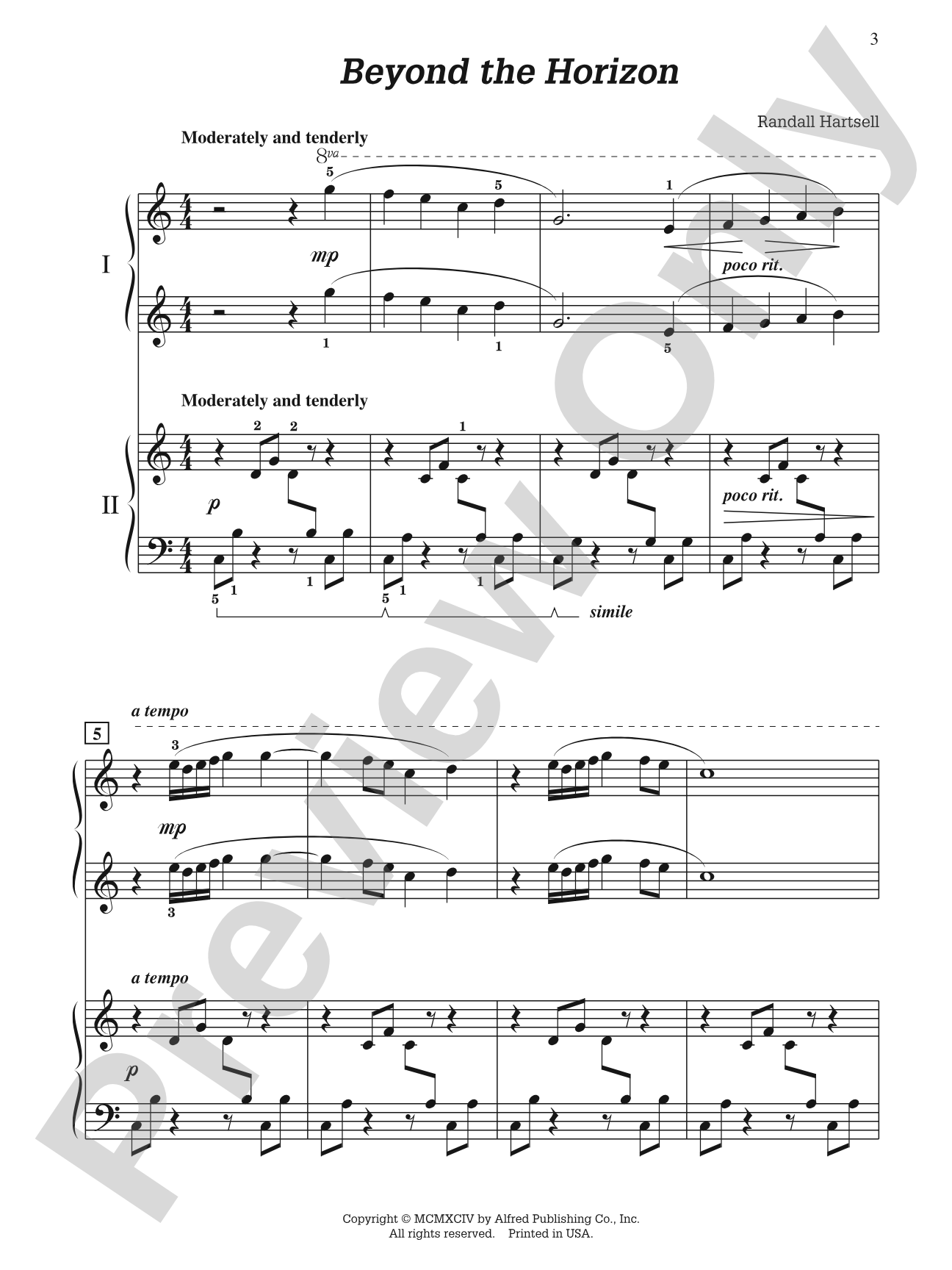
Randall Hartsell here paints an expansive musical picture of earth and sky featuring two pianists at two pianos. The piece features legato rolling broken eighth note pairings against soaring melodic lines, with both parts sharing accompaniment and melody duties. This is a good opportunity for intermediate level pianists to portray beautiful expression and wide dynamics. Two scores are included. A Federation Festivals 2024-2028 selection.

Beyond the Horizon - Piano Duo (2 Pianos, 4 Hands): Piano Duo (2 Pianos, 4 Hands) isn't in MakeMusic Cloud just yet...but it could be. Let us know you'd like to see it, and you'll help shape what comes next. In the meantime, start a free trial and dive into thousands of interactive titles your students can play along with today.

Sample Audio
No sample audio found.
Sample Video
Additional Details
Publisher: Alfred Music
Page Count: 8
SKU: 00-PS-0017580

More about this title

About the Composer: Randall Hartsell

Randall Hartsell

Randall Hartsell's compositional voice speaks directly to students. Growing up in North Carolina without a piano at home, he developed discipline by practicing daily at his aunt and uncle's house; his parents eventually purchased one after a year of that commitment. His early compositions drew inspiration from literature studied in English class and from accompanying his high school choir, establishing a pattern of writing music rooted in narrative and emotional depth.

After earning his degree from East Carolina University, Hartsell taught in small towns while composing steadily. A pivotal meeting with Lynn Freeman Olson in the early 1980s led him to pursue publication, resulting in the three-book series Something Special (1990) and more than 60 subsequent collections and solos. Now based in Charlotte, he continues as an active teacher, clinician, and church musician, bringing decades of classroom experience to every piece he writes.

Why we love this

Hartsell constructs this piece with genuine pedagogical insight: the rolling eighth-note accompaniment in one part frees the other to sing without the burden of heavy voicing work. Both pianists get meaningful material, neither feels relegated to accompanist duties. It's the kind of writing that teaches collaboration naturally.

What to expect

The piece evokes wide open space: earth stretching beneath, sky unfolding overhead. One piano anchors the listener with its gentle, rhythmic accompaniment while the other reaches upward with lyrical lines that breathe and swell. The effect is contemplative and expansive at once.

Who it's for

Early intermediate pianists ready to experience genuine ensemble writing without overwhelming technical demands. This works well for festival seasons, recital pairings, or students building confidence in collaborative performance.

How to get the most out of it

  • Shape the rolling eighth notes as a continuous undercurrent rather than individual figures; think of them as the breath beneath the melody, not the main event.
  • Balance the dynamic range intentionally. The piece asks for contrast between intimate passages and soaring moments, so resist playing everything at a comfortable middle dynamic.
  • Rehearse the parts separately before combining them, even with intermediate students. This builds confidence and allows each pianist to internalize their line's phrasing before negotiating the partnership.
  • Coordinate pedal releases at phrase endings to keep the texture clear without creating muddy overlap between the parts.

How to use it

Program this as a refreshing change of pace on a recital featuring solo repertoire, pairing it with other duet works to create a chamber segment. It also fits naturally into a festival season or spring concert where you want to showcase collaborative musicianship without demanding advanced technique.

Skills your students will build

  • Balancing melody and accompaniment within an ensemble setting
  • Shaping legato phrasing through sustained eighth-note figures
  • Responding dynamically to a partner's musical line
  • Coordinating pedal release between two instruments
  • Reading and performing broken chord patterns over multiple measures

You May Also Like