
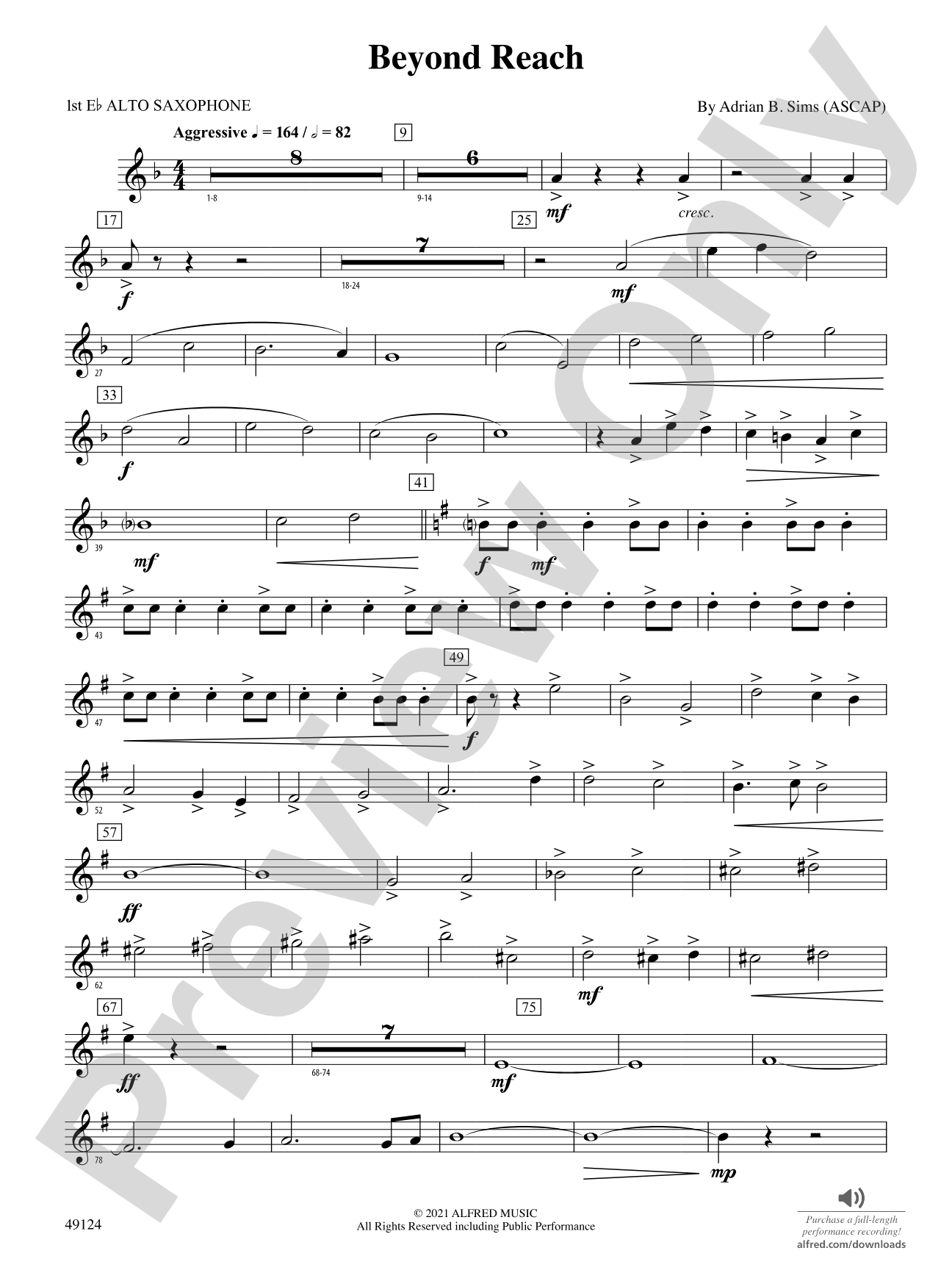

Beyond Reach: E-flat Alto Saxophone
By Adrian B. Sims
Grade: 3 (Medium)
Item: 00-PC-0018689_AX1
$3.00
Pickup currently not available
Description
Reminiscent of a movie soundtrack, Beyond Reach, by Adrian B. Sims, characterizes an action-filled journey depicting the trek towards an unseen opposition. This work is full of unforgettable melodic lines and explores various harmonic twists and turns. Filled with anticipation, hope, fear, and bravery, the adventurers unabashedly charge into combat, ultimately emerging victorious. (3:30)


Don't just read it, hear it, play along with it, and watch your students grow with it. In MakeMusic Cloud, Beyond Reach: E-flat Alto Saxophone comes alive with professional accompaniment, adjustable tempo, and built-in practice tools that turn solo practice into real progress.
Open in the Player
Jump straight in and assign it today.
Start Your Free Trial
Open this title and explore the full library in minutes.
Sample Audio
1
Audio File
--:--
0:00
0:00
Sample Video
Additional Details
Series:
Young Symphonic
Publisher:
Alfred Music
Page Count:
174
SKU:
00-PC-0018689_AX1
More about this title
About the Composer: Adrian B. Sims

Adrian B. Sims was born in Seattle in 2000 and developed his musicianship across multiple roles: as a composer, conductor, educator, and trombonist. He studied at Catonsville High School in Maryland and went on to The University of Maryland, where he pursues a dual degree in Music Education and Composition under the mentorship of Dr. Robert Gibson and guidance from world-renowned composer Brian Balmages.
Sims's compositions have earned recognition at major venues including The Midwest Band and Orchestra Clinic and placements on the Bandworld Top 100 List. He has won awards in the Maryland Music Educators Association Young Composers Project and the Make Music Young Composers Contest. As a performer, he has appeared in pit orchestras, symphony orchestras, jazz ensembles, and concert bands, including performances with the Baltimore Symphony Orchestra and current roles in top ensembles at The University of Maryland, where he studies bass trombone with Matthew Guilford of the National Symphony Orchestra.
Why we love this
Beyond Reach delivers cinema-quality storytelling through instrumental music, making it an excellent choice for conductors seeking a narrative-driven piece that resonates with audiences without requiring extensive rehearsal time. The Grade 3 difficulty means advanced middle school or developing high school bands can execute this work convincingly, and the 3:30 duration and contest-friendly designation make it ideal for festival seasons. The melodic accessibility combined with harmonic sophistication keeps students engaged while building their interpretive skills.
What to expect
Beyond Reach sweeps you into an action-adventure narrative scored with unforgettable melodies and unexpected harmonic turns. You feel the weight of obstacles, the surge of courage, and ultimately the triumph of victory, all rendered through instrumental color and momentum rather than literal storytelling.
Who it's for
Concert bands at the Grade 3 level, particularly those with developing musicianship and interpretive abilities. This work suits both high school ensembles seeking festival repertoire and advanced middle school bands ready to tackle music with cinematic ambition.
How to get the most out of it
- Shape the melodic lines as if they belong in a film score; listen closely to how different sections carry the narrative, and encourage players to think beyond their individual parts to the larger emotional arc.
- Balance the harmonic twists carefully in rehearsal by isolating chord changes and asking students to identify when the harmonic color shifts; this prevents muddiness and clarifies the composer's intent.
- Use the emotional arc outlined in the description (anticipation, hope, fear, bravery, victory) as a rehearsal framework; mark these sections in the score and discuss how tempo, dynamics, and articulation reinforce each emotional moment.
How to use it
Program this as a centerpiece concert selection or festival entry that stands on its own narratively; its film-score sensibility pairs well with other contemporary works or classical pieces that share emotional intensity. The work's moderate length and manageable difficulty make it suitable for mid-season programming when your ensemble has developed cohesion but still benefits from repertoire that challenges their interpretive maturity.
Skills your students will build
- Shaping extended melodic phrases with consistent phrasing and direction
- Identifying and executing harmonic color changes within functional harmony
- Balancing individual voice independence with ensemble blend across four-part texture
- Interpreting emotional narrative through tempo, dynamics, and articulation choices
- Reading concert band scoring conventions and managing entrances across full instrumentation