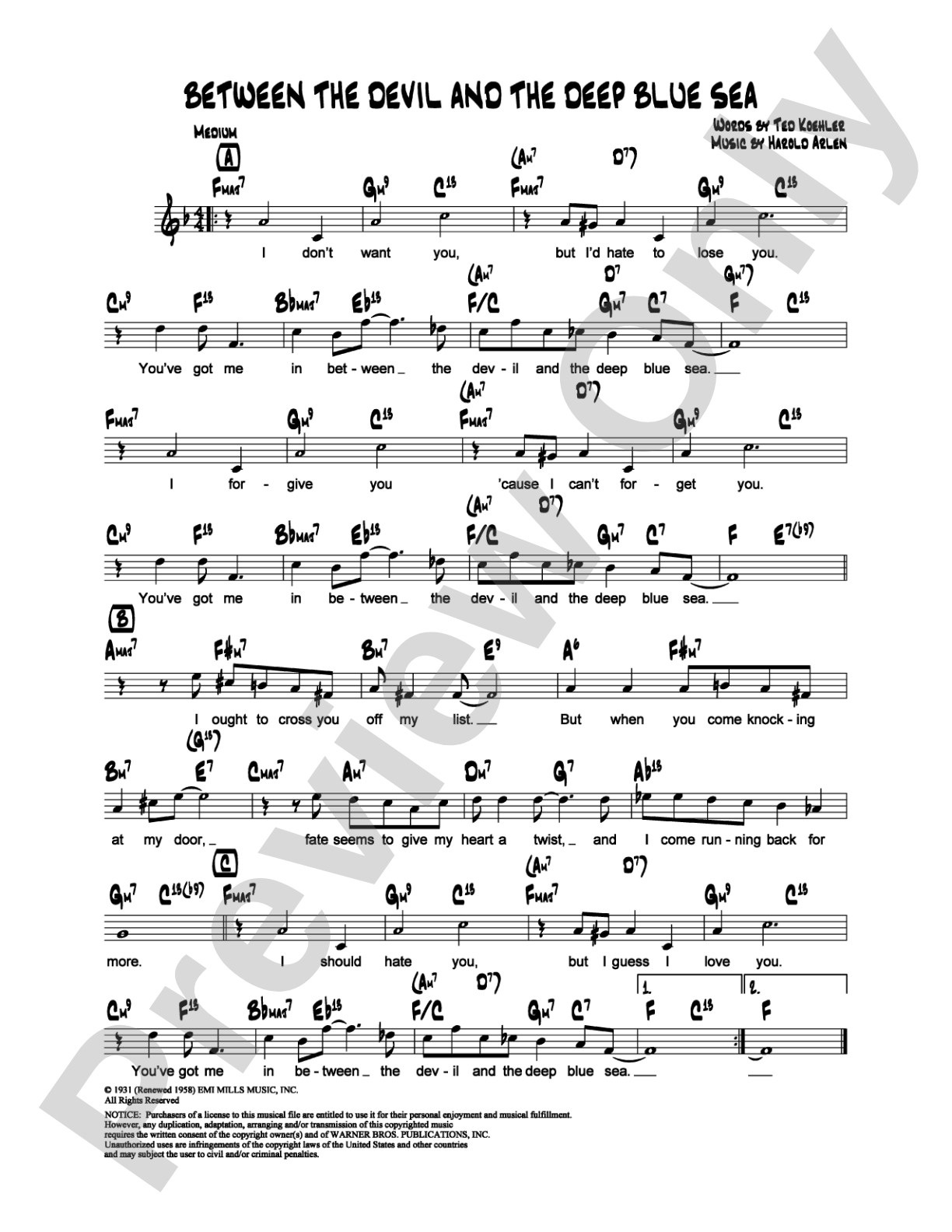
Between the Devil and the Deep Blue Sea: Lead Sheet Digital Sheet Music

Between the Devil and the Deep Blue Sea: Lead Sheet Digital Sheet Music

Harold Arlen, Cab Calloway, Louis Armstrong

Item: 00-PS-0002576

Digital Download
$1.99
Description

Between the Devil and the Deep Blue Sea: Lead Sheet Digital Sheet Music isn't in MakeMusic Cloud just yet...but it could be. Let us know you'd like to see it, and you'll help shape what comes next. In the meantime, start a free trial and dive into thousands of interactive titles your students can play along with today.

Sample Audio
No sample audio found.
Sample Video
Additional Details
SKU: 00-PS-0002576

More about this title

About the Artist: Louis Armstrong

Louis Armstrong (1901-1971) transformed jazz from a regional New Orleans sound into an international art form. His innovations on trumpet and his revolutionary approach to phrasing, swing, and improvisation became the foundation for modern jazz pedagogy. Armstrong's influence extends far beyond performance; his recordings and interpretations remain essential listening for anyone studying how to swing, bend pitch, and communicate through melody.

Why we love this

This standard sits at the intersection of jazz history and accessibility. The melody is memorable enough for singers and soloists to grab immediately, yet the harmonic movement and blues changes reward deeper exploration of improvisation. Whether you're teaching jazz repertoire, building swing vocabulary, or introducing students to classic American songwriting, this lead sheet gives you the exact tool you need without extra instrumentation.

What to expect

A conversation between two voices, neither rushing. The melody rides the pocket with an almost conversational ease, full of the wit and warmth that made this 1931 standard endure. It has just enough harmonic flavor to keep things interesting without demanding technical gymnastics from the player.

Who it's for

Vocalists and jazz instrumentalists preparing solos or head arrangements; jazz ensembles building their standard repertoire; music theory students analyzing blues form and jazz harmony. This lead sheet works for intermediate to advanced players comfortable with swing feel and basic jazz vocabulary.

How to get the most out of it

  • Shape the melody with emphasis on the backbeat; swing eighth notes rather than playing them straight to capture the ease and float Armstrong and Calloway brought to this tune.
  • Treat the lyrics as rhythmic guides even if you're playing an instrumental arrangement. The natural phrasing Armstrong used follows speech patterns, not metronomic precision.
  • Outline the blues changes during solo sections by landing chord tones on strong beats; this keeps improvisation grounded even when exploring outside passages.
  • Listen to multiple recorded versions before settling on tempo and interpretation; Armstrong's reading differs noticeably from Calloway's, each offering legitimate stylistic choices.

How to use it

Pair this with other classic swing-era standards in a jazz or American songbook concert. It also serves well as a teaching piece for analyzing the relationship between melody and chord changes, or as a feature for a vocalist or trumpet soloist in a mixed ensemble setting.

Skills your students will build

  • Reading and interpreting jazz lead sheet notation and chord symbols
  • Swinging eighth notes and maintaining jazz phrasing conventions
  • Navigating 12-bar blues changes and secondary dominants in a harmonic context
  • Creating solo variations that respect the original melody while exploring improvisation
  • Understanding the rhythmic relationship between lyrics and melodic placement

You May Also Like