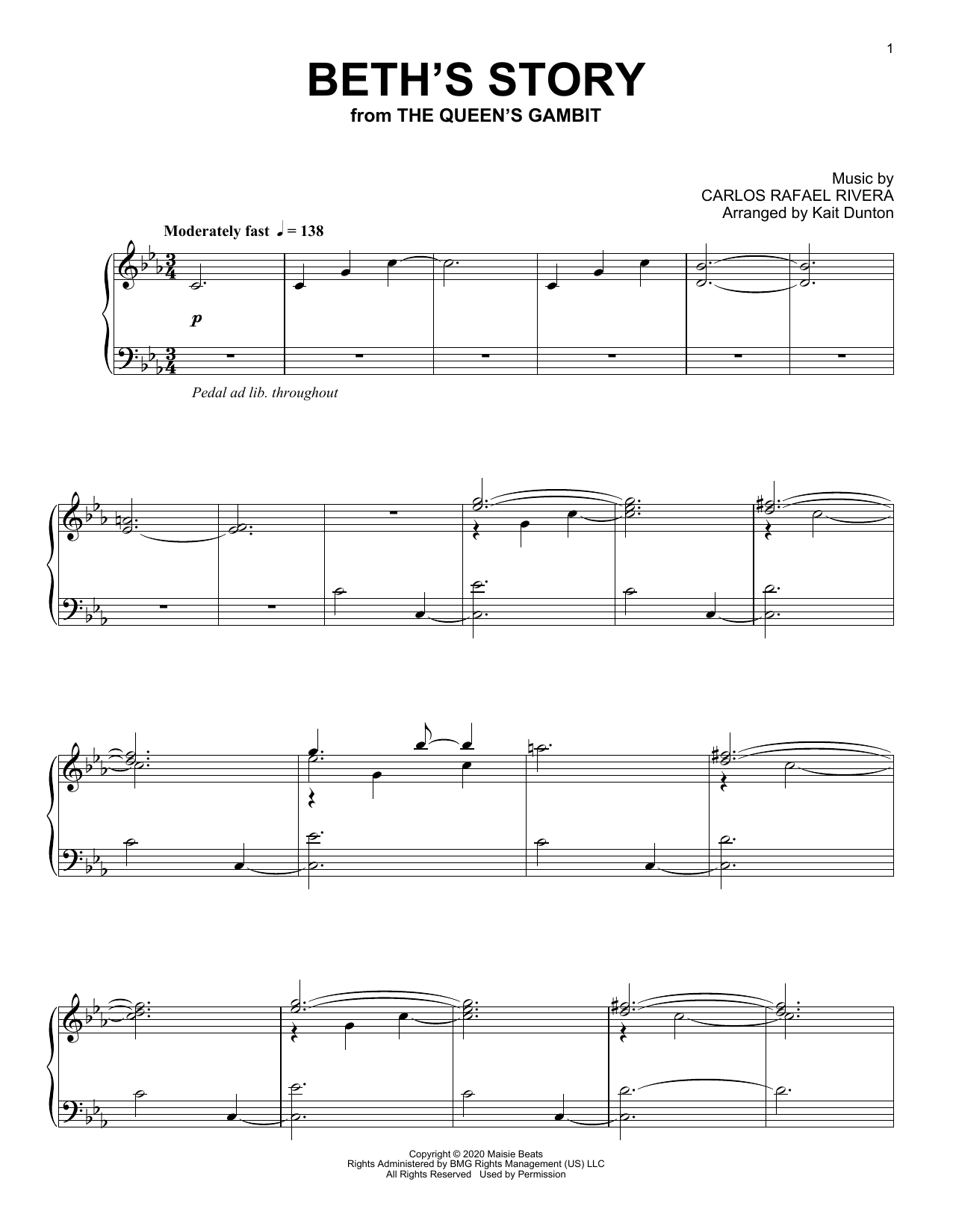
Beth's Story (from The Queen's Gambit) Sheet Music Preview

Beth's Story (from The Queen's Gambit): Piano Solo

By Carlos Rafael Rivera

Item: 35-DS01087421

Digital Download
$5.99
Description

Beth's Story (from The Queen's Gambit): Piano Solo isn't in MakeMusic Cloud just yet...but it could be. Let us know you'd like to see it, and you'll help shape what comes next. In the meantime, start a free trial and dive into thousands of interactive titles your students can play along with today.

Sample Audio
No sample audio found.
Sample Video
Additional Details
Publisher: Hal Leonard
Page Count: 4
SKU: 35-DS01087421

More about this title

About the Composer: Carlos Rafael Rivera

Carlos Rafael Rivera is a composer and conductor whose work spans orchestral, chamber, and film/television scores. His compositions for screen have earned recognition for their emotional specificity and harmonic sophistication, bringing literary narratives to life through precise musical language. Rivera's approach to writing for piano draws from both classical tradition and contemporary film scoring practice, making his work valuable for students exploring how character and narrative translate into sound.

Why we love this

This arrangement captures the introspective quality of a key dramatic moment without requiring advanced virtuosity, making it accessible for intermediate pianists who want meaningful contemporary material. The writing respects both the emotional weight of the source material and the pedagogical need for clear harmonic and structural logic.

What to expect

Introspective and measured, with moments of quiet tension beneath a composed surface. The harmonic language suggests both constraint and searching, matching a character working through conflict with intelligence and restraint. There is melancholy here, but it is thoughtful rather than indulgent.

Who it's for

Intermediate pianists seeking contemporary material with genuine dramatic stakes, and teachers who want to introduce students to film scoring language within a manageable technical range. This works equally well for recital programming and for students studying how music supports narrative and character.

How to get the most out of it

  • Shape the phrasing around emotional beats rather than bar lines; listen to the original score to understand where the narrative breathes and reflect that in your rubato.
  • Balance textural layers carefully so accompanying figures never obscure the melodic line, even when the hand positions feel close together.
  • Explore dynamic gradation beyond forte and piano; the subtle shifts between mezzo-forte and mezzo-piano often carry more weight than dramatic contrasts in this kind of underscore writing.
  • Consider the harmonic tension and resolution as your guide to tempo flexibility; slight ritardandi around unexpected chord changes can heighten their expressive impact.

How to use it

Place this on a recital alongside contemporary classical pieces or art song settings to show students how modern composers approach emotional storytelling. It also works as a bridge piece for discussions about adapting screen music for concert performance or for student composers studying how underscoring differs from concert music.

Skills your students will build

  • interpreting dynamic and tonal nuance in film/TV score language
  • balancing melody and accompaniment in close hand positions
  • managing rubato that serves narrative pacing rather than metric feel
  • recognizing and voicing contemporary harmonic language
  • understanding how character development translates to musical phrasing

You May Also Like