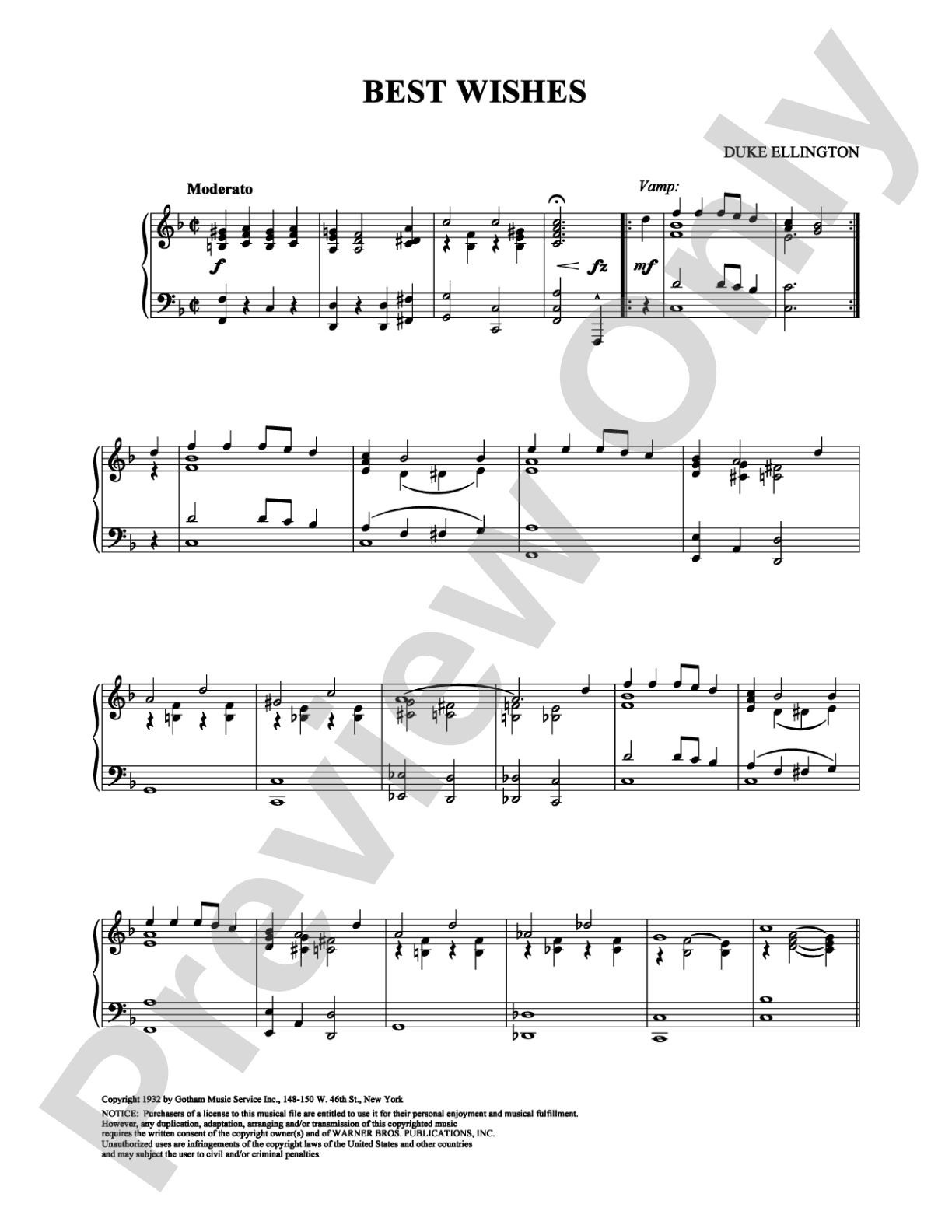
Best Wishes: Piano Digital Sheet Music

Best Wishes: Piano Digital Sheet Music

Duke Ellington

Item: 00-PS-0008201

Digital Download
$3.99
Description

Best Wishes: Piano Digital Sheet Music isn't in MakeMusic Cloud just yet...but it could be. Let us know you'd like to see it, and you'll help shape what comes next. In the meantime, start a free trial and dive into thousands of interactive titles your students can play along with today.

Sample Audio
No sample audio found.
Sample Video
Additional Details
SKU: 00-PS-0008201

More about this title

About the Artist: Duke Ellington

Duke Ellington (1899, 1974) stands as one of the most prolific and influential composers in American music history. His career spanned six decades, during which he created over a thousand compositions while leading his orchestra through constant evolution and innovation. Ellington's harmonic sophistication, orchestral thinking, and genre-defying approach to composition made him a towering figure in jazz, popular music, and concert music alike.

For music educators, Ellington's work offers a masterclass in compositional craft across multiple idioms. His pieces reveal how strong melodic writing, unexpected harmonic movement, and rhythmic flexibility can coexist within accessible frameworks. Teaching Ellington means introducing students to a composer who refused to stay in one lane, who wrote for dancers and concert halls with equal conviction, and who proved that popular music and serious artistry are not opposing forces.

Why we love this

Best Wishes belongs to Ellington's catalog of accessible yet musically rich compositions that work beautifully in recital settings. The piece offers pianists a direct connection to jazz idiom without requiring specialized training in improvisation or advanced harmonic theory, making it ideal for intermediate to advanced players exploring jazz literature. Programming an Ellington standard reminds audiences that jazz composition and classical performance are not separate worlds.

What to expect

Best Wishes carries the sophisticated warmth characteristic of Ellington's writing; a piece built on graceful melodic contours and underlying harmonic richness that never feels pretentious. The composition invites a lyrical, conversational quality that sits comfortably in the jazz standard tradition while maintaining the compositional clarity that defines Ellington's enduring legacy.

Who it's for

Pianists at intermediate to advanced levels who are beginning to explore jazz standards and want direct access to Ellington's compositional voice. Teachers can use this piece to introduce students to jazz idiom through authentic repertoire rather than simplified arrangements. It serves equally well for recital performance, jazz history study, or cross-genre programming that bridges classical and jazz traditions.

How to get the most out of it

  • Shape the melody with clear phrasing rather than mechanical evenness; Ellington's melodies reward sensitive rubato and dynamic shaping
  • Balance the harmonic sophistication with direct expression; resist over-complicating passages that benefit from straightforward, singing interpretation
  • Pay close attention to chord voicings in the accompaniment, as Ellington's harmonic language often carries thematic weight alongside the melody
  • Allow space for the inherent swing character of the piece to emerge naturally rather than forcing rhythmic alterations

How to use it

Include this piece on recitals that explore American composition or twentieth-century music, where it can stand alongside classical works to demonstrate the depth of jazz as concert literature. It works particularly well in programs exploring songwriting or melody-driven composition. Consider pairing it with other Ellington standards or with contemporary classical works that share harmonic interests.

Skills your students will build

  • Interpreting jazz articulation and phrasing idioms within a written score
  • Understanding Ellington-era jazz harmony and chord substitution
  • Balancing composed detail with expressive, lyrical performance
  • Sight-reading and performing twentieth-century American music notation

You May Also Like