
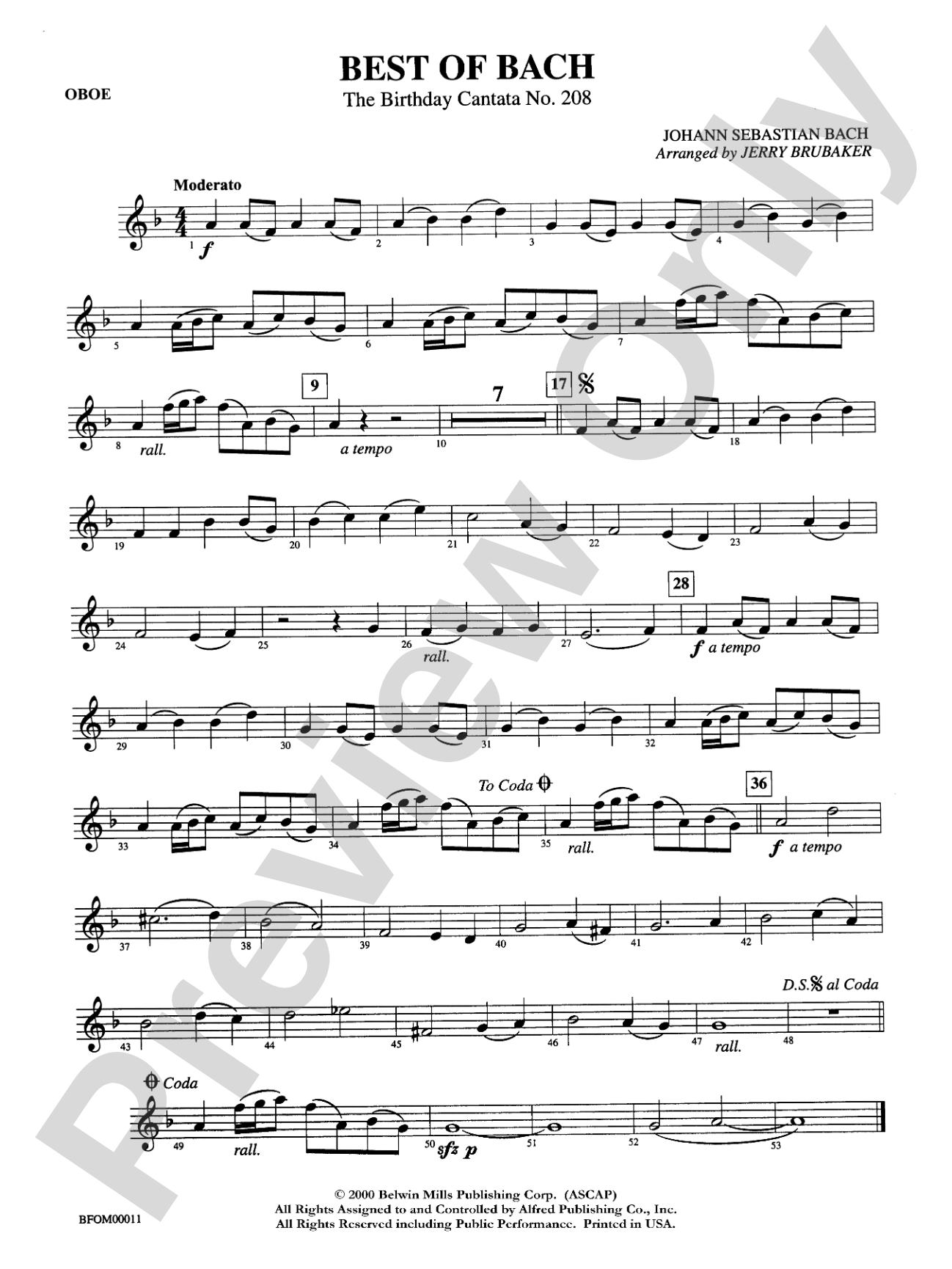

Best of Bach: Oboe
By Johann Sebastian Bach / arr. Jerry Brubaker
Grade: 2.5
Item: 00-PC-0002222_O1
$3.00
Pickup currently not available
Description
From the Birthday Cantata, this familiar tune is filled with the infectious melodic material and mesmerizing harmonic content that are so characteristically Bach. The Best of Bach can be played with just strings or by adding any combination of winds up to full orchestra instrumentation. (3:07)


Don't just read it, hear it, play along with it, and watch your students grow with it. In MakeMusic Cloud, Best of Bach: Oboe comes alive with professional accompaniment, adjustable tempo, and built-in practice tools that turn solo practice into real progress.
Open in the Player
Jump straight in and assign it today.
Start Your Free Trial
Open this title and explore the full library in minutes.
Sample Audio
1
Audio File
--:--
0:00
0:00
Sample Video
Additional Details
Series:
Belwin Intermediate String/Full Orchestra
Publisher:
Alfred Music
Page Count:
110
SKU:
00-PC-0002222_O1
More about this title
About the Composer: Johann Sebastian Bach
Johann Sebastian Bach (1685, 1750) stands as one of the most prolific and intellectually rigorous composers in Western music. His output spans every major genre of his era except opera, and his mastery of counterpoint, harmonic language, and structural architecture set the standard for centuries of composers who followed. Bach's music demands precision and intention from performers, yet beneath its mathematical elegance lies profound emotional depth that continues to reward both study and performance.
For ensemble musicians, Bach's works offer unparalleled training in voice leading, intonation, and rhythmic clarity. His melodies are memorable and singable; his harmonies are logical yet surprising. Whether a student encounters Bach through a cantata movement, a chorale, or an orchestral suite, the experience builds foundational skills that transfer across all musical styles.
Why we love this
Jerry Brubaker's arrangement captures the melodic charm of the Birthday Cantata in a configuration that truly flexes. The scoring grows naturally from strings alone to full orchestra, so you can match the complexity to your ensemble's strengths without sacrificing the integrity of Bach's voice leading. It reads cleanly and plays beautifully at this level, making it a genuine asset for contests, festivals, or a concert that needs something both recognizable and musically substantial.
What to expect
Warm, buoyant, and architecturally secure. The melody sits naturally in the hand and sings without strain, while the harmonies unfold with a sense of inevitability that feels both familiar and fresh. There's a clarity and purpose in every measure that makes Bach's music feel inevitable rather than imposed.
Who it's for
Directors working with intermediate orchestras who want serious repertoire that doesn't demand advanced technique. This is ideal for ensembles with developing winds or an incomplete instrumentation, since the string-only option is fully satisfying on its own. Students who are learning Bach for the first time will find his compositional voice crystal clear in this arrangement.
How to get the most out of it
- Balance the inner voices carefully in tutti sections. Bach's harmonies depend on hearing all four parts, even when winds double strings. Have your viola and second violin players think of themselves as essential melodic lines, not filler.
- Keep articulation consistent across the ensemble. Bach's rhythmic drive thrives when all players match their note lengths and attack points. A quick rehearsal pass focusing only on articulation pays dividends.
- Lean into the harmonic rhythm rather than fighting it. The chords shift deliberately; let those shifts be audible rather than trying to smooth them over with rubato.
- Use the optional wind parts to add color and support, not weight. This arrangement rewards clarity above all else.
How to use it
Pair this with contemporary or modern works on a concert to give the program historical weight and breathing room. At 3:07, it fills a slot between longer pieces without feeling lightweight. It's equally at home as a festival or contest selection where you want to demonstrate ensemble musicianship and control.
Skills your students will build
- Reading and sustaining four-part harmony
- Balancing inner voices in orchestral texture
- Consistent articulation across ensemble
- Understanding Baroque harmonic rhythm and phrasing
- Intonation tuning to functional harmony (not equal temperament)
- Playing with clarity and architectural awareness rather than vibrato or rubato