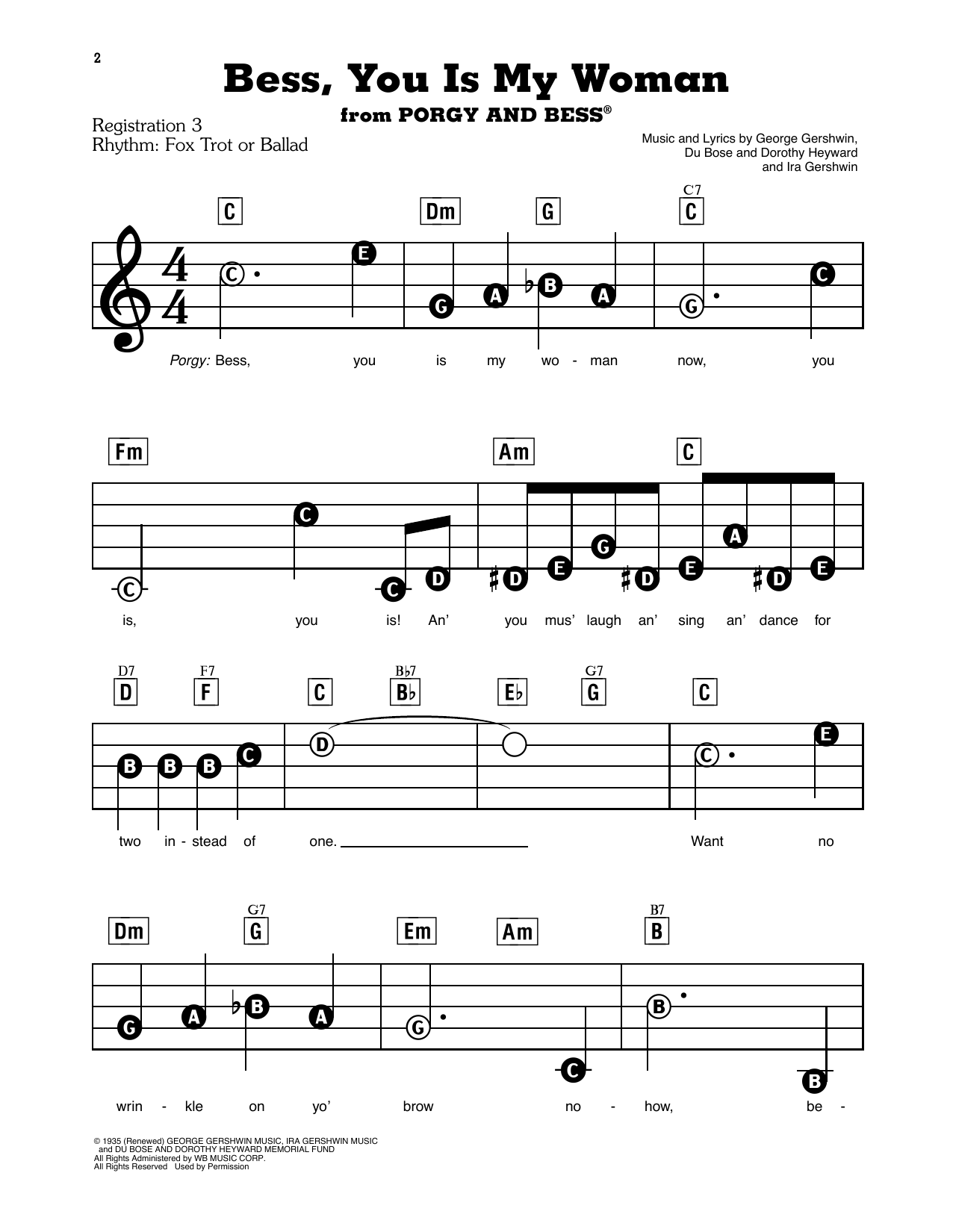
Bess, You Is My Woman (from Porgy And Bess) Sheet Music Preview

Bess, You Is My Woman (from Porgy And Bess): E-Z Play Today

As performed by George Gershwin

Item: 35-DS00590525

Digital Download
$4.99
Description

Bess, You Is My Woman (from Porgy And Bess): E-Z Play Today isn't in MakeMusic Cloud just yet...but it could be. Let us know you'd like to see it, and you'll help shape what comes next. In the meantime, start a free trial and dive into thousands of interactive titles your students can play along with today.

Sample Audio
No sample audio found.
Sample Video
Additional Details
Publisher: Hal Leonard
Page Count: 3
SKU: 35-DS00590525

More about this title

About the Artist: George Gershwin

George Gershwin (1898–1937) bridged the concert hall and Broadway with a compositional voice that felt utterly American. His gift for melody was matched by his ability to blend jazz idioms, classical forms, and popular song into work that audiences loved and musicians respected. Porgy and Bess, his 1935 opera, remains his masterwork: a sprawling, emotionally complex score that draws on folk traditions, blues, and the musical language of 1930s Harlem to tell a deeply human story.

For music educators, Gershwin's writing offers something crucial: it shows students how jazz vocabulary and classical technique can coexist. His melodies sing naturally, his harmonies surprise without feeling forced, and his orchestrations (even in simplified arrangements) reveal layers of craft worth studying. Teaching Gershwin means teaching students to hear the genuine article.

Why we love this

This E-Z Play arrangement captures one of Broadway's most achingly beautiful love songs without losing the emotional truth that makes it endure. The simplified piano part keeps the character and harmonic language of Gershwin's original intact, so pianists aren't just playing a dumbed-down version; they're engaging with the real thing in a form they can manage. For recitals, casual performances, or students building their jazz-inflected repertoire, this works perfectly.

What to expect

Tender and genuine, with an underlying sadness that never tips into self-pity. The melody unfolds with the ease of someone who knows exactly what he needs to say, and the harmonies, even in this streamlined form, support that emotional certainty with warmth and sophistication. There's an intimacy here that fills a room.

Who it's for

Pianists at the intermediate level who want accessible repertoire with real musical substance. Students exploring jazz and Broadway idioms will find this both immediately playable and genuinely rewarding. It's also ideal for singers preparing this aria who need an accompaniment they can manage themselves.

How to get the most out of it

  • Shape the melody phrase by phrase rather than note by note. This song breathes like a vocalist; let it have space and direction even in the simplest arrangement.
  • The accompaniment figures are jazz-influenced and repetitive by design. Resist the urge to rush or accent them mechanically; they should feel warm and supportive, never anxious.
  • If you have access to the recorded accompaniment, use it to ground yourself in the harmonic language, but don't become dependent on it. This melody is strong enough to stand on its own.

How to use it

Pair this with other jazz-age repertoire or American song standards for a program exploring early 20th century vernacular music. It works equally well as a standalone recital piece or as accompaniment for a vocalist performing the aria. The three-page length makes it manageable for student recitals while providing enough substance to feel like a genuine performance moment.

Skills your students will build

  • Jazz harmony voicings and chromaticism
  • Phrasing and rubato in popular song
  • Sight-reading within the E-Z Play simplified notation system
  • Accompanying singers with text awareness and sensitivity

You May Also Like