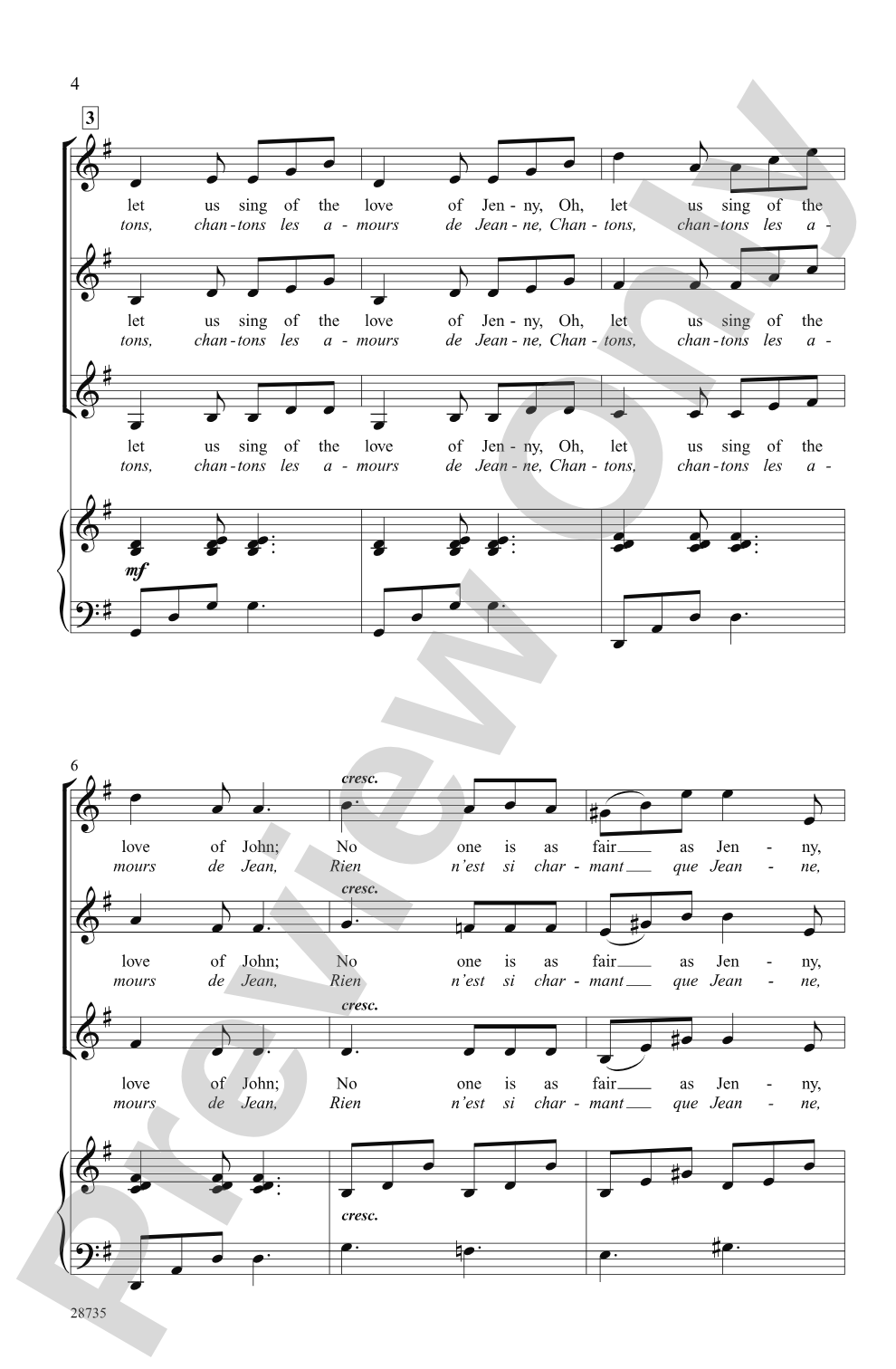
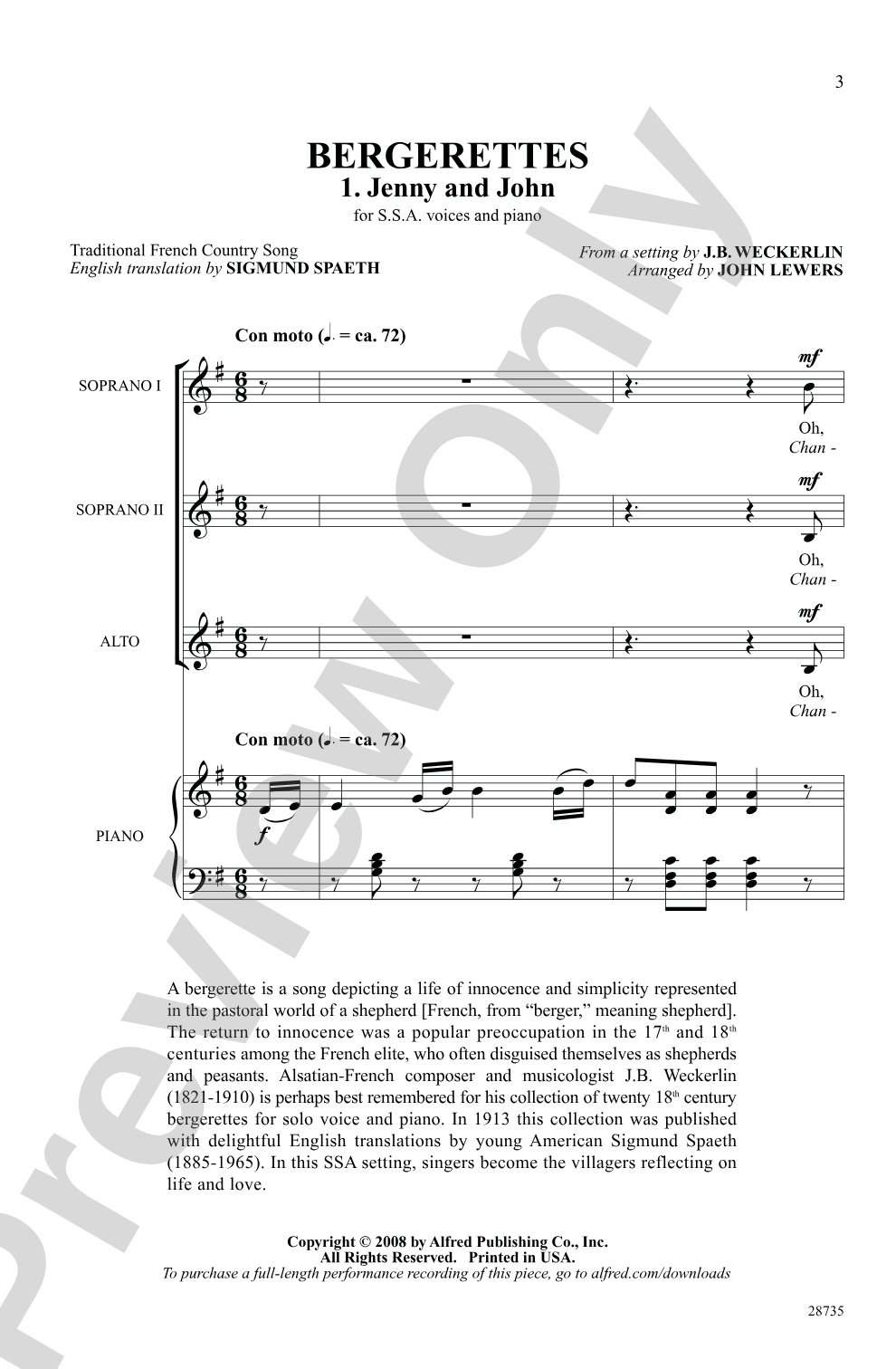
Bergerettes 1: Jenny and John Sheet Music Preview

Bergerettes 1: Jenny and John: SSA Choral Octavo

Traditional French Country Song, English translation by Sigmund Spaeth, based on an arrangement by J. B. Weckerlin / arr. John Lewers

Item: 00-PO-0000555

Digital Download
$1.75

Minimum order quantity: 20 copies

Description
These 18th century French country songs are delightful whether performed as a set or singly. Popularized by J.B. Weckerlin's solo settings in 1913, these new choral arrangements may be sung in either French or English. In both strophic settings, SSA singers become villagers reflecting on life and love.

Bergerettes 1: Jenny and John: SSA Choral Octavo isn't in MakeMusic Cloud just yet...but it could be. Let us know you'd like to see it, and you'll help shape what comes next. In the meantime, start a free trial and dive into thousands of interactive titles your students can play along with today.

Sample Audio
0:00
0:00
Sample Video
Additional Details
Series: Lawson-Gould
Publisher: Alfred Music
Page Count: 12
SKU: 00-PO-0000555

More about this title

About the Composer: J. B. Weckerlin

Jean-Baptiste Weckerlin (1821-1910) was a French composer, conductor, and musicologist whose passion for preserving folk traditions shaped much of his life's work. As director of the Paris Conservatoire's library and a prolific arranger, he collected and published hundreds of traditional songs from across Europe, believing that folk music deserved the same scholarly attention and artistic treatment as composed works.

Why we love this

These bergerettes showcase Weckerlin's gift for bringing centuries-old melodies into vivid choral life without overwrought arrangement. The dual-language option lets you meet singers where they are, whether your group reads French fluently or prefers English texts, making these pieces genuinely accessible for diverse programs and festivals.

What to expect

These charming country songs capture the intimacy of village life, where ordinary moments around love and observation become the stuff of song. The straightforward harmonic language and singable melodies create warmth and accessibility, inviting singers to inhabit the roles of everyday people sharing their stories.

Who it's for

SSA choirs seeking repertoire that feels fresh yet grounded in genuine tradition. This works equally well for high school and community choirs, festival participants, and educational programs exploring multicultural and historical vocal literature.

How to get the most out of it

  • Honor the strophic form by finding fresh interpretive choices across verses rather than repeating the same phrasing mechanically. Subtle dynamic shifts, slight tempo flexibility, or varied articulation can keep audience interest alive.
  • If performing both songs in sequence, create a musical bridge between them through intentional silence or a brief gesture that signals the shift from one villager's perspective to another's.
  • Balance the SSA texture so the outermost voices (soprano and alto) don't overshadow the middle soprano line, which often carries important melodic material and harmonic color.
  • Attend carefully to text clarity in whichever language you choose. Pristine diction matters enormously when the harmonic language is simple and transparent.

How to use it

Program these as a pair to create a thematic moment about rural life and human connection, or use either song individually as a lighter moment between weightier concert selections. They sit naturally in programs exploring folk traditions, Renaissance and Baroque music, or explorations of French cultural heritage.

Skills your students will build

  • Stylistic awareness of 18th-century French country song traditions
  • Bilingual musicality (singing with equal comfort in French and English)
  • Part independence within close SSA voicing
  • Textual storytelling and character interpretation in traditional repertoire

You May Also Like