

Berens: School of Velocity, Op. 61: Piano Book
By Johann Herman Berens
Level: Intermediate / Advanced
Item: 00-PK-0002940

$9.99
Pickup currently not available
Buy Extra Parts (Digital PDF Download)
Parts Added to Cart!
Related Items
School of Velocity, Opus 61: Piano Book |
$9.95
|
View |
Description
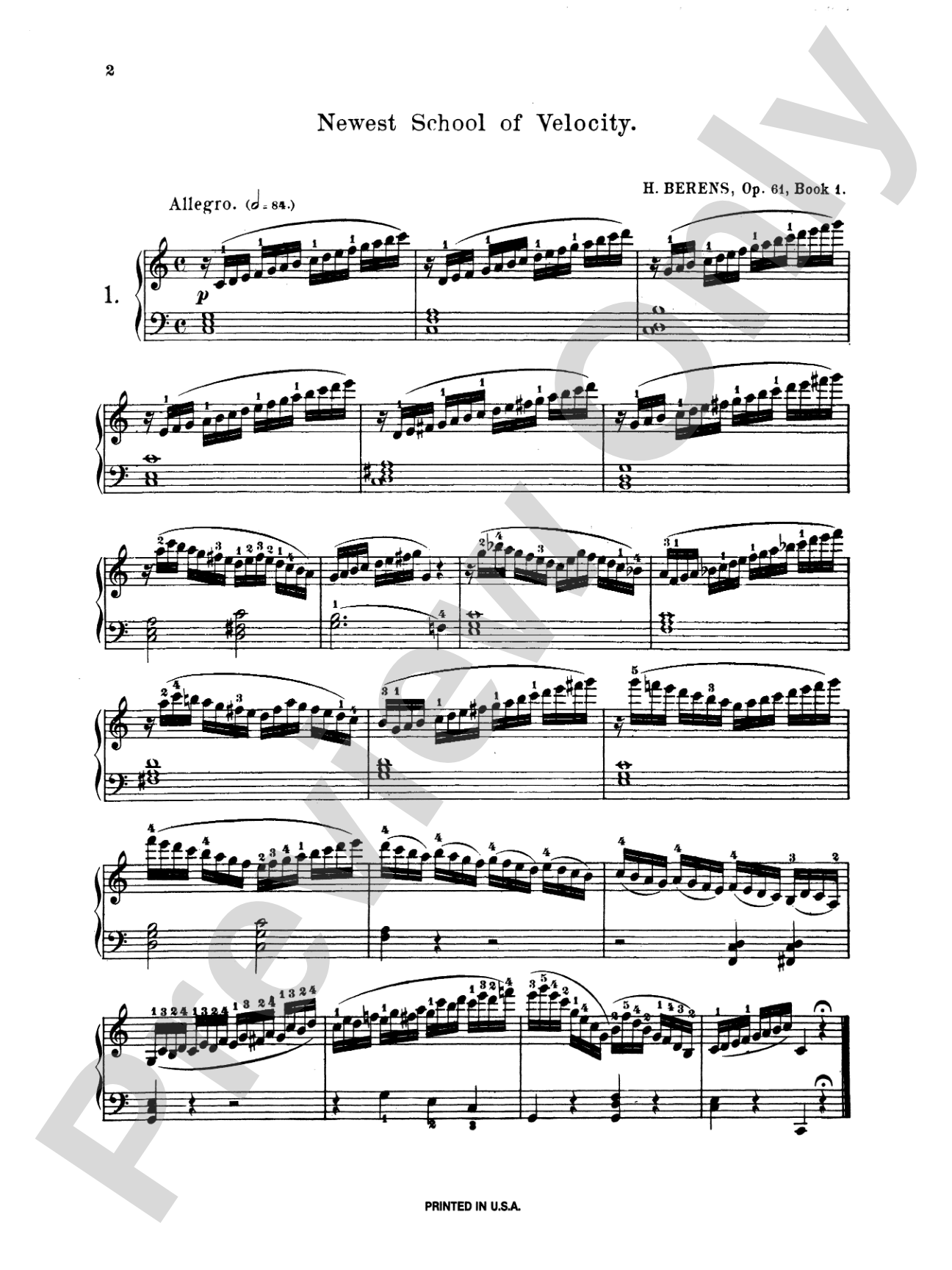
Hermann Berens (1826--1880) was a German Romantic composer famous mainly for his piano music. These 40 Studies for piano include Books 1-4 of Berens' School of Velocity, Opus 61. 65 pages.


Don't just read it, hear it, play along with it, and watch your students grow with it. In MakeMusic Cloud, Berens: School of Velocity, Op. 61: Piano Book comes alive with professional accompaniment, adjustable tempo, and built-in practice tools that turn solo practice into real progress.
Open in the Player
Jump straight in and assign it today.
Start Your Free Trial
Open this title and explore the full library in minutes.
Sample Audio
No sample audio found.
Sample Video
No sample videos found.
Additional Details
Series:
Kalmus Edition
Publisher:
Alfred Music
Page Count:
68
SKU:
00-PK-0002940
More about this title
About the Composer: Johann Herman Berens
Johann Herman Berens (1826–1880) was a German pianist and composer whose output centered almost entirely on keyboard music. He spent much of his career as a performer and teacher, which shaped his compositional approach: his works are idiomatically written for the hands and deeply concerned with the mechanics of piano technique.
The School of Velocity stands as his most enduring contribution to piano pedagogy. Rather than abstract exercises, these studies embed technical challenges within musical contexts that reward expressive playing. Berens understood that students learn fastest when they're engaged with material that sounds good, and his studies prove this principle across four progressively sophisticated books.
Why we love this
Berens strikes a rare balance between genuine musical substance and purposeful technical work. Each study targets specific velocity patterns without sacrificing melody or harmonic interest, making them far more engaging to practice than many Czerny or Hanon alternatives. Teachers appreciate these pieces because students actually want to play them, not just endure them.
What to expect
These studies pulse with Romantic-era sensibility. Beneath the rapid figurework lies genuine harmonic motion and melodic intent, creating a sense of momentum and purpose rather than mechanical display. Passages that initially feel like fingerwork reveal themselves as miniature compositions, with satisfying resolutions and expressive possibilities that invite the player to make them sing.
Who it's for
Pianists in their second or third year of study who have mastered basic technique and are ready for systematic work on velocity and finger independence. Advanced elementary and early intermediate students benefit from Books 1-2, while Book 3-4 suit intermediate and advancing students preparing for more virtuosic repertoire. Teachers seeking studies that combine technical rigor with musical integrity will find these invaluable for studio or classroom use.
How to get the most out of it
- Maintain evenness of touch across scalar passages by thinking in phrases rather than individual notes. Break each study into 2-4 bar units and practice those as complete musical statements before linking them.
- Attend to the harmonic rhythm underneath the velocity work. Berens's accompaniment figures aren't mere filler; they anchor the phrasing and prevent the right hand from floating into mechanical playing.
- Use tempo judiciously. The written tempo marking is a target, but solid technical foundation at a moderate pace beats rushed, uneven playing at the marked speed. Build gradually toward the intended tempo over several practice sessions.
- Shape the melodic line even in rapid passages. These studies reward slight dynamic shaping and voicing that emphasizes the primary melody, transforming what could sound like finger drills into actual performances.
How to use it
Program individual studies from this collection in student recitals as standalone pieces, not merely as practice tools. The shorter studies work well in themed programs (velocity studies from multiple composers, studies by Romantic-era composers, etc.). For teachers, rotate through these books as the backbone of technical training across multiple students at similar levels, ensuring consistency and variety in daily practice routines.
Skills your students will build
- Scalar velocity and finger independence across both hands
- Evenness and control in rapid sixteenth and thirty-second note passages
- Hand position stability during extended runs
- Reading and executing ornaments and embellishments in context
- Phrase shaping and dynamic control within fast-moving textures
- Coordination of melody and accompaniment at increasing tempos