
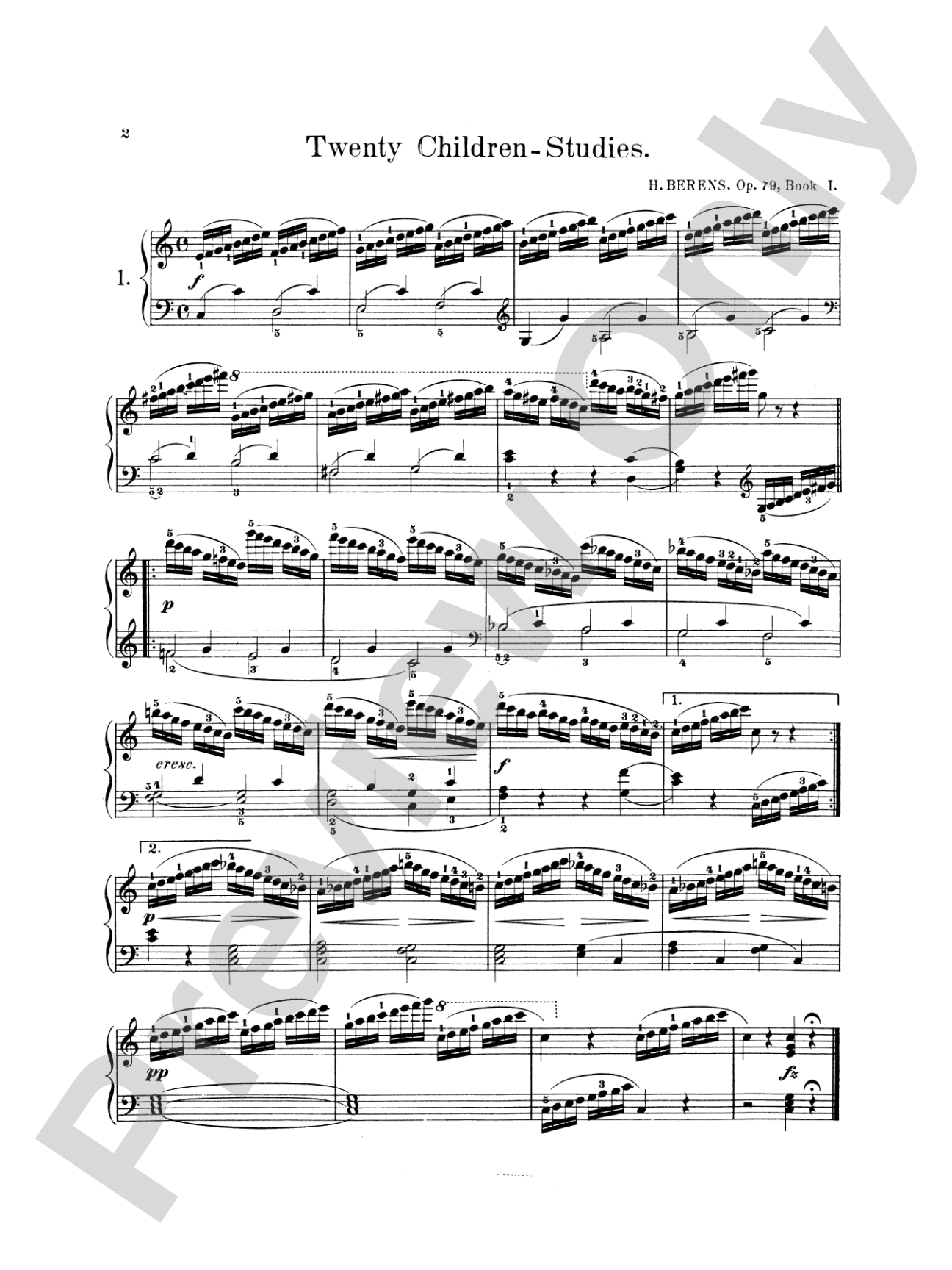

Berens: 20 Children's Studies, Op. 79: Piano Book
By Johann Herman Berens
Item: 00-PK-0002942

$7.99
Pickup currently not available
Buy Extra Parts (Digital PDF Download)
Parts Added to Cart!
Related Items
20 Children's Studies, Opus 79: Piano Book |
$7.99
|
View |
Description
Hermann Berens (1826--1880) was a German Romantic composer famous mainly for his piano music. These intermediate level studies make up Berens' Opus 79. 21 pages.


Don't just read it, hear it, play along with it, and watch your students grow with it. In MakeMusic Cloud, Berens: 20 Children's Studies, Op. 79: Piano Book comes alive with professional accompaniment, adjustable tempo, and built-in practice tools that turn solo practice into real progress.
Open in the Player
Jump straight in and assign it today.
Start Your Free Trial
Open this title and explore the full library in minutes.
Sample Audio
No sample audio found.
Sample Video
No sample videos found.
Additional Details
Series:
Kalmus Edition
Publisher:
Alfred Music
Page Count:
24
SKU:
00-PK-0002942
More about this title
About the Composer: Johann Herman Berens
Johann Herman Berens (1826, 1880) was a German Romantic pianist and composer whose output centered almost entirely on keyboard music. Though less celebrated than some of his contemporaries, Berens developed a reputation for writing pedagogically sound works that balanced musical substance with technical accessibility, making him a fixture in piano studios across Europe during the mid-nineteenth century.
His studies and character pieces remain valuable precisely because they refuse to separate musicality from technique. Berens understood that students learn best when they're engaged with music that respects their developing abilities rather than condescending to them.
Why we love this
These studies arrive at a sweet spot between pure technique and genuine musical expression. Berens gives students real harmonic language, phrase shapes, and character to interpret rather than mechanical patterns, making them far more rewarding to assign than comparable workout pieces.
What to expect
These studies breathe with Romantic sensibility. You'll find gentle character pieces with lilting rhythms, occasional moments of dramatic tension, and frequent opportunities to explore the singing tone and expressive possibilities of the instrument. The harmonic language is accessible but never simplistic.
Who it's for
Intermediate pianists ready to move beyond basic technique books into repertoire that teaches and entertains simultaneously. This collection works well for students around Grade 3-4 level who need focused work on specific technical patterns without sacrificing musicality.
How to get the most out of it
- Shape each study as a complete musical thought rather than a technical drill. Berens intended these as miniature character pieces, so bring out melody lines and observe harmonic changes even in passages designed to build finger work.
- Invest in the pedal usage suggested or implied by the harmonic language. Romantic-era students learned color and resonance through these studies, not just finger independence.
- Work hands separately before combining, but aim to hear the upper voice singing over the accompaniment pattern. Identify where the musical interest lives in each piece and prioritize that voice.
How to use it
Assign individual studies alongside other Romantic repertoire to build technique specific to the music your students are learning. A single study can serve as a warm-up or standalone recital piece; together, they form a coherent progression suitable for student recitals or as supplementary material in a summer study program.
Skills your students will build
- Legato passage work and control of finger independence
- Interpretation of Romantic-era phrasing and harmonic color
- Pedal technique and its relationship to harmonic change
- Reading and performing character pieces with minimal guidance
- Technical facility across multiple figuration patterns at intermediate level