
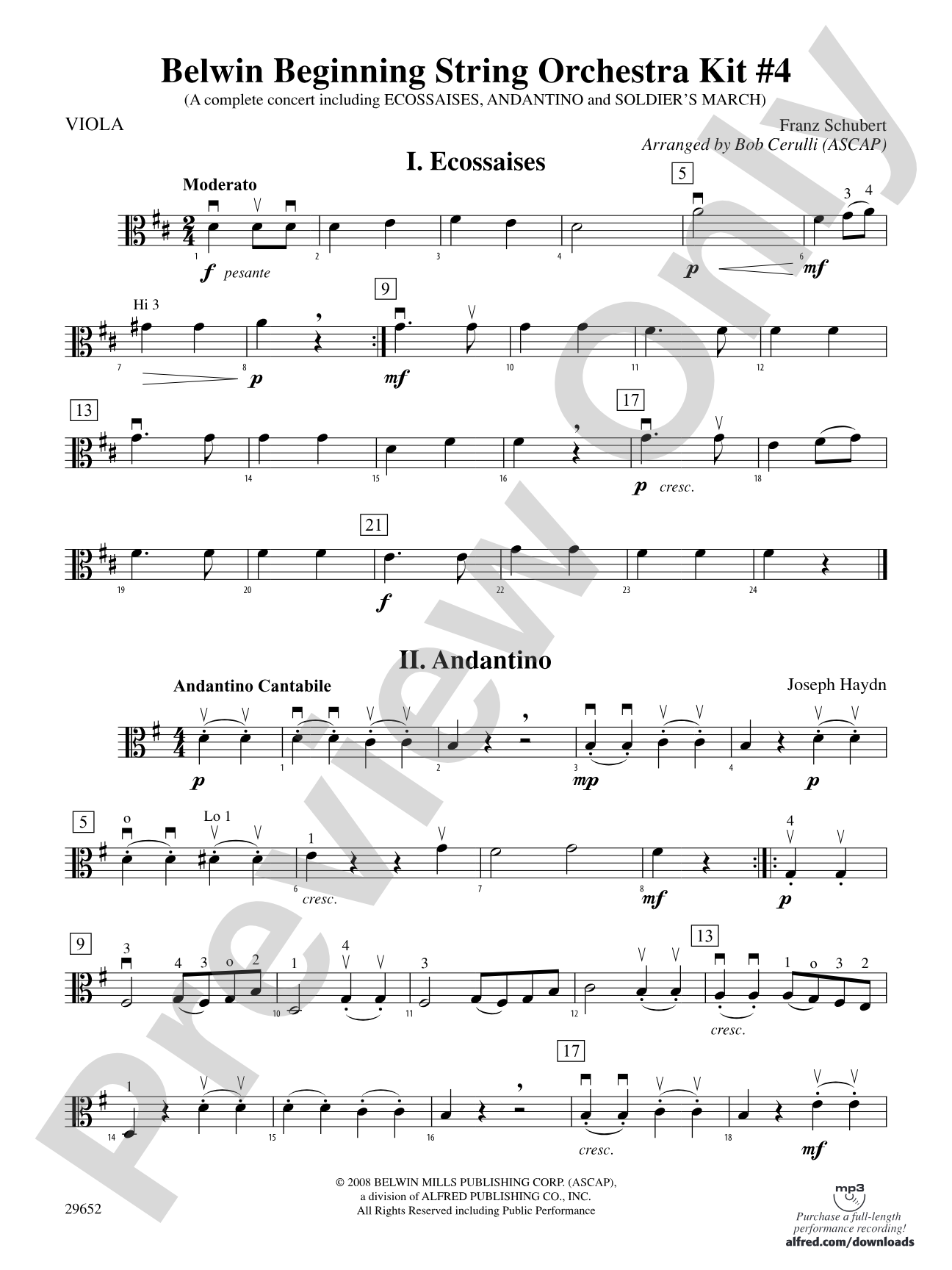

Belwin Beginning String Orchestra Kit #4: Viola
Featuring: Ecossaises / Andantino / Soldier's March
By Franz Schubert, Joseph Haydn, and Robert Schumann / arr. Bob Cerulli
Grade: 2
Item: 00-PC-0001530_VA1
$5.99
Pickup currently not available
Description
A complete concert in one! Wonderful arrangements for young players including Schubert's Ecossaisses with the feel of a contradance, Haydn's lyrical Andantino and concluding with the crisp staccato of Schumann's Soldier's March. Play any or all of the tunes and develop skills with contrasting dynamics and styles. (4:15)


Don't just read it, hear it, play along with it, and watch your students grow with it. In MakeMusic Cloud, Belwin Beginning String Orchestra Kit #4: Viola comes alive with professional accompaniment, adjustable tempo, and built-in practice tools that turn solo practice into real progress.
Open in the Player
Jump straight in and assign it today.
Start Your Free Trial
Open this title and explore the full library in minutes.
Sample Audio
1
Audio File
--:--
0:00
0:00
Sample Video
No sample videos found.
Additional Details
Series:
Belwin Beginning String Orchestra
Publisher:
Alfred Music
Page Count:
144
SKU:
00-PC-0001530_VA1
More about this title
About the Arranger: Bob Cerulli

Bob Cerulli studied double bass at the Curtis Institute of Music under Roger Scott, then earned degrees in music education from the University of the Arts and conducting from the College of New Jersey. His performance career included principal bass positions with the Greater Trenton Symphony, The New Jersey Capital Philharmonic Orchestra, and Delaware Valley Philharmonic Orchestra, along with freelance work in Philadelphia and Atlantic City accompanying Broadway performers and recording with major film composers including Henry Mancini, Bill Conte, and Michel LeGrand.
Cerulli's experience spans both the orchestral stage and the classroom. He taught public school music for 29 years and currently serves as a Senior Adjunct Professor at Rowan College at Burlington County, where he conducts orchestral reading sessions and festival performances. His own compositions, including the orchestral work Celebration (performed by the Philadelphia Orchestra) and Romance in D Major for cello and piano, reflect his deep understanding of instrumental writing and student capability.
Why we love this
Cerulli's ear for orchestration shows throughout this collection. He draws from three distinct classical voices (Schubert's spirited contradance style, Haydn's singing lyricism, and Schumann's crisp articulation) without creating redundant sound or technical demand. A conductor gets substantial rehearsal value from the contrasting character work without needing multiple separate pieces.
What to expect
The music shifts gracefully from the spirited energy of a European village dance to the gentle nobility of a singing line, then lands firmly in the decisive character of a military march. Each piece settles into its own world without demanding technical virtuosity, allowing young players to inhabit the style and hear themselves within the larger ensemble sound.
Who it's for
Beginning string orchestras in grades 2 and up benefit from a conductor score and parts that deliver concert-ready material without oversimplification. This collection suits ensembles preparing for festival performance or school concerts who want to program recognizable classical repertoire with immediate success.
How to get the most out of it
- Shape the Schubert with the contradance's forward momentum in mind. The young players should feel the lift in the phrasing rather than treating each measure as static.
- Balance the Haydn's melody against the inner voices so the Andantino breathes rather than droops. Work intonation in exposed passages where octaves and thirds emerge clearly.
- Attack the staccato articulation in the Schumann with precision from the start. Consistent tongue placement across the section prevents the march from sounding sloppy when tempo tightens.
- Use the variety of these three pieces to explore different bow speeds and weights within a single rehearsal. Students develop control across multiple contexts rather than perfecting one approach.
How to use it
Program the complete suite as a concert feature or select individual movements depending on rehearsal time and concert length. The Schubert opens well; the Haydn works as a lyrical contrast in a mixed program; the Schumann closes with energy. Consider performing all three consecutively to showcase the orchestra's range within classical styles.
Skills your students will build
- Contrasting bow weights and articulation styles (legato, staccato, marcato)
- Dynamic shaping and phrasing in classical forms
- Intonation in ensemble contexts with exposed inner voices
- Rhythmic precision in coordinated section playing
- Stylistic interpretation across three distinct musical characters