
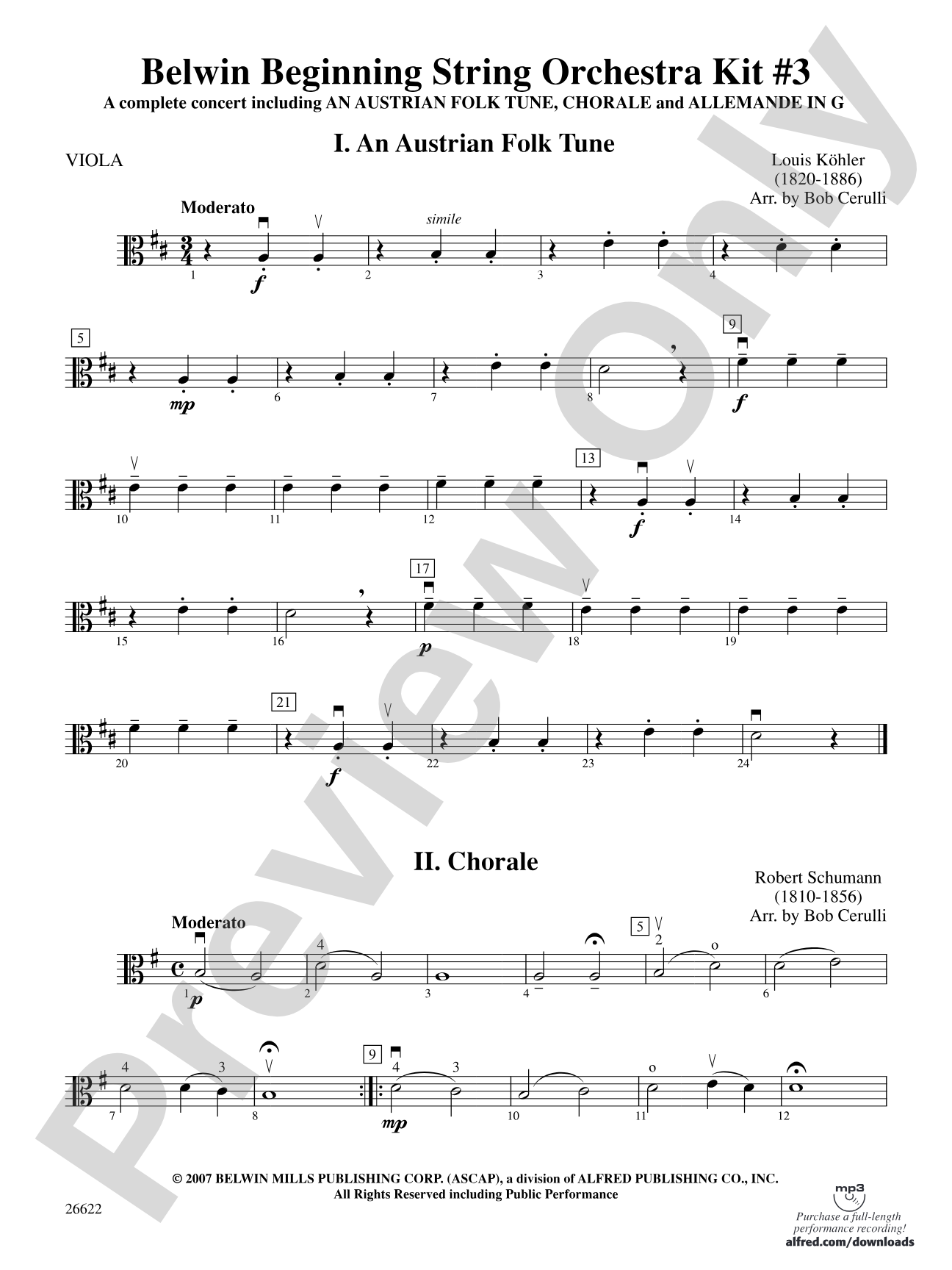

Belwin Beginning String Orchestra Kit #3: Viola
A Complete Concert Including: An Australian Folk Tune / Chorale / Allemande in G
Arr. Bob Cerulli
Grade: 2
Item: 00-PC-0001126_VA1
$5.99
Pickup currently not available
Description
A complete concert in one kit! Tunes can be performed as a complete program, or stand alone. The "Austrian Folk Tune," "Choral" and "Allemande" provide contrasting styles intended to build your students' skills, particularly in the use of rhythm and dynamics. Lovely! This title is available in MakeMusic Cloud.


Don't just read it, hear it, play along with it, and watch your students grow with it. In MakeMusic Cloud, Belwin Beginning String Orchestra Kit #3: Viola comes alive with professional accompaniment, adjustable tempo, and built-in practice tools that turn solo practice into real progress.
Open in the Player
Jump straight in and assign it today.
Start Your Free Trial
Open this title and explore the full library in minutes.
Sample Audio
1
Audio File
--:--
0:00
0:00
Sample Video
No sample videos found.
Additional Details
Series:
Belwin Beginning String Orchestra
Publisher:
Alfred Music
Page Count:
72
SKU:
00-PC-0001126_VA1
More about this title
About the Arranger: Bob Cerulli

Bob Cerulli trained at the Curtis Institute of Music, where he studied double bass with Roger Scott, and earned degrees in music education from the University of the Arts and conducting from the College of New Jersey. He performed as Principal Bass with the Greater Trenton Symphony, the New Jersey Capital Philharmonic Orchestra, and Delaware Valley Philharmonic Orchestra, and spent years freelancing in Philadelphia and Atlantic City alongside Broadway performers and composers including Henry Mancini, Bill Conte, Michel LeGrand, and Marvin Hamlish.
Cerulli's career spans both performance and education. He taught music in public schools for 29 years and currently serves as a Senior Adjunct Professor at Rowan College at Burlington County. His original compositions include Celebration, which was performed by the Philadelphia Orchestra, and Romance in D Major for cello and piano. He has conducted orchestral reading sessions and performances at regional music festivals throughout his career.
Why we love this
Three pieces in one package, each offering distinct pedagogical value without requiring separate purchases or lesson planning. Cerulli's arrangements show sophisticated understanding of how beginning string players develop rhythmic precision and dynamic control, and the contrasting styles ensure students encounter varied textures and phrasing demands within a single rehearsal cycle.
What to expect
A curated concert journey that moves from folk simplicity through lyrical stillness to baroque-inspired courtliness. The shifting rhythmic and dynamic landscapes keep young players engaged and aware of the larger musical architecture, while the melodies themselves remain accessible and expressive.
Who it's for
Conductors programming Grade 2 string orchestras who want concert-ready material that develops musical maturity without overextending players technically. This kit works especially well for directors whose students benefit from performing a complete program that feels substantial and varied, rather than isolated single movements.
How to get the most out of it
- Establish a clear pulse before students enter each movement; the transitions between Austrian Folk Tune, Choral, and Allemande work best when the tempo grid is locked in advance and maintained through shifts in character.
- Shape the Choral section by focusing on sustained tone quality and the weight behind dynamic changes; younger players often rush through softer passages, so isolate this section for breath control and phrase breathing.
- Balance the rhythmic drive of the outer movements by keeping subdivisions light in the string sections; students hearing the rhythm clearly without exaggeration will respond with cleaner articulation.
- Use the contrasting moods as rehearsal anchors: return to the Austrian Folk Tune energy when concentration flags, then reset with the introspection of the Choral before closing with the Allemande.
How to use it
Program this as your full opening set at a winter or spring concert, letting the three movements breathe as a natural sequence that showcases ensemble cohesion and stylistic range. The contrasting character of each piece also makes it ideal for a multi-grade festival or demonstration where you want to highlight how beginning orchestras handle structural variety.
Skills your students will build
- Dynamic shaping across sustained and moving lines
- Rhythmic precision in mixed meters and shifting subdivisions
- Baroque articulation and phrasing conventions
- Ensemble balance and blend across multi-movement works
- Transition clarity between contrasting tempos and styles