
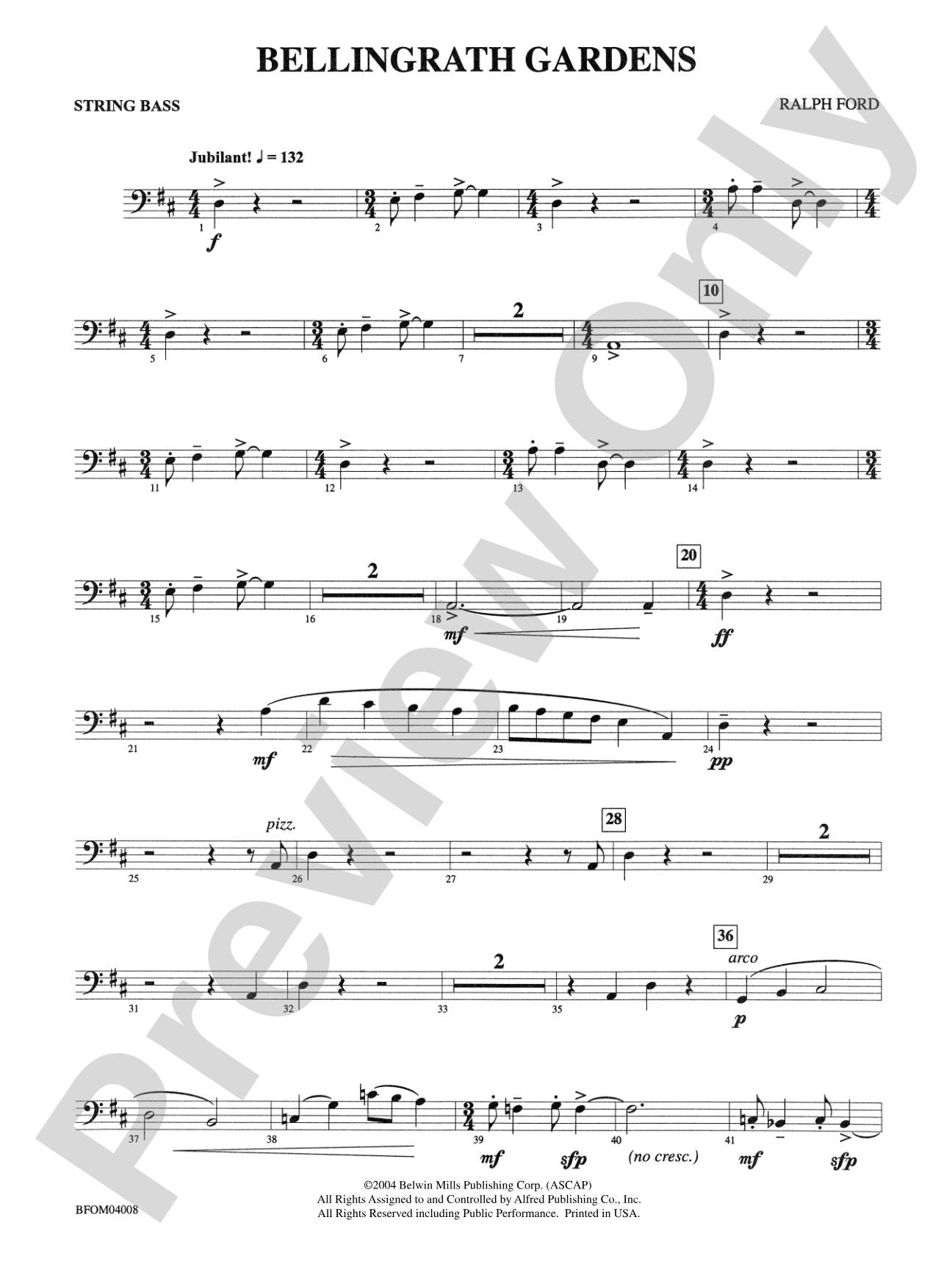

Bellingrath Gardens: String Bass
By Ralph Ford
Grade: 2.5
Item: 00-PC-0002238_SB
$3.00
Pickup currently not available
Description
With this stunning new overture for intermediate orchestra, your students will sound glorious -- nothing is musically out of reach. A magnificent fanfare sets the stage for the beautiful woodwind melody, interrupted by driving percussion and brass flourishes generously cross cued. This one's perfect for contest or competition and will complete any performance need. A wonderful introduction to full orchestra or playable by strings alone. (2:37)


Bellingrath Gardens: String Bass isn't in MakeMusic Cloud just yet...but it could be. Let us know you'd like to see it, and you'll help shape what comes next. In the meantime, start a free trial and dive into thousands of interactive titles your students can play along with today.
Request This Title
Tell us you want it.
Start Your Free Trial
Explore everything that's ready to play right now.
Sample Audio
1
Audio File
--:--
0:00
0:00
Sample Video
No sample videos found.
Additional Details
Series:
Belwin Intermediate String/Full Orchestra
Publisher:
Alfred Music
Page Count:
256
SKU:
00-PC-0002238_SB
More about this title
About the Composer: Ralph Ford

Ralph Ford has spent nearly three decades teaching at the university level while maintaining an active career as a composer, arranger, and clinician. His professional trajectory spans media production, broadcast work, and live conducting, all of which inform his compositional voice. Based in Los Angeles as an exclusive composer and arranger for the Belwin division of Alfred Music, Ford has created over 250 titles across orchestra, concert band, jazz ensemble, and marching band; his works are performed regularly by university, military, professional, community, and school ensembles worldwide.
Ford's early training in arranging began at age fifteen in Panama City, Florida, and accelerated during his undergraduate years at Troy State University, where he directed the Jazz Ensemble and served as staff arranger for the band program. He earned his Master of Science degree in 1988 while teaching full time, and his subsequent work in media production, including live broadcasts, scoring, and audio production for national networks, deepened his understanding of dramatic pacing and orchestration. His commissioned works reflect both his academic rigor and his instinct for what sounds effective in the rehearsal room.
Why we love this
Ford writes for where your orchestra actually is, not where you wish it were. The generous cross-cueing means no section gets stranded, and the fanfare-driven architecture gives every student a moment to shine while maintaining the forward momentum that makes rehearsal days productive. At 2:37, it's substantial enough to matter on a concert but short enough to work in a festival rotation without eating up your whole program.
What to expect
A celebration opening on a fanfare, blooming into something genuinely lyrical before the ensemble muscles up with brass and percussion flourishes. The orchestration feels spacious and colorful rather than dense, letting individual lines breathe while everything locks together.
Who it's for
Intermediate orchestras ready to program something beyond simple arrangements but not yet tackling Grade 3.5 complexity. Works equally well as a full orchestra piece or as strings alone, making it flexible for varying instrumentation needs.
How to get the most out of it
- Balance the opening fanfare so the brass cuts through without overwhelming the orchestra; the woodwinds need breathing room once they enter with the main melody.
- Let the percussion lines drive forward without rushing; they're written to punctuate, not to compensate for tempo wobble.
- Mark your string entrances clearly during the faster sections so the ensemble stays unified when parts layer over one another.
- Use the recording to lock the overall shape before rehearsing individual sections; this piece depends on knowing where the arc goes.
How to use it
Open a concert with this to set an upbeat, confident tone, or place it mid-program as a palate cleanser between heavier works. It works especially well in festival contexts where you want the judges to hear your orchestra's blend and confidence without technical demands getting in the way.
Skills your students will build
- Balancing melody and accompaniment across multiple instrumental families
- Maintaining steady tempo through rhythmic punctuation from percussion and brass
- Responding to cross-cueing so no section feels abandoned
- Shaping a musical phrase that spans multiple sections working together
- Reading and executing dynamic contrast in a full orchestral texture