Belfast to Boston: Piano/Vocal/Chords Digital Sheet Music

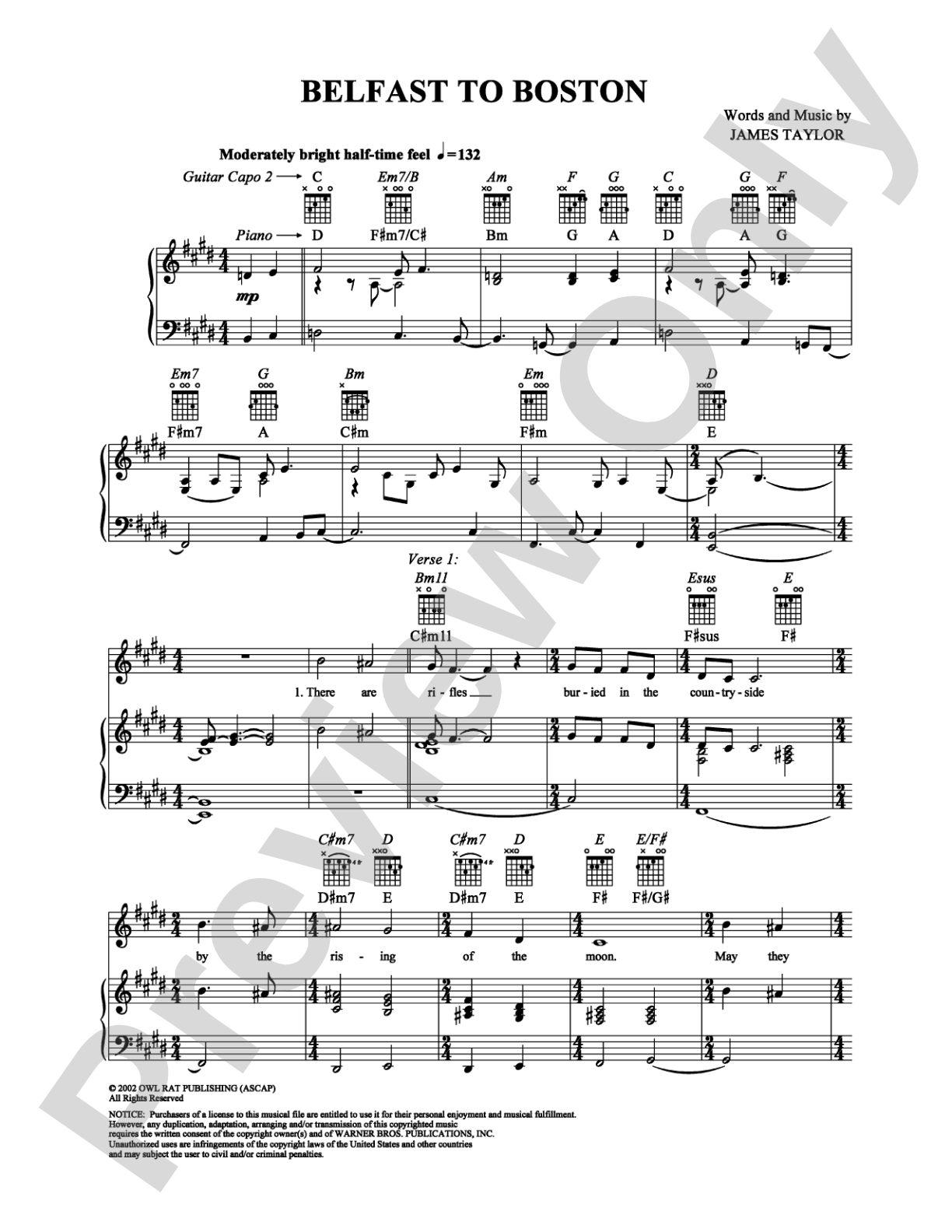
Belfast to Boston: Piano/Vocal/Chords Digital Sheet Music

James Taylor

Item: 00-PS-0003668

Digital Download
$3.99
Description

Belfast to Boston: Piano/Vocal/Chords Digital Sheet Music isn't in MakeMusic Cloud just yet...but it could be. Let us know you'd like to see it, and you'll help shape what comes next. In the meantime, start a free trial and dive into thousands of interactive titles your students can play along with today.

Sample Audio
No sample audio found.
Sample Video
Additional Details
SKU: 00-PS-0003668

More about this title

About the Artist: James Taylor

James Taylor is a singer-songwriter whose career spans five decades, beginning with his breakthrough in the early 1970s. His influence on popular music extends across generations, shaped by his fingerstyle guitar technique, introspective lyrics, and ability to blend folk, rock, and soul sensibilities into deeply personal songs.

Why we love this

This arrangement gives singers and pianists access to one of Taylor's signature pieces in a straightforward, singable format. The piano/vocal/chords layout works equally well for solo recital preparation, jazz ensemble settings, or classroom study of contemporary songwriting craft.

What to expect

Intimate and reflective, with the conversational warmth Taylor brings to narratives about place and memory. The arrangement invites you into a quiet room with a piano, where the focus is on the story being told and the subtle emotional shifts between verses.

Who it's for

Pianists and vocalists working at the intermediate level or above who want to explore contemporary song interpretation and understand how chord symbols translate to actual playing. It's also valuable for music students studying singer-songwriter composition or analyzing how folk-rock arrangements function.

How to get the most out of it

  • Balance the vocal line so it sits naturally over the piano voicings rather than competing with them; Taylor's style relies on conversational delivery rather than belting.
  • Pay attention to chord voicings in the piano part; they carry much of the song's harmonic color and shouldn't be flattened into simple block chords.
  • Lean into the story and emotional arc of the lyric; the piano/vocal format asks you to be present with the words, not hidden behind arrangement complexity.

How to use it

Include this in a recital program exploring American singer-songwriters, or use it in a jazz/pop ensemble setting where vocalists study contemporary standards. It also works well in a music theory or songwriting class as a model for how chord progressions and vocal phrasing interact.

Skills your students will build

  • Reading and interpreting chord symbols accurately
  • Balancing melody and accompaniment in piano/vocal textures
  • Understanding phrase pacing in narrative-driven popular songs
  • Translating folk-rock idioms into classical piano technique

You May Also Like