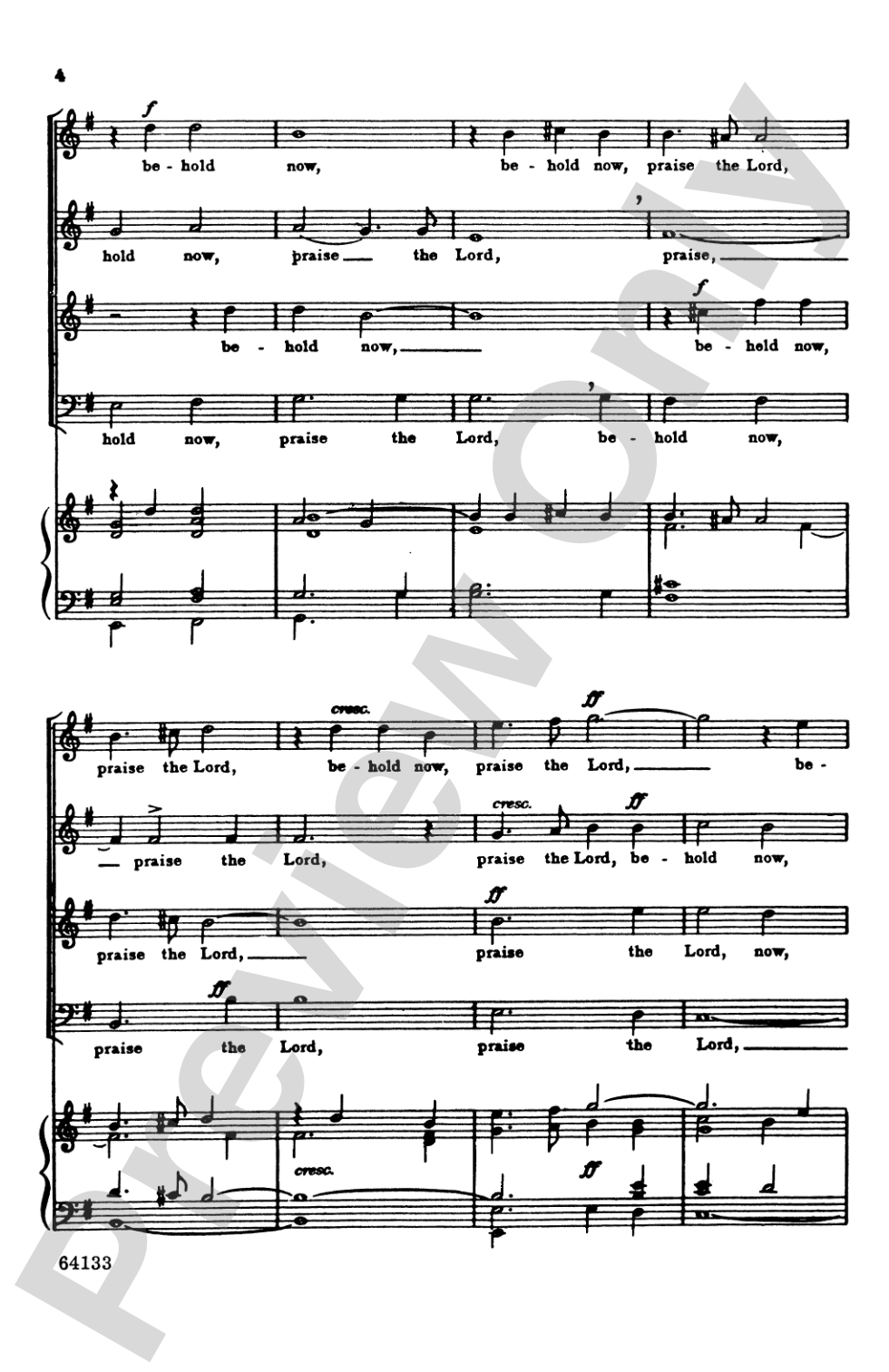
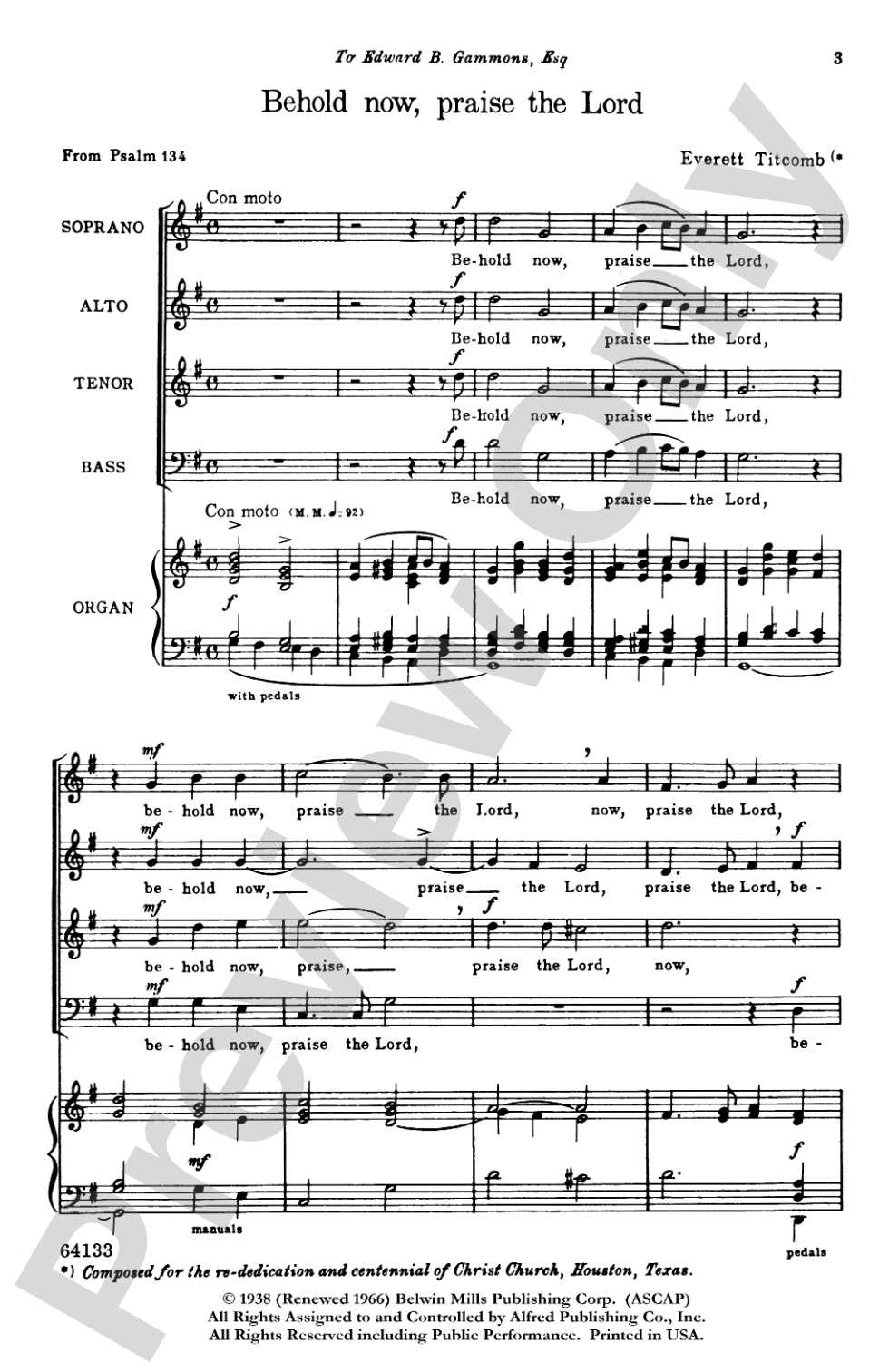
Behold Now, Praise the Lord Sheet Music Preview

Behold Now, Praise the Lord: SATB Choral Octavo

Everett Titcomb

Level: Moderate

Item: 00-PO-0002477

Digital Download
$2.25

Minimum order quantity: 20 copies

Description

Behold Now, Praise the Lord: SATB Choral Octavo isn't in MakeMusic Cloud just yet...but it could be. Let us know you'd like to see it, and you'll help shape what comes next. In the meantime, start a free trial and dive into thousands of interactive titles your students can play along with today.

Sample Audio
No sample audio found.
Sample Video
Additional Details
Series: Alfred Archive Edition: Alfred Church Choral Series
Publisher: Alfred Music
Page Count: 12
SKU: 00-PO-0002477
Instrumentation: Organ

More about this title

About the Composer: Everett Titcomb

Everett Titcomb (1884-1968) was an American composer and organist whose sacred choral works earned wide respect in church music circles. His compositions demonstrate a deep understanding of liturgical function combined with accessible, singable melodic writing that serves both amateur and semi-professional choirs.

Why we love this

Titcomb's setting avoids the ornate, allowing the text to shine through clear harmonic writing. At grade 3, the piece sits perfectly for choirs ready to move beyond unison work but not yet tackling the dense four-part textures of advanced literature. The moderate difficulty makes it genuinely rewarding to rehearse and perform without becoming a distraction.

What to expect

The music carries a reverent, hymnlike quality grounded in steady harmonic movement. Titcomb's setting feels intimate rather than grand, inviting singers and listeners into focused contemplation without theatrical gesture.

Who it's for

This piece suits developing SATB choirs with basic four-part experience and relatively secure sight-readers. Church choirs preparing for Advent or general worship services, and high school or advanced middle school choirs working toward festival performance will find this approachable without condescending.

How to get the most out of it

  • Shape each phrase by listening to the soprano line as your melodic anchor; the other voices follow naturally when sopranos project with purpose.
  • Balance the organ part as a supporting foundation, not a wall. The choir's voice should float over, not sink into, the accompaniment.
  • Mark breath points in pencil during first reads so singers know exactly where the phrase ends; ambiguous phrasing slows rehearsal and weakens performance.

How to use it

Slot this into a liturgical context where a single, dignified anthem serves the service. Paired with instrumental or organ-only interludes, it also works as the foundation of a short sacred concert program alongside other pieces from the Alfred Church Choral Series.

Skills your students will build

  • Sustaining melodic phrases across multiple measures in four-part texture
  • Balancing ensemble sound when all four voices carry equal rhythmic interest
  • Responding to organ accompaniment as a structural guide rather than a crutch
  • Maintaining intonation in sustained harmonic progressions

You May Also Like