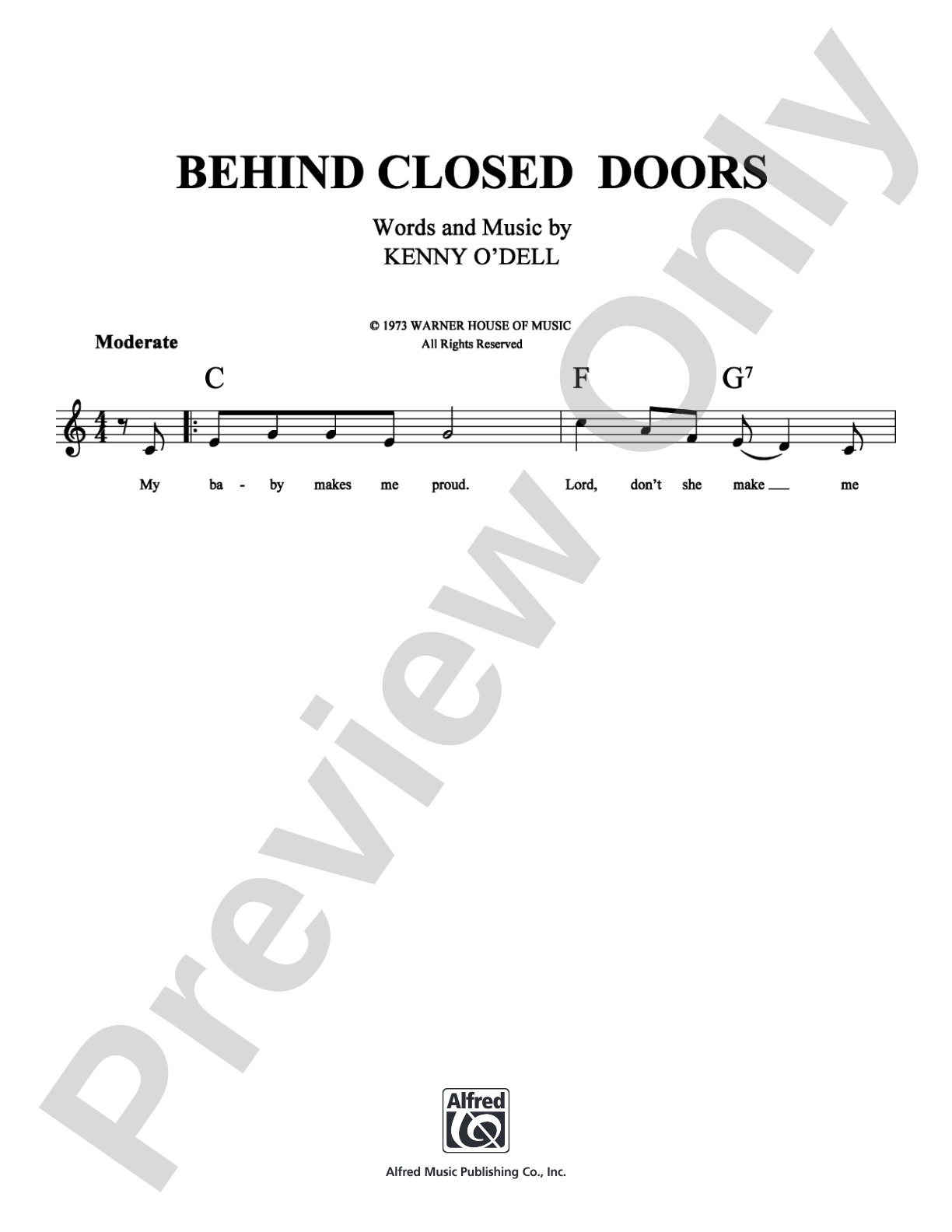
Behind Closed Doors: Lead Sheet Digital Sheet Music

Behind Closed Doors: Lead Sheet Digital Sheet Music

Charlie Rich, Kenny O'Dell

Item: 00-PS-0009103

Digital Download
$1.99
Description

Behind Closed Doors: Lead Sheet Digital Sheet Music isn't in MakeMusic Cloud just yet...but it could be. Let us know you'd like to see it, and you'll help shape what comes next. In the meantime, start a free trial and dive into thousands of interactive titles your students can play along with today.

Sample Audio
No sample audio found.
Sample Video
Additional Details
SKU: 00-PS-0009103

More about this title

About the Artist: Charlie Rich

Charlie Rich (1932-1995) was an American singer and pianist whose career spanned country, pop, and soul music. Known for his smooth baritone voice and sophisticated musical arrangements, Rich achieved massive commercial success in the 1970s, particularly with ballads that showcased his technical skill as both vocalist and instrumentalist.

Why we love this

Lead sheets unlock the harmonic and melodic architecture of Rich's sophisticated pop-country style, giving musicians the freedom to reinterpret this crossover hit in their own arrangement. The song's clever melody and jazz-inflected chord movement make it rewarding for musicians who want to explore how pop and country idioms blend.

What to expect

Intimate and knowing, this song carries the weight of quiet confession. The melody moves with restraint and control, supported by chord changes that suggest both vulnerability and confidence, creating a musical space where secrets feel safe to tell.

Who it's for

Pianists, guitarists, and vocalists looking to learn the harmonic and melodic structure of a crossover classic will find this lead sheet essential. It works equally well for jazz-oriented musicians exploring country-pop vocabulary and for music students analyzing how popular song construction bridges multiple genres.

How to get the most out of it

  • Pay attention to the lyrical phrasing marked on the lead sheet; Rich's delivery emphasizes conversational storytelling, so let the melody breathe rather than rush the rhythm.
  • Explore the harmonic substitutions and extensions suggested in the chord symbols; they reveal how Rich achieved that sophisticated, jazz-influenced sound within a country framework.
  • Use the melody line as your anchor, but treat the rhythmic notation as a guide rather than a strict template, allowing space for the natural swing that defines this era of his music.

How to use it

Include this in a jazz or pop elective focused on 1970s crossover repertoire, or program it as a vocalist feature in a concert celebrating country-pop songwriting. Its harmonic sophistication also makes it suitable for music theory classes studying jazz harmony in popular song.

Skills your students will build

  • Reading jazz and extended chord symbols in a pop-country context
  • Interpreting rubato and conversational phrasing in melody
  • Understanding harmonic movement across genre boundaries
  • Analyzing lyrical melody construction and storytelling through music

You May Also Like