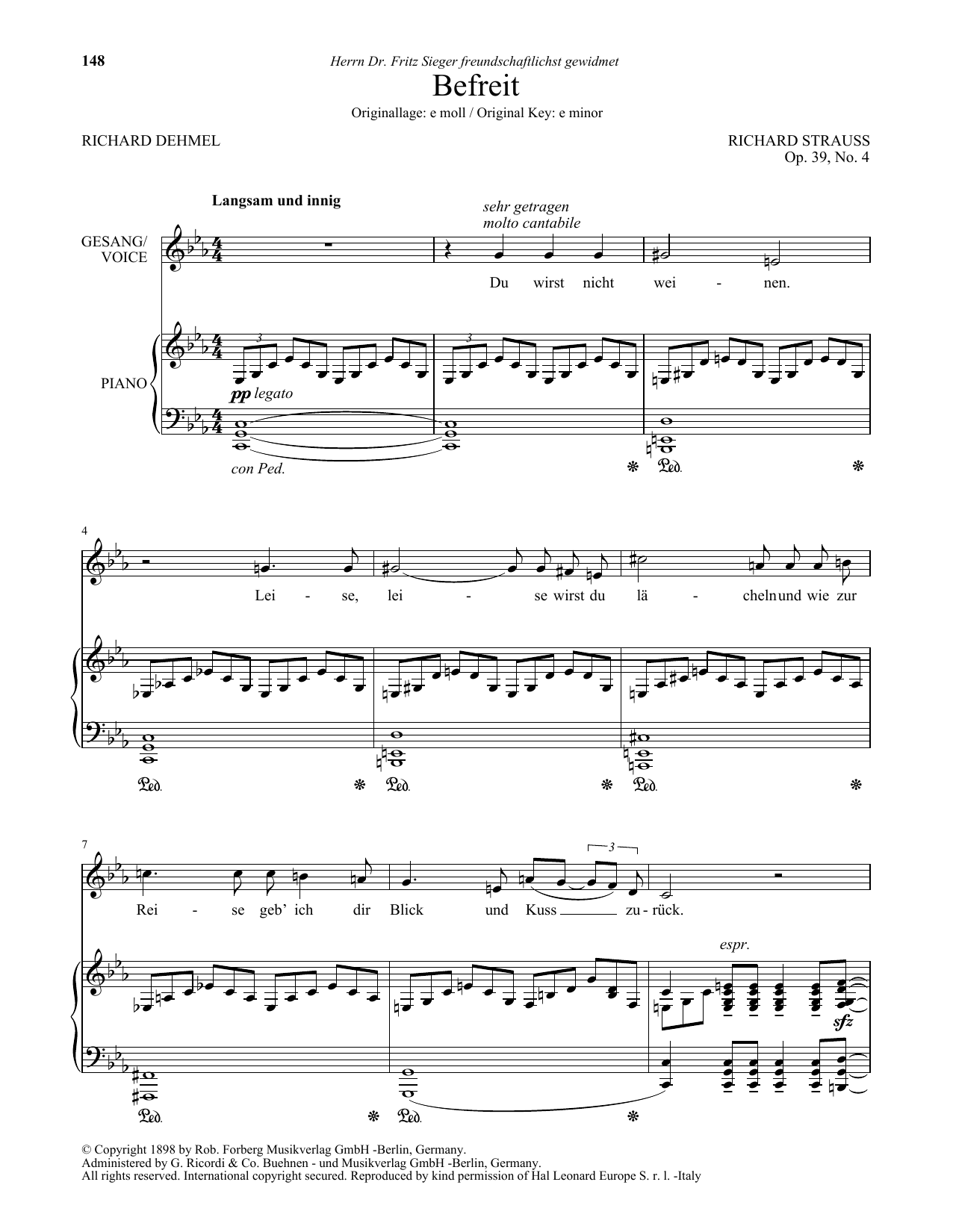
Befreit (Low Voice) Sheet Music Preview

Befreit (Low Voice): Piano Vocal

Item: 35-DS00811275

Digital Download
$5.99
Description

Befreit (Low Voice): Piano Vocal isn't in MakeMusic Cloud just yet...but it could be. Let us know you'd like to see it, and you'll help shape what comes next. In the meantime, start a free trial and dive into thousands of interactive titles your students can play along with today.

Sample Audio
No sample audio found.
Sample Video
Additional Details
Publisher: Hal Leonard
Page Count: 6
SKU: 35-DS00811275

More about this title

About the Creator: Richard Strauss

Richard Strauss composed Befreit in 1901 as part of his song cycle exploring themes of liberation and transcendence. Working during a period of remarkable creative output, Strauss brought his gift for soaring melody and sophisticated harmonic language to the German Lied tradition, expanding its expressive possibilities while honoring its intimate character. His approach to vocal writing combined the dramatic intensity of operatic writing with the nuance and introspection that the form demands.

Why we love this

Strauss's setting captures the ecstatic release of the text with orchestral richness translated beautifully to the piano, making this accessible to singers without requiring full ensemble resources. The emotional arc is unmistakable and immediately engaging for audiences, yet the harmonic language offers enough sophistication to sustain repeated hearings and serious musical exploration.

What to expect

The song radiates warmth and expansiveness, with a sense of emotional release that builds gradually through the text. Strauss's lush harmonic palette creates an almost orchestral intimacy at the keyboard, enveloping the voice in rich color while the melody soars with effortless grace.

Who it's for

Singers with secure middle and upper range extension who can sustain lyrical lines with control and expression. This works equally well for recital singers building their solo repertoire or advanced students exploring the German vocal tradition under mentorship.

How to get the most out of it

  • Shape the melodic line through the text's emotional arc rather than pushing volume; the words will carry naturally when phrased with intention.
  • Coordinate with your accompanist on the piano's structural moments, particularly where it moves into fuller sonorities. These need clarity without overwhelming the voice.
  • Allow space for the voice to breathe between phrases. Strauss often sets longer melodic arcs that invite a generous sense of line.

How to use it

Include this in a recital program exploring German Romanticism or as a centerpiece in a concert pairing classical song with other Strauss orchestral transcriptions. Its emotional immediacy makes it effective as a programming anchor that gives audiences something to hold onto between more experimental or unfamiliar works.

Skills your students will build

  • Sustaining long, connected vocal lines across harmonic changes
  • Balancing technical facility with textual expression in German diction
  • Understanding Romantic era harmonic language and its relationship to text painting
  • Collaborating with an accompanist to shape ensemble sound in the vocal/piano format

You May Also Like