
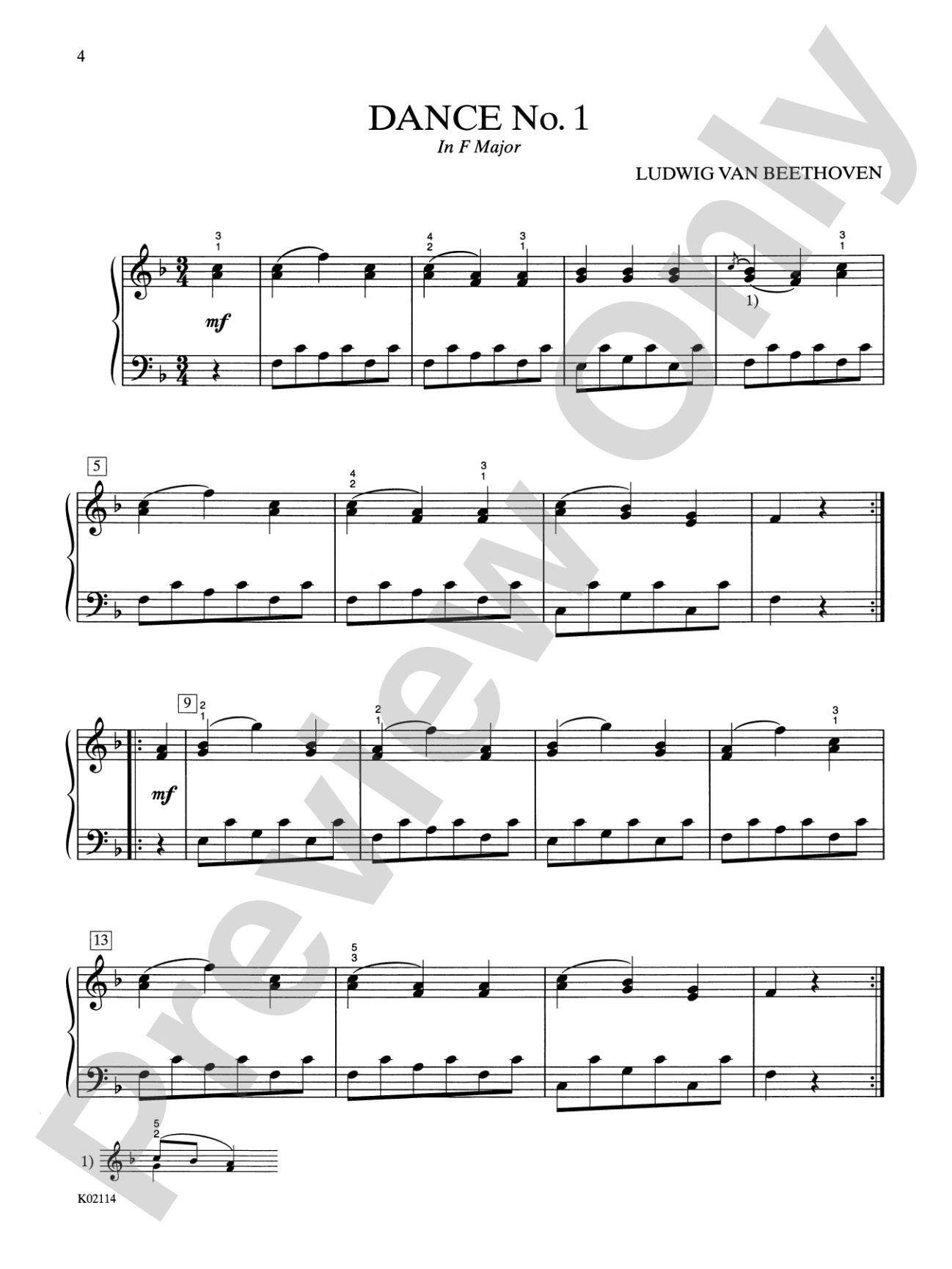

Beethoven: Six German Dances, Allemande and Waltz: Piano Book
And Allemande and Waltz
By Ludwig van Beethoven
Item: 00-PK-0002760

$4.99
Pickup currently not available
Buy Extra Parts (Digital PDF Download)
Parts Added to Cart!
Related Items
Six German Dances: Piano Book |
$4.95
|
View |
Description
A collection of the Beethoven dances for the early grade pianist. These short works will make great recital pieces. A composer biography is included. Titles: Dance No. 1 in F Major * Dance No. 2 in D Major * Dance No. 3 in F Major * Dance No. 4 in A Major * Dance No. 5 in D Major * Dance No. 6 in G Major * Allemande in A Major * Waltz in D Major.


Don't just read it, hear it, play along with it, and watch your students grow with it. In MakeMusic Cloud, Beethoven: Six German Dances, Allemande and Waltz: Piano Book comes alive with professional accompaniment, adjustable tempo, and built-in practice tools that turn solo practice into real progress.
Open in the Player
Jump straight in and assign it today.
Start Your Free Trial
Open this title and explore the full library in minutes.
Sample Audio
No sample audio found.
Sample Video
No sample videos found.
Additional Details
Series:
Kalmus Edition
Publisher:
Alfred Music
Page Count:
16
SKU:
00-PK-0002760
More about this title
About the Composer: Ludwig van Beethoven
Ludwig van Beethoven (1770-1827) stands at the intersection of Classical and Romantic music, a composer whose evolution shaped the future of Western music. His early works, including these dances, reveal the formal clarity and wit of the Classical tradition while hinting at the emotional depth and structural innovation that would define his later symphonies and sonatas. For piano students, Beethoven's output offers an essential pathway into the repertoire: accessible pieces that demand musicality without requiring virtuosic pyrotechnics.
Beethovenís dance movements occupy a special place in his catalog. Written for social occasions and small ensembles, they capture the spirit of Viennese musical life while maintaining the craftsmanship expected of a master composer. These works remind students that great music need not be grand in scale to be significant in quality.
Why we love this
This collection gives early-grade pianists direct access to authentic Beethoven without arrangement or simplification. The eight pieces offer variety in key and character, making it easy to find something suited to each student's interests and technical level. Programming these dances builds a recital that honors Classical craftsmanship while introducing listeners to a composer they'll encounter throughout their musical lives.
What to expect
These dances sparkle with the elegance of Viennese ballrooms and country celebrations. Each piece is lean and purposeful, with melodies that sing naturally and harmonic progressions that feel inevitable. The collection balances charm with substance, offering moments of brightness and warmth without sentimentality.
Who it's for
This book is built for early-grade pianists ready to move beyond simplified folk melodies and into the Classical repertoire. Students with solid note-reading skills and basic hand independence will find pieces here that challenge them without frustration. It also works well for adult learners returning to piano who appreciate learning from authentic historical sources.
How to get the most out of it
- Shape each piece with clear phrase architecture rather than playing it as a series of connected measures. Even in short dances, listen for the arc of each eight or sixteen-bar section.
- Observe tempo markings and stylistic conventions of the Classical era: these dances should dance, not plod. A lively tempo makes the rhythm speak.
- Balance melodic clarity with harmonic support. Beethoven often places the tune in the right hand while the left hand establishes rhythmic and harmonic grounding; neither should overwhelm the other.
- Attend to the character implied by each key. The sunnier dances in D and F major call for brightness, while the A major pieces invite a more songful approach.
How to use it
Pair these dances as a suite in a student recital to create a coherent program segment that showcases variety without demanding lengthy practicum. They also fit naturally into a chronological survey concert tracing piano literature from Bach through the Romantics. A single German Dance or the Waltz works beautifully as a prelude to a longer Classical sonata movement or as a bridge between contrasting program pieces.
Skills your students will build
- Executing Alberti bass patterns with independence and evenness
- Recognizing and performing eight-bar and sixteen-bar phrase structures
- Reading across multiple key signatures (F, D, A, and G major)
- Interpreting ornaments and articulation markings appropriate to Classical style
- Balancing melody and accompaniment with clarity and ensemble feel