
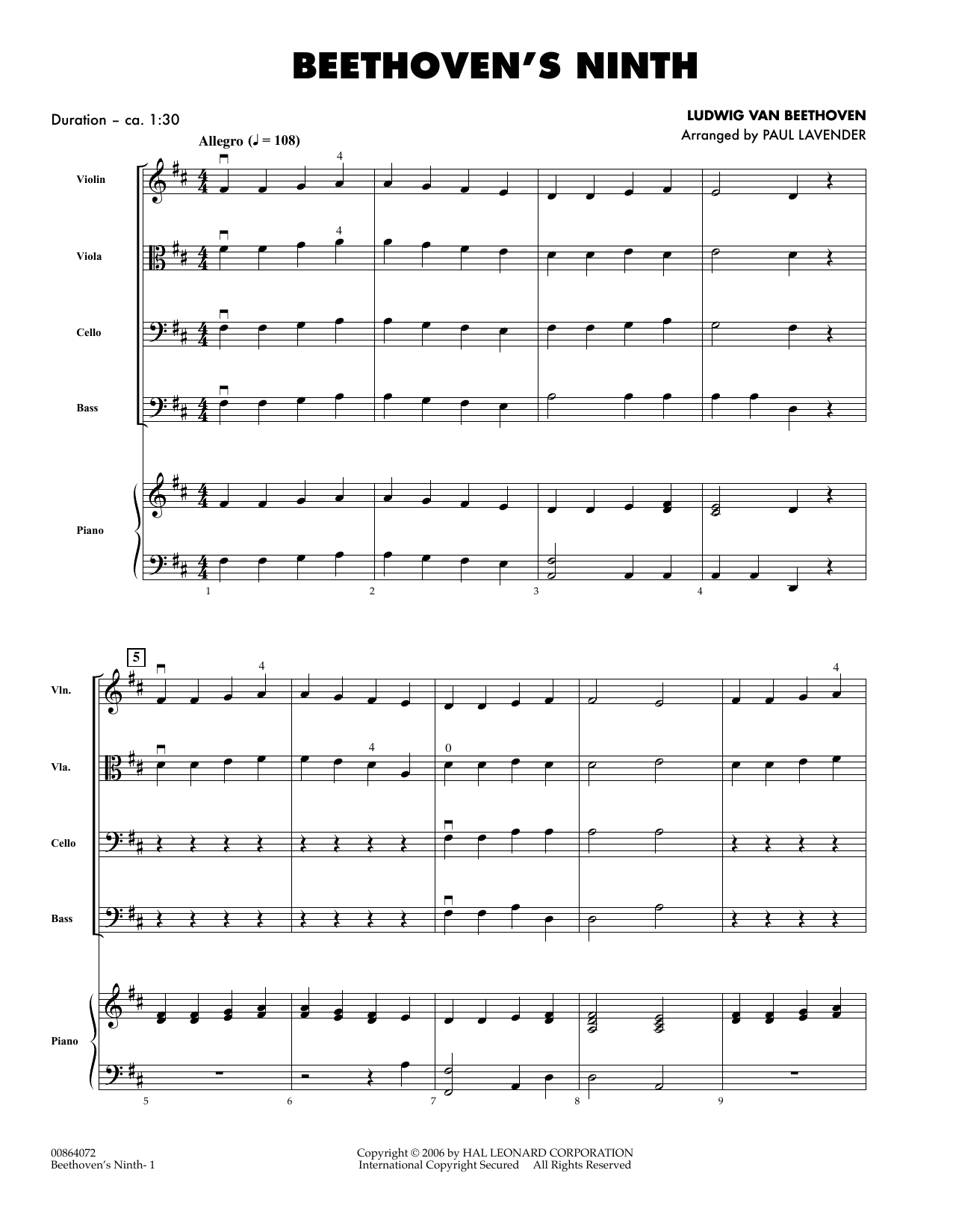

Beethoven's Ninth: String Orchestra Conductor Score & Parts
As performed by Ludwig Van Beethoven / Arranged by Paul Lavender
Grade: 1
Item: 35-PK00319628
$35.00
Pickup currently not available
Buy Extra Parts (Digital PDF Download)
| Product | Price | Quantity |
|---|---|---|
| Beethoven's Ninth - Full Score | $7.50 | |
| Beethoven's Ninth - Violin | $7.00 | |
| Beethoven's Ninth - Viola | $7.00 | |
| Beethoven's Ninth - Cello | $7.00 | |
| Beethoven's Ninth - String Bass | $7.00 | |
| Beethoven's Ninth - Piano | $7.00 |
Parts Added to Cart!
Description
Beethoven's Ninth


Beethoven's Ninth: String Orchestra Conductor Score & Parts isn't in MakeMusic Cloud just yet...but it could be. Let us know you'd like to see it, and you'll help shape what comes next. In the meantime, start a free trial and dive into thousands of interactive titles your students can play along with today.
Request This Title
Tell us you want it.
Start Your Free Trial
Explore everything that's ready to play right now.
Sample Audio
No sample audio found.
Sample Video
No sample videos found.
Additional Details
Publisher:
Hal Leonard
SKU:
35-PK00319628
More about this title
About the Artist: Ludwig Van Beethoven
Ludwig van Beethoven (1770-1827) stands as the bridge between Classical and Romantic music, a composer whose symphonies fundamentally changed what orchestral music could express. His Ninth Symphony, completed near the end of his life and while profoundly deaf, remains his most performed work and one of the most significant compositions in Western music history.
For music educators, Beethoven's legacy centers on his gift for architectural clarity combined with emotional depth. His works teach students how melody, harmony, and rhythm can build from simple materials into overwhelming power, making his scores invaluable teaching tools across all ability levels.
Why we love this
Paul Lavender's string orchestra arrangement opens Beethoven's most ambitious symphony to younger players without sacrificing the work's essential character or structural logic. At Grade 1, this lets beginning ensembles access one of music's most profound statements rather than relegating them to lighter fare.
What to expect
The Ninth emerges as a conversation between optimism and struggle, between darkness and light. Even in this accessible arrangement, you'll feel Beethoven's architectural ambition: themes that begin simply gain momentum and depth as the movement unfolds, creating a sense of inevitability and triumph that young players find both challenging and deeply rewarding.
Who it's for
String orchestras at early levels who are ready to experience substantial repertoire with genuine artistic weight. This arrangement works equally well for school ensembles, community orchestras, and chamber groups seeking meaningful literature beyond their typical grade level offerings.
How to get the most out of it
- Establish the tempo in the opening movement with absolute consistency; Beethoven's architecture depends on proportional relationships between sections, and even small rubato can destabilize the form.
- Shape phrases by thinking in longer arcs rather than measure-by-measure. Young players often hear individual lines, but Beethoven's genius emerges when each voice contributes to a unified sweep.
- Balance the Ode to Joy theme so it sings without overwhelming the harmonic support beneath it. This melody's power comes from clarity, not volume.
How to use it
Consider pairing this with earlier Beethoven works to create a composer study, or use it as a capstone piece that demonstrates how far an ensemble has progressed. The Ninth also works powerfully as a season closer, offering a work of such stature that it becomes a defining concert experience for your students.
Skills your students will build
- Reading sonata form structure and understanding how themes develop and return
- Maintaining ensemble pulse across longer movements with minimal direction
- Balancing multiple independent lines while maintaining textural clarity
- Responding to subtle dynamic and tempo variations that shape Beethoven's phrasing
- Building expressive control without sacrificing rhythmic precision