
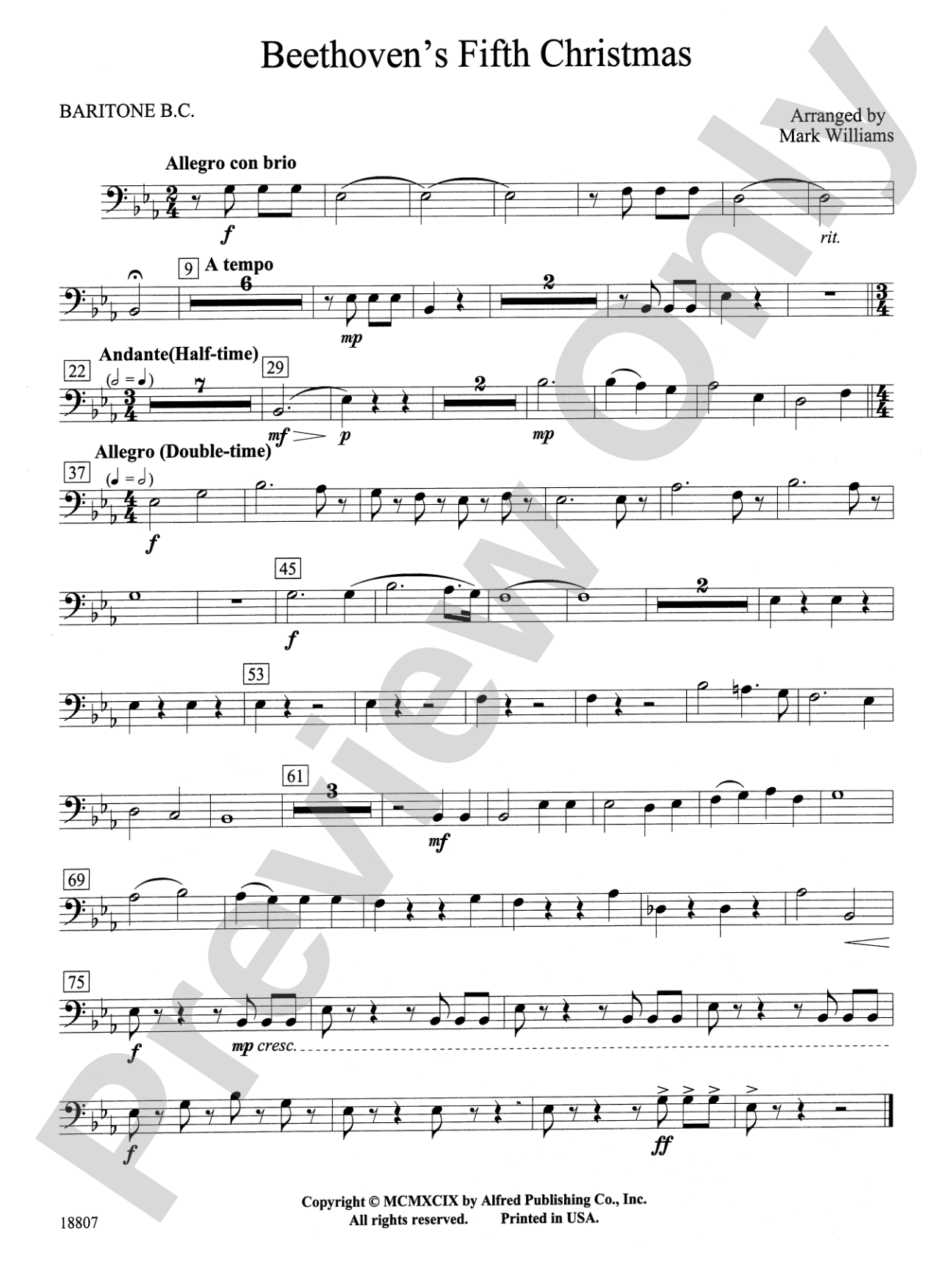

Beethoven's Fifth Christmas: Baritone B.C.
Arr. Mark Williams
Grade: 2 (Medium Easy)
Item: 00-PC-0000285_BBC1
$3.00
Pickup currently not available
Description
You've never heard Beethoven's fifth symphony like this! Themes from three movements of this famous symphony are combined with familiar carols in the fun style you've come to expect from Mark Williams. Make Beethoven's Fifth Christmas a wacky addition to your next holiday program.


Don't just read it, hear it, play along with it, and watch your students grow with it. In MakeMusic Cloud, Beethoven's Fifth Christmas: Baritone B.C. comes alive with professional accompaniment, adjustable tempo, and built-in practice tools that turn solo practice into real progress.
Open in the Player
Jump straight in and assign it today.
Start Your Free Trial
Open this title and explore the full library in minutes.
Sample Audio
1
Audio File
--:--
0:00
0:00
Sample Video
Additional Details
Series:
Young Symphonic
Publisher:
Alfred Music
Page Count:
212
SKU:
00-PC-0000285_BBC1
More about this title
About the Arranger: Mark Williams

Mark Williams built his reputation as a prolific composer and arranger for school ensembles, with over 200 published works spanning band, orchestra, and choir. A native of Chicago who spent formative years in Spokane, Washington, he earned degrees in music education from Eastern Washington University and maintained a career teaching elementary band while developing a distinctive voice for young musicians. His work with the 560th Air Force Band as woodwind performer and arranger informed his deep understanding of ensemble writing.
As a clinician and guest conductor, Williams traveled extensively across 34 states, five Canadian provinces, and Australia, building direct relationships with teachers and students. He earned recognition through the Western International Band Clinic's Gralia Competition and multiple ASCAP Special Awards. Beyond his composing and arranging, Williams performed bassoon regularly and served as conductor and artistic director for the Spokane British Brass Band, demonstrating a commitment to musical performance at every level.
Why we love this
Williams takes one of classical music's most recognizable symphonies and remixes it with holiday favorites in a way that feels fresh, not forced. The Grade 2 scoring keeps all sections engaged without overwhelming younger or developing players, while the novelty element carries genuine comedic timing that audiences eat up. It's the kind of piece that builds enthusiasm for your winter concert without sacrificing musicianship.
What to expect
Cheeky and clever, with the famous four-note motif of the Fifth popping up in unexpected places alongside beloved carols. There's a wink-and-nudge quality throughout, designed to make musicians smile while they play and audiences chuckle in recognition. It's lighthearted without being silly, accomplished without being pretentious.
Who it's for
Intermediate concert bands looking to energize a winter program with something audiences will remember. Directors teaching Grade 2 ensembles who want a piece that doesn't feel simplified or condescending while still being accessible to developing players. It works especially well for programs that balance serious repertoire with music that celebrates joy and play.
How to get the most out of it
- Balance the familiar melody against the Beethoven motif so neither drowns out the other; the contrast is where the humor lives
- Lean into style shifts deliberately; treat each carol-and-symphony mashup section as its own mini-arrangement with distinct character
- Let the percussion section lock in early, since the rhythmic drive of the original symphony underpins the comedic timing
- Program this after a more serious piece to give your audience permission to laugh; the setup matters as much as the piece itself
How to use it
Use this as your holiday program's closer or as a palate-cleanser between heavier works to reset the room's energy. It pairs well with at least one genuine classical or serious contemporary piece, so the novelty registers as contrast rather than the whole concert's tone. Consider programming it in the second half after intermission, when audiences are warmed up and receptive to fun.
Skills your students will build
- Stylistic flexibility and switching between classical and holiday idioms
- Rhythmic precision in comedic contexts where timing affects effectiveness
- Articulation clarity in passages where thematic material overlaps
- Listening for counterpoint and layered melodies