Beethoven's 5th Symphony, Finale: 1st B-flat Trumpet Sheet Music Preview

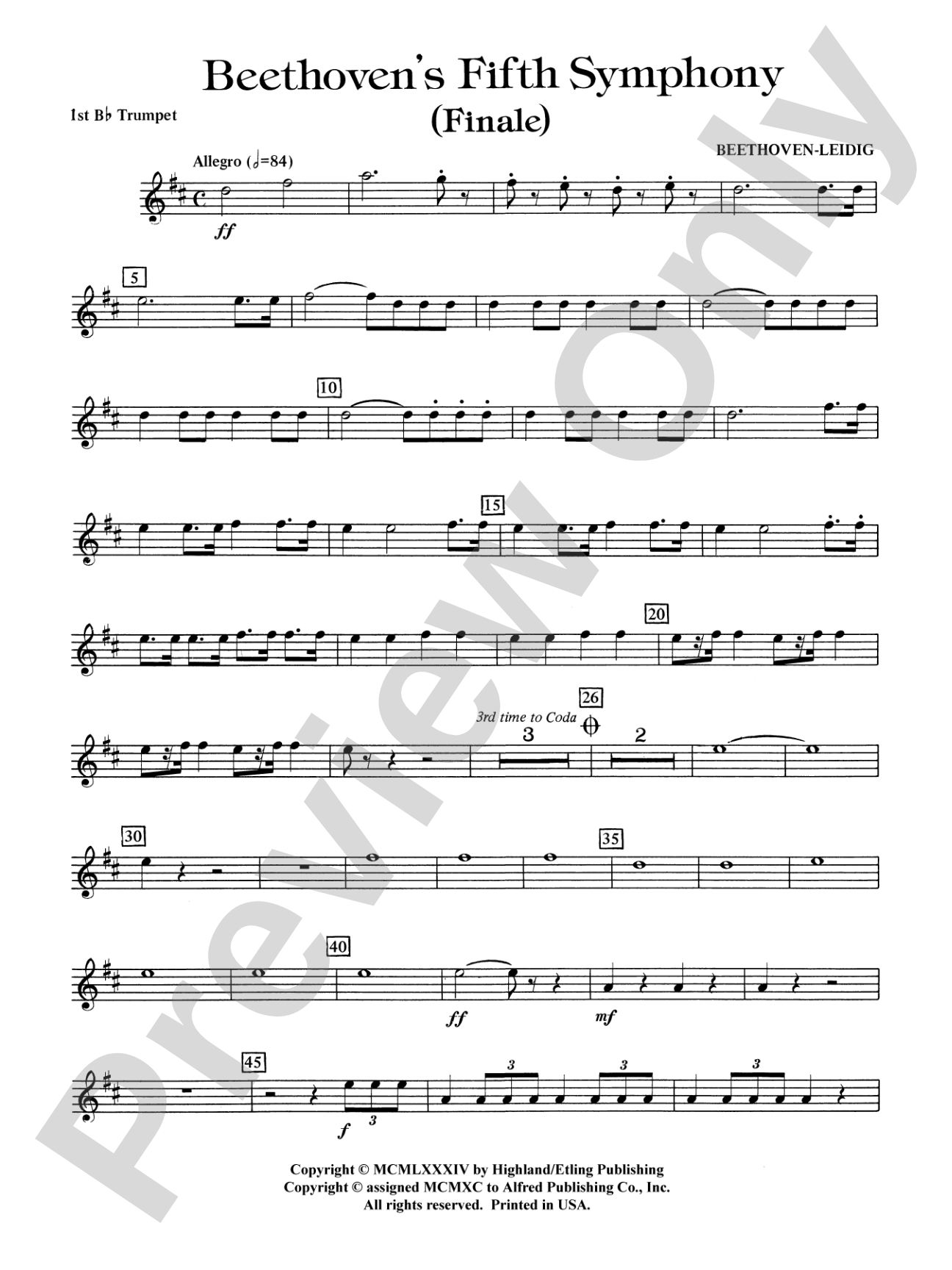
Beethoven's 5th Symphony, Finale: 1st B-flat Trumpet

(Finale)

By Ludwig van Beethoven / arr. Vernon Leidig

Grade: 3

Item: 00-PC-0000033_T1

Digital Download
$3.00
Description

Don't just read it, hear it, play along with it, and watch your students grow with it. In MakeMusic Cloud, Beethoven's 5th Symphony, Finale: 1st B-flat Trumpet comes alive with professional accompaniment, adjustable tempo, and built-in practice tools that turn solo practice into real progress.

Sample Audio
No sample audio found.
Sample Video
Additional Details
Series: Highland/Etling Full Orchestra
Publisher: Alfred Music
Page Count: 220
SKU: 00-PC-0000033_T1

More about this title

About the Arranger: Vernon Leidig

Vernon Leidig served as a conductor, composer, and arranger with deep roots in music education. His arrangements for school orchestras balanced the integrity of masterworks with the technical and musical accessibility that young orchestral musicians need to grow.

Why we love this

This arrangement opens Beethoven's most iconic symphony to orchestras that might not yet have the technical resources for the original score. Leidig preserves the visceral power of the finale's famous four-note motif and the driving rhythm that makes this movement unforgettable, while scaling instrumentation and passages to Grade 3 reading levels. You get a real masterwork, not a watered-down version.

What to expect

Unstoppable forward drive. The famous four-note motif pounds relentlessly while the orchestra swirls around it with energy and urgency. Even in an arrangement, Beethoven's obsessive, almost violent insistence on this simple idea creates tension that younger players can feel and respond to.

Who it's for

Grade 3 full orchestras ready to tackle serious repertoire. This works for ensembles with developing technique in all sections but solid rhythmic discipline. You'll need parts for your full instrumentation, so verify that this download includes all the sections your orchestra uses.

How to get the most out of it

  • Establish the opening four-note gesture as a rhythmic anchor for your ensemble. This motif returns obsessively throughout the movement; lock it in early and keep it consistent across all repetitions so the architecture of the form remains clear.
  • Balance the tuttis carefully. Even at Grade 3, young orchestras tend to play heavy when everyone has notes. Conductor control of dynamics and articulation will keep the texture transparent and let the famous motif cut through.
  • Shape the climactic moments with gradual crescendi rather than sudden volume jumps. The movement's forward momentum depends on tension building over multiple measures, not on spotty accents.

How to use it

Program this as a festival or contest piece where you want your orchestra to make a genuine musical statement. The finale's fame and power appeal to audiences and adjudicators alike, and Grade 3 accessibility means you can spend rehearsal time on musicianship rather than just note-learning. It also pairs well in a concert that explores how composers return to and develop a single musical idea.

Skills your students will build

  • Rhythmic precision in repeated motifs and ostinato figures
  • Ensemble balance and texture control at dynamic extremes
  • Conducting and responding to clear harmonic architecture in sonata form
  • Sustaining focus through repetitive material without losing energy or precision

You May Also Like