
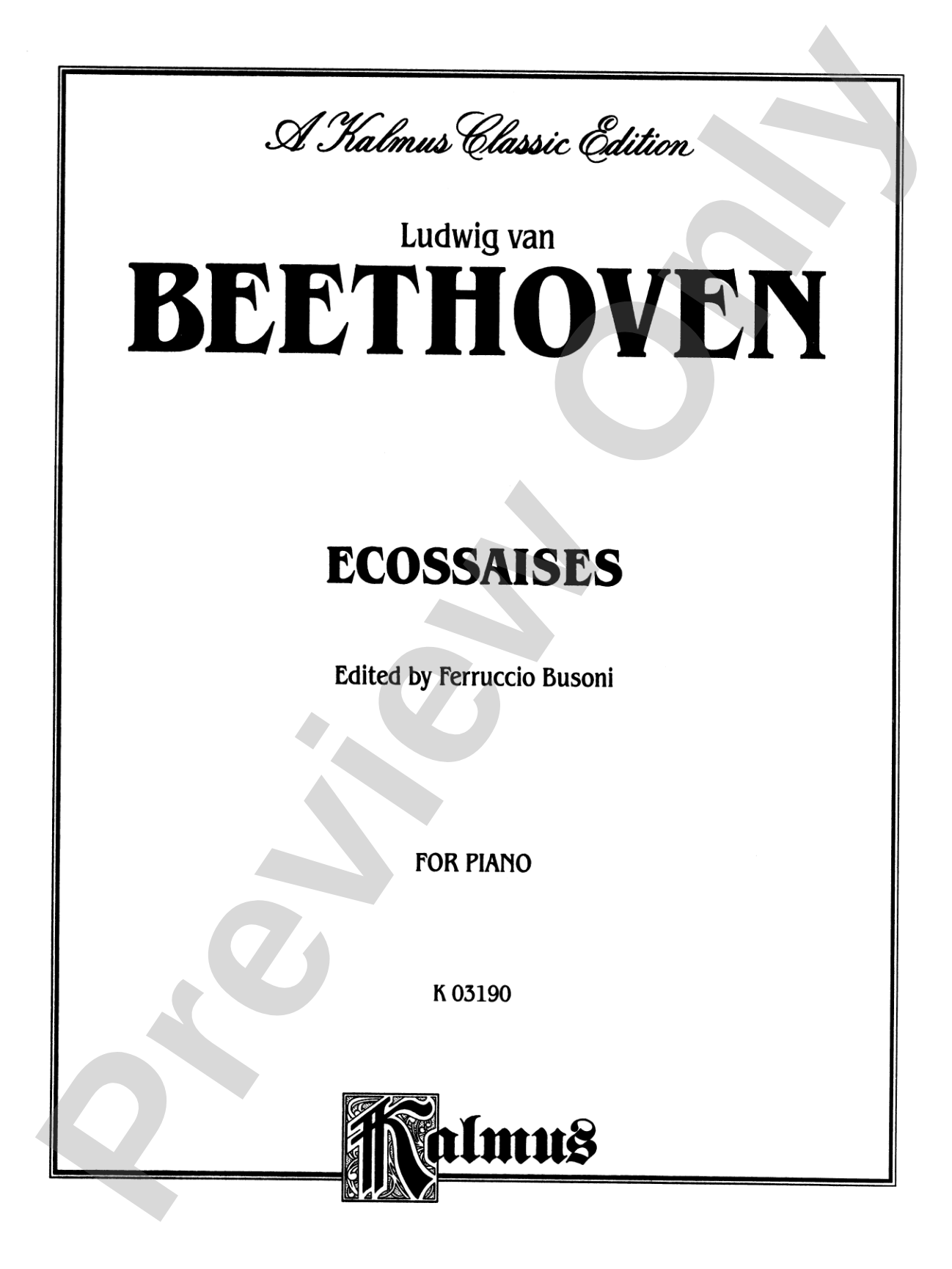

Beethoven: Ecossaises (Ed. Feruccio Busoni)
By Ludwig van Beethoven / ed. Ferruccio Busoni
Level: Intermediate / Advanced
Item: 00-PC-0005272
$5.99
Pickup currently not available
Description
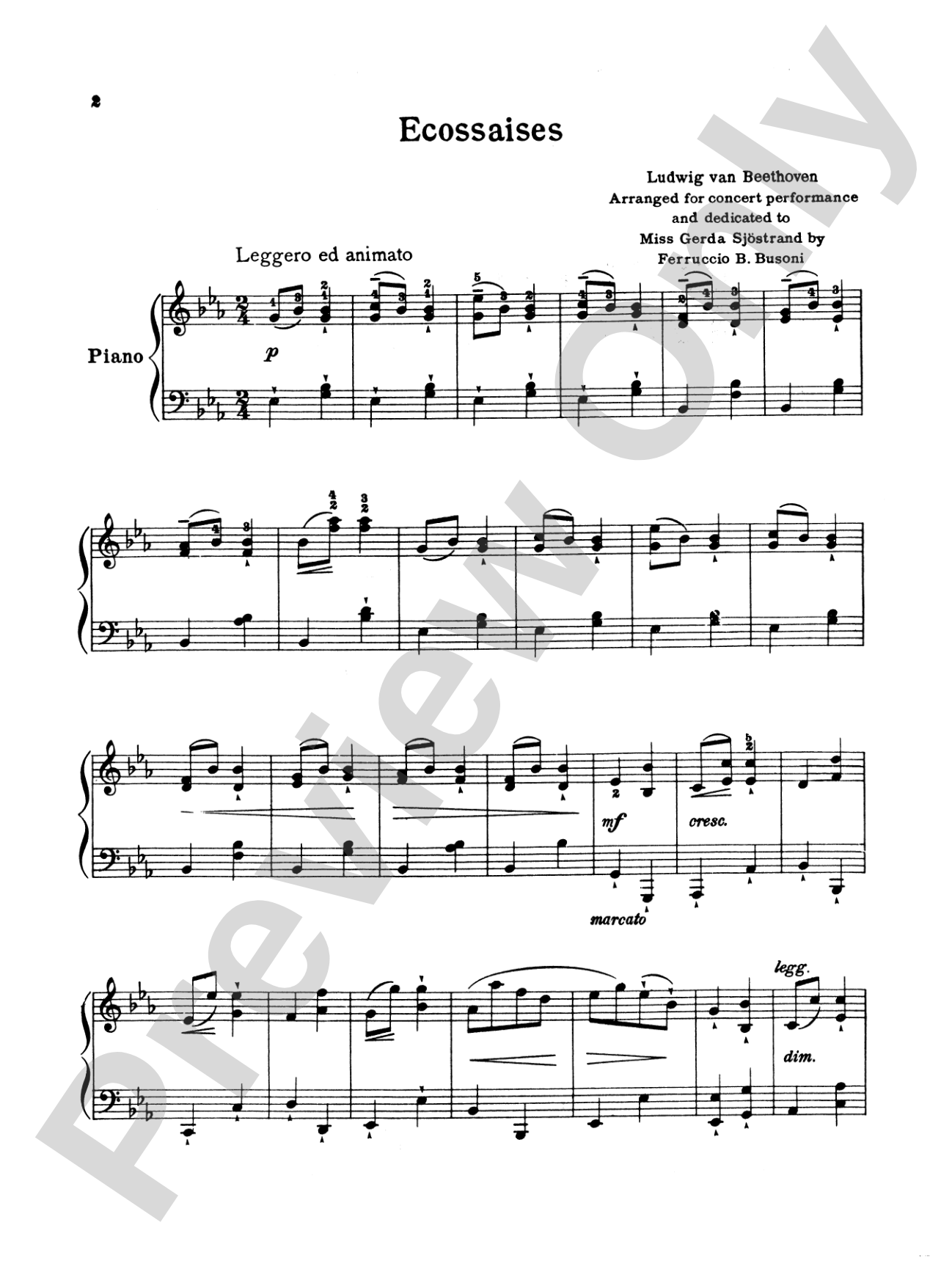
The six Ecossaises by Ludwig van Beethoven are arranged here by Ferruccio Busoni. This musical form features a variety of rhythms and significant dynamic contrasts.


Don't just read it, hear it, play along with it, and watch your students grow with it. In MakeMusic Cloud, Beethoven: Ecossaises (Ed. Feruccio Busoni) comes alive with professional accompaniment, adjustable tempo, and built-in practice tools that turn solo practice into real progress.
Open in the Player
Jump straight in and assign it today.
Start Your Free Trial
Open this title and explore the full library in minutes.
Sample Audio
No sample audio found.
Sample Video
No sample videos found.
Additional Details
Series:
Kalmus Edition
Publisher:
Alfred Music
Page Count:
8
SKU:
00-PC-0005272
More about this title
About the Composer: Ludwig van Beethoven
Ludwig van Beethoven (1770-1827) stands as one of history's most transformative composers, a figure who bridged the Classical and Romantic eras while fundamentally reshaping what music could express. Born in Bonn and trained in the Classical tradition, Beethoven moved to Vienna as a young man and quickly established himself as a virtuoso pianist and innovative composer. His relentless exploration of form, harmony, and orchestration influenced every major composer who followed, from Brahms to the twentieth century modernists.
Beyond his symphonies and concertos, Beethoven's piano works reveal a composer constantly experimenting with smaller forms and idioms. His sets of dances, character pieces, and variations demonstrate his ability to find profound musical substance in compact structures. These works remained central to the pianist's repertoire throughout the nineteenth century and continue to challenge and reward players seeking to understand Beethoven's compositional language across all scales.
Why we love this
Busoni's edition brings clarity and interpretive guidance to these six dance pieces without obscuring Beethoven's essential voice. The Ecossaises offer intermediate-advanced pianists a chance to engage with Beethoven's rhythmic vitality and dramatic gestures in a more manageable context than his sonatas, making them ideal for building stylistic understanding of the period.
What to expect
These dances pulse with aristocratic elegance and rhythmic bite. Sharp, incisive melodies sit atop graceful accompaniment figures, and Beethoven's sudden dynamic leaps create moments of genuine surprise. There's a playfulness here that belies the composer's harmonic sophistication, a sense of music that entertains while it subtly rewires your ear.
Who it's for
Intermediate-advanced pianists developing fluency in Classical and early Romantic idioms. Students working toward recital programming that showcases style and technical control without demanding the sustained intensity of a full sonata. Teachers seeking accessible Beethoven that builds interpretive maturity.
How to get the most out of it
- Honor the rhythmic precision that defines the ecossaise form; these dances demand crisp articulation and steady pulse even as you shape dynamic gestures within phrases.
- Exploit the dynamic contrasts explicitly. Beethoven's forte and piano markings are structural tools, not just volume changes; let them define form and energy flow.
- Balance textural variety across the set. Each ecossaise has distinct character; resist the temptation to play them as interchangeable. Listen for harmonic color and melodic contour that distinguish one from another.
- Approach Busoni's editorial markings as suggestions for musical decision-making rather than absolute directives. Consider how his phrasing and pedal indications inform your own interpretation while maintaining contact with Beethoven's score.
How to use it
Anchor a recital program with one or two Ecossaises as stylistic bookends to Romantic or contemporary pieces, or group all six as a self-contained suite that demonstrates Beethoven's range within a single dance form. They work equally well as teaching repertoire within a unit on Classical instrumental dance music.
Skills your students will build
- Rhythmic precision and clarity in articulation characteristic of early nineteenth-century dance styles
- Interpretation and realization of editorial markings from historically informed editions
- Dynamic contrast and phrasing that serves formal structure rather than mere expression
- Understanding of how Beethoven sustains interest within compact, repetitive harmonic structures
- Facility with moderate textural density and hand independence suitable for intermediate-advanced players