
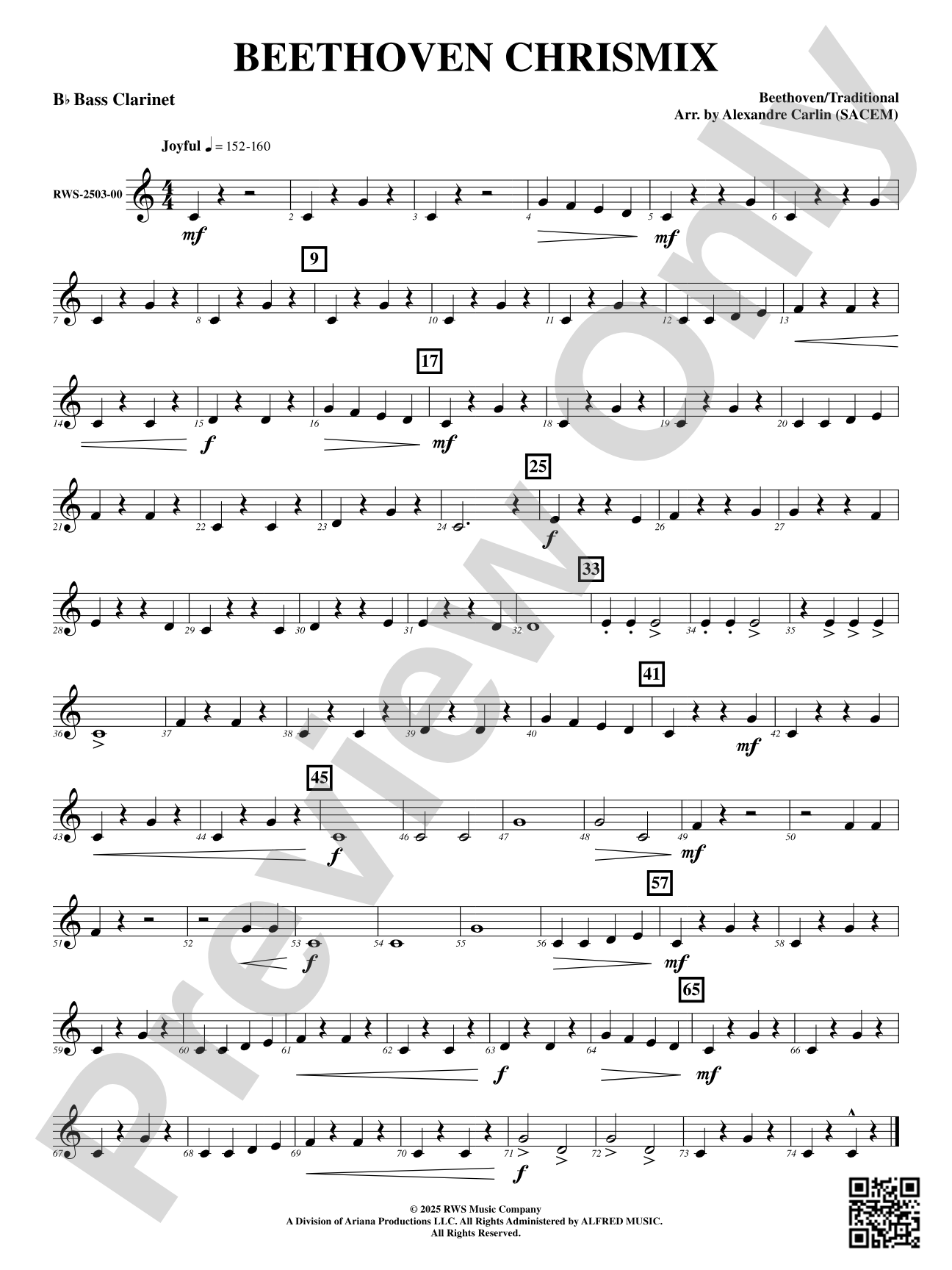

Beethoven Chrismix: B-flat Bass Clarinet
By Ludwig van Beethoven, Traditional / arr. Alexandre Carlin
Grade: 1
Item: 98-PC-RWS2503_BC
$3.99
Pickup currently not available
Description
Introducing Alexandre Carlin's Beethoven Chrismix---the perfect holiday piece for your beginning band! This imaginative arrangement blends iconic themes from Beethoven's 5th and 9th Symphonies with a festive twist, creating a memorable and engaging choice for your student's first holiday program. Young musicians will delight in playing recognizable melodies while developing essential ensemble skills. Mixing the powerful, triumphant opening of the 5th Symphony to the joyful strains of the "Ode to Joy," with holiday classics "Jingle Bells" and "Gloria," this piece is both educational and entertaining. Bring the genius of Beethoven and the magic of the holiday season together for an unforgettable concert experience! (2:05)


Beethoven Chrismix: B-flat Bass Clarinet isn't in MakeMusic Cloud just yet...but it could be. Let us know you'd like to see it, and you'll help shape what comes next. In the meantime, start a free trial and dive into thousands of interactive titles your students can play along with today.
Request This Title
Tell us you want it.
Start Your Free Trial
Explore everything that's ready to play right now.
Sample Audio
1
Audio File
--:--
0:00
0:00
Sample Video
Additional Details
Series:
RWS - Beginning Band
Publisher:
RWS Music Company
SKU:
98-PC-RWS2503_BC
More about this title
About the Composer: Ludwig van Beethoven
Ludwig van Beethoven (1770-1827) revolutionized Western music by expanding the symphony from a courtly entertainment into a vehicle for profound emotional and philosophical expression. His nine symphonies remain cornerstones of the concert repertoire, and his melodies have transcended classical music to become part of popular culture and educational curricula worldwide.
For music educators, Beethoven's work offers an unparalleled teaching resource. His themes are instantly recognizable, his harmonic language is direct and powerful, and his orchestration demonstrates how simple ideas can be developed into something monumental. Beginning musicians benefit enormously from playing his music because the thematic clarity cuts through any roughness in their execution.
Why we love this
This arrangement captures what makes Beethoven accessible to young ensembles: unmistakable melodies that students recognize immediately, paired with the novelty of holiday context. Carlin's orchestration respects the Grade 1 level without sacrificing the architectural integrity of these themes, meaning your band plays actual Beethoven, not a simplified approximation. The blend of symphonic material with familiar carols creates a programming moment that works equally well for holiday concerts aimed at general audiences and for student morale.
What to expect
Triumphant and celebratory from the opening gesture, then warm and lyrical as the "Ode to Joy" unfolds. The piece balances the architectural grandeur of Beethoven with the straightforward joy of the season, creating moments of both spirited energy and gentle accessibility. Holiday familiarity mingles with symphonic legitimacy, making the piece feel both comforting and special.
Who it's for
Beginning band directors seeking engaging, age-appropriate holiday repertoire that doesn't talk down to their students. Young musicians who are building foundational ensemble skills and benefit from playing recognizable, motivating material. Programs that want to offer audiences a concert experience combining classical substance with festive appeal.
How to get the most out of it
- Balance the sustained melody lines between sections rather than letting single instruments dominate; Beethoven's themes sing most effectively when the band plays as one voice.
- Anchor the famous opening of the 5th Symphony with a clear, unified articulation from the entire ensemble on that iconic four-note motive.
- Allow the "Ode to Joy" section to breathe with warmth; resist the urge to rush even though the melody is so familiar.
- Use the recorded accompaniment to lock in rhythmic precision, especially during transitions between the symphonic themes and the holiday material.
How to use it
Position this as an opener or closer for a holiday concert, where it can anchor a program mixing seasonal favorites with classical literature. It works especially well in early December performances when audiences expect both novelty and substance. Include it in a set that explores how great composers have influenced music across genres and centuries.
Skills your students will build
- Ensemble balance and blending across sections
- Articulation consistency within thematic material
- Reading concert band instrumentation and ranges
- Playing recognizable melodies with musical intention rather than mechanical accuracy
- Transitions between contrasting musical ideas