
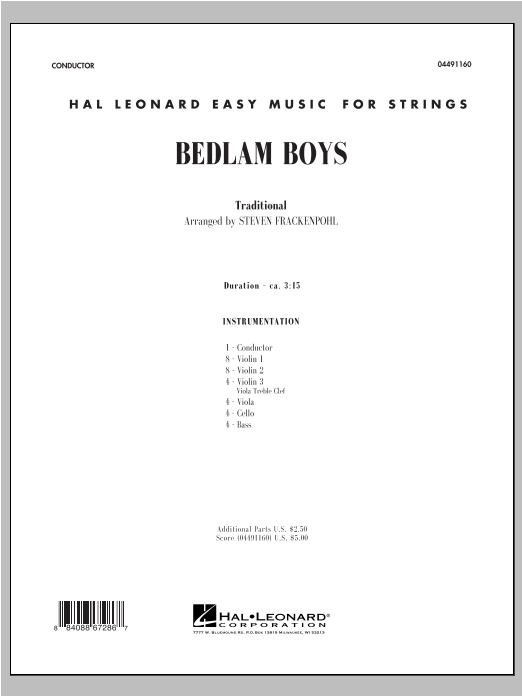

Bedlam Boys: String Orchestra Conductor Score & Parts
Arranged by Steven Frackenpohl
Grade: 2
Item: 35-PK00250383
$40.00
Pickup currently not available
Buy Extra Parts (Digital PDF Download)
| Product | Price | Quantity |
|---|---|---|
| Bedlam Boys - Full Score | $6.00 | |
| Bedlam Boys - Violin 1 | $7.00 | |
| Bedlam Boys - Violin 2 | $7.00 | |
| Bedlam Boys - Violin 3 (Viola Treble Clef) | $7.00 | |
| Bedlam Boys - Viola | $7.00 | |
| Bedlam Boys - Cello | $7.00 | |
| Bedlam Boys - Bass | $7.00 |
Parts Added to Cart!
Description
Here's an old British fiddling tune that makes a great ensemble piece for younger players. Simple meter changes, diatonic lines, and repeated 16th-note figures make this lively folk dance number a good choice for teaching and performance. Dur: 3:15


Bedlam Boys: String Orchestra Conductor Score & Parts isn't in MakeMusic Cloud just yet...but it could be. Let us know you'd like to see it, and you'll help shape what comes next. In the meantime, start a free trial and dive into thousands of interactive titles your students can play along with today.
Request This Title
Tell us you want it.
Start Your Free Trial
Explore everything that's ready to play right now.
Sample Audio
No sample audio found.
Sample Video
No sample videos found.
Additional Details
Publisher:
Hal Leonard
SKU:
35-PK00250383
More about this title
About the Arranger: Steven Frackenpohl
Steven Frackenpohl is a prolific arranger and composer whose work spans orchestral, band, and chamber settings. His arrangements for young ensembles demonstrate a keen ear for what works in the rehearsal room: he builds technical skills progressively while keeping the music engaging and musically honest.
Frackenpohl's arrangements are staples in school music programs precisely because he understands the pedagogical moment. He writes idiomatically for young players without condescending to them, and he has an instinct for selecting folk material that translates beautifully to ensemble settings.
Why we love this
Frackenpohl captures the infectious spirit of British dance music while building genuine musicianship. The meter changes aren't arbitrary ornament; they sit naturally in the phrasing and teach students to read and feel rhythmic variety as an integral part of the tune's character rather than as an obstacle.
What to expect
Bedlam Boys dances. It has the scrappy, barefoot energy of a village tune played at full tilt, all forward motion and no apology. Even at a young ensemble's tempo, the piece radiates joy and mischief. The repeated figures create momentum that carries less experienced players along, while the folk melody itself is instantly memorable and satisfying to execute cleanly.
Who it's for
Grade 2 string orchestras ready to explore material beyond strictly diatonic exercises. Students need comfort with basic shifting and rhythmic reading, but the piece rewards any ensemble that's learning to play as a cohesive unit.
How to get the most out of it
- Anchor the repeated 16th-note figures rhythmically by bringing out the downbeat of each pattern. Young string players often rush repetitive figures; marking beat one in rehearsal keeps the energy driving forward without losing precision.
- Balance the parts so that the melody sings through the accompaniment. The folk tune needs air around it, not a thick background; this teaches students to listen beyond their own line.
- Approach the meter changes with historical context. Mention that fiddlers historically shifted meters as they felt the music, which helps your ensemble hear these moves as natural phrase architecture rather than notation tricks.
How to use it
Schedule this as a concert opener or closer on a string orchestra concert; its brevity and infectious character work perfectly as a framing piece. It also pairs naturally with other British traditional material or with light orchestral works, giving you flexibility in building thematic programs.
Skills your students will build
- Reading and executing simple meter changes (commonly 2/4 and 3/4 transitions)
- Maintaining rhythmic precision through repeated 16th-note figures across multiple measures
- Playing diatonic melodies with idiomatic phrasing appropriate to folk material
- Balancing ensemble parts so that the primary melody projects clearly
- Responding to conductor cues at tempo changes or meter shifts