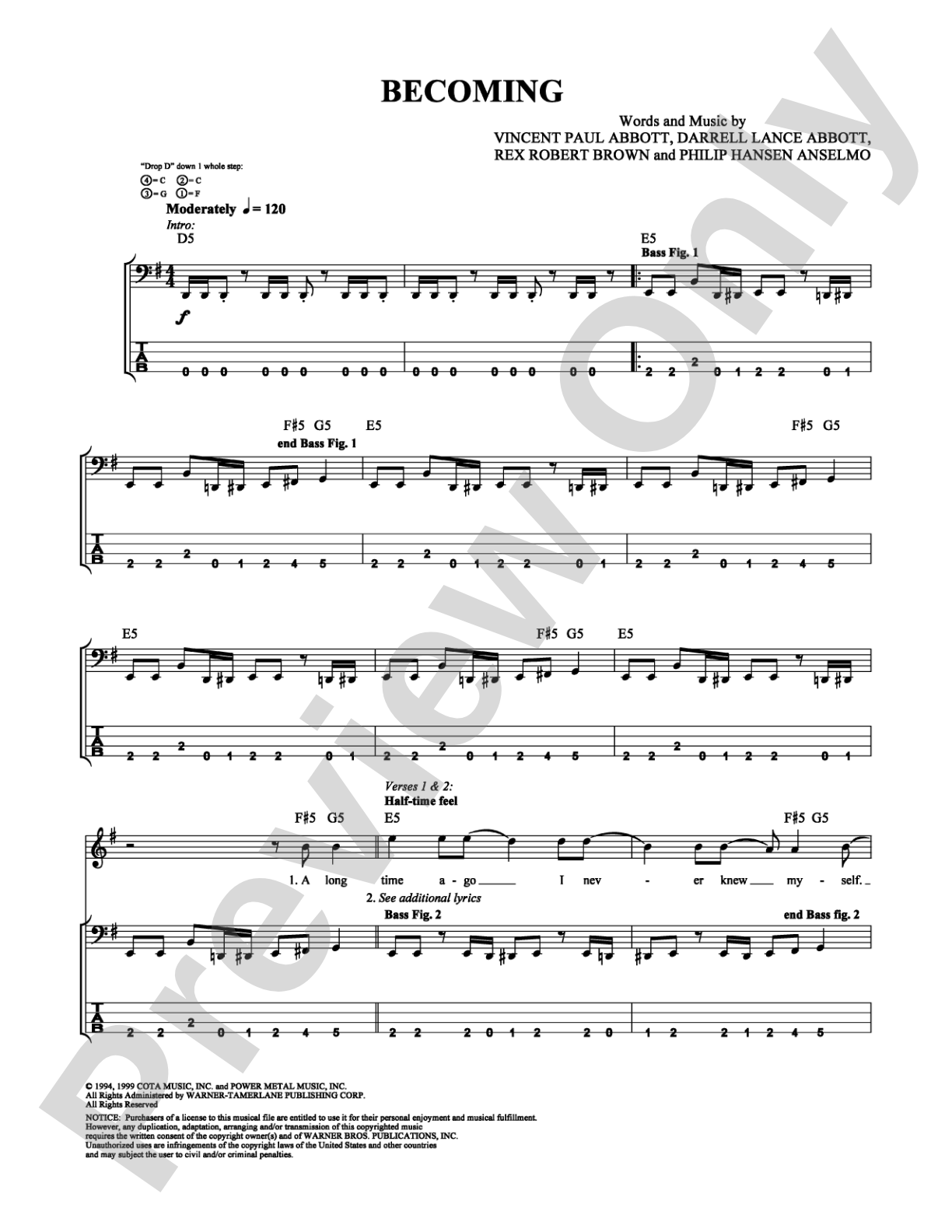
Becoming: Bass TAB Digital Sheet Music

Becoming: Bass TAB Digital Sheet Music

Pantera, Rex Brown, Darrell Lance Abbott, Philip Hansen Anselmo, Vincent Paul Abbott

Item: 00-PS-0003110

Digital Download
$2.99
Description

Becoming: Bass TAB Digital Sheet Music isn't in MakeMusic Cloud just yet...but it could be. Let us know you'd like to see it, and you'll help shape what comes next. In the meantime, start a free trial and dive into thousands of interactive titles your students can play along with today.

Sample Audio
No sample audio found.
Sample Video
Additional Details
SKU: 00-PS-0003110

More about this title

About the Artist: Pantera

Pantera emerged from Arlington, Texas, in the late 1980s to become one of heavy metal's most influential and commercially successful bands. Fronted by vocalist Phil Anselmo and anchored by the guitar work of Dimebag Darrell, the band's 1990 album Cowboys from Hell established them as innovators who bridged thrash metal with groove-oriented riffing, creating a template that countless metal bands have followed. Their bassist Rex Brown was instrumental in crafting the low-end foundation that made Pantera's sound distinctive, laying down lines that were simultaneously heavy, melodic, and technically demanding.

Pantera's influence on metal pedagogy is substantial. Their catalog remains essential listening for bass students interested in heavy music, offering case studies in how to serve a riff-based ensemble while maintaining rhythmic clarity and harmonic sophistication. The band's work demonstrates how technical proficiency and songwriting craft elevate metal from mere distortion into genuinely complex musical expression.

Why we love this

This track gives bass students authentic material rooted in one of metal's most important bands, with tab transcription that captures the actual recorded line rather than approximation. The combination of technical challenge and groove-oriented musicality makes it engaging for players who want to develop both precision and feel within a heavy music context.

What to expect

Driving and visceral, with a low-end presence that anchors the song's momentum. The bass line sits in the pocket between serving the riff and pushing the overall groove forward, creating that characteristic metal feel where weight and propulsion are inseparable.

Who it's for

Bass players drawn to heavy music who want to learn from professional transcriptions and are ready for intermediate to advanced technical material. This works well for students exploring how bass functions in riff-driven ensembles and for those building confidence with the faster note values and extended range that metal repertoire demands.

How to get the most out of it

  • Build the line in sections: isolate the opening riff until your timing locks with a metronome set to the recorded tempo, then connect each phrase systematically rather than attempting the full line immediately
  • Study how the bass interacts with the kick drum in the recording; matching that pocket alignment is more important than achieving perfect technical speed
  • Address any stretches or position shifts on your fretboard by mapping them out visually before playing; metal lines often require efficient hand positioning to sustain longer passages without fatigue
  • Layer in dynamics gradually: begin with even dynamics across all notes, then listen to the recording for subtle emphasis points that create groove rather than just meter

How to use it

This works best in a focused lesson sequence on metal bass vocabulary rather than as a complete solo performance piece. It's ideal for demonstrating how professional bass transcriptions reveal the details behind recorded music, and it pairs naturally with study of other influential metal bands' bass lines to build genre literacy.

Skills your students will build

  • Reading and performing complex rhythmic figures in standard notation and tab simultaneously
  • Maintaining steady time while navigating technical passages and position shifts
  • Understanding bass line construction within groove-oriented metal arrangements
  • Translating recorded performances into playable transcriptions
  • Building finger strength and left-hand accuracy for sustained technical demands

You May Also Like