
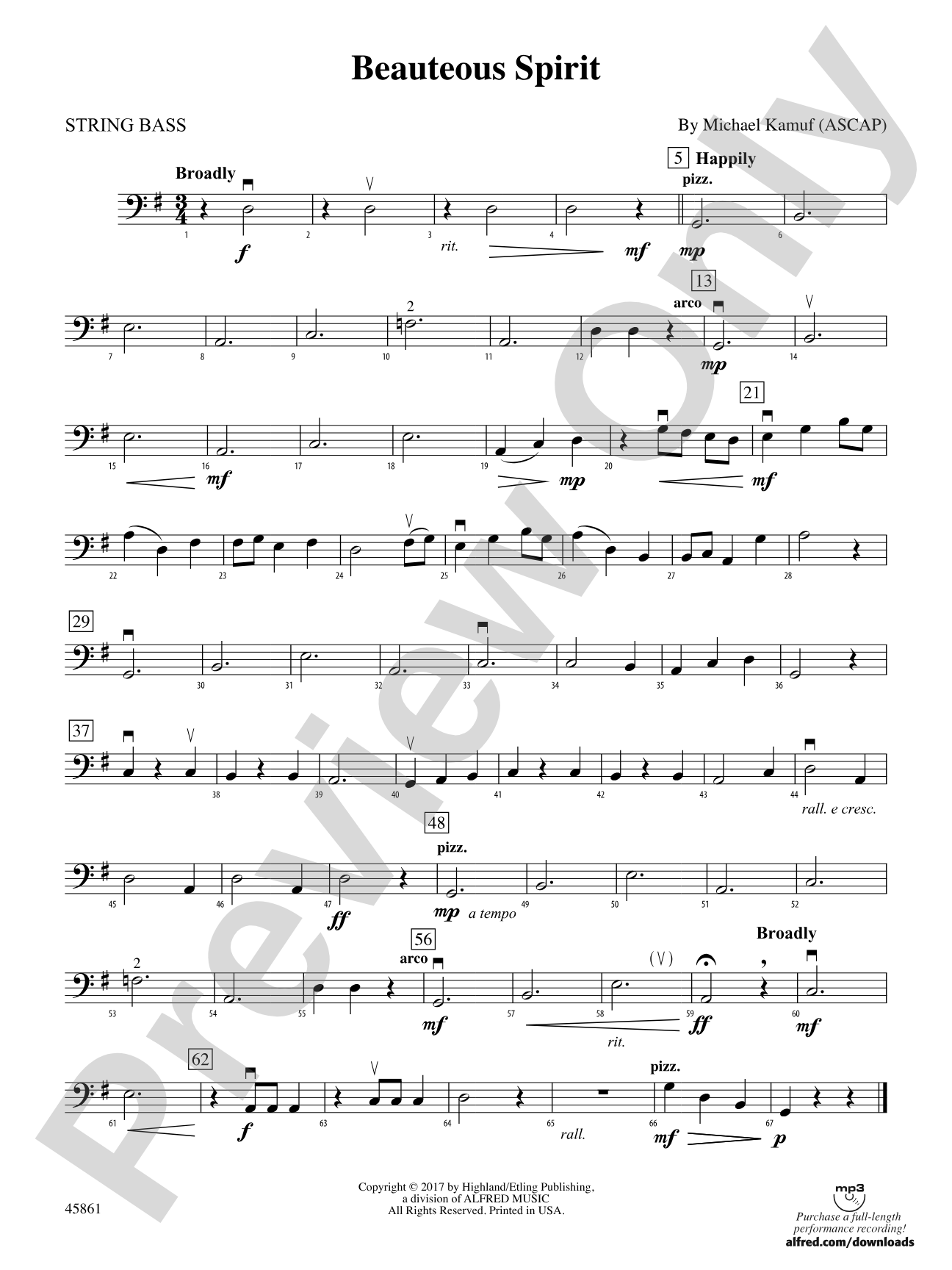

Beauteous Spirit: String Bass
By Michael Kamuf
Grade: 1.5
Item: 00-PC-0017660_SB
$5.99
Pickup currently not available
Description
A stunning lyrical work, this is the perfect selection to introduce expressive playing to your beginning string students. All students have an opportunity to play melodic material in this harmonically rich composition by composer and educator Michael Kamuf. This piece is dedicated to the memory of Bebe, a gentle and sweet rabbit, who spent several years in a shelter before being rescued by the composer's family. To learn more about Bebe's story, please visit the composer's website at www.mikekamuf.com. (2:15)


Don't just read it, hear it, play along with it, and watch your students grow with it. In MakeMusic Cloud, Beauteous Spirit: String Bass comes alive with professional accompaniment, adjustable tempo, and built-in practice tools that turn solo practice into real progress.
Open in the Player
Jump straight in and assign it today.
Start Your Free Trial
Open this title and explore the full library in minutes.
Sample Audio
1
Audio File
--:--
0:00
0:00
Sample Video
Additional Details
Series:
Sound Innovations for String Orchestra
Publisher:
Alfred Music
Page Count:
76
SKU:
00-PC-0017660_SB
More about this title
About the Composer: Michael Kamuf

Michael Kamuf earned Bachelor of Music degrees in Jazz Performance and Music Education from the Dana School of Music at Youngstown State University, followed by a Master of Arts in Instrumental Conducting from George Mason University. His compositions and arrangements have been performed by ensembles including the Woody Herman and Glenn Miller Orchestras, the USAF Airmen of Note, and the US Navy Commodores, as well as soloists such as James Moody, Eddie Daniels, and Sean Jones. He maintains an exclusive publishing relationship with the Belwin Division of Alfred Music, with additional works published through UNC Jazz Press, Neil A. Kjos Music, and FJH Music Company.
Kamuf spent thirty years teaching instrumental music in Montgomery County, Maryland Public Schools, where he directed bands and orchestras at John T. Baker Middle School for twenty-seven of those years. His ensembles consistently achieved high festival ratings and commissioned works for young concert bands. He has also served as assistant principal trumpet with the Youngstown Symphony Orchestra and currently leads the Mike Kamuf Little Big Band, a jazz octet based in the Baltimore and Washington, DC region.
Why we love this
Kamuf writes with genuine affection for beginning string players, crafting melodies that sing without demanding technical virtuosity. Every section gets meaningful musical material, so no student sits idle, and the harmonic richness rewards careful listening and nuanced bow control from the first rehearsal. This piece proves that introducing expressive playing doesn't require complicated rhythms or extended techniques—just honest writing and purpose.
What to expect
Gentle and meditative, with warm harmonies that create an intimate, reflective character. The writing draws students into careful listening; they must shape their sound thoughtfully rather than relying on rhythmic momentum to carry them forward.
Who it's for
Beginning string orchestras (Grade 1.5) seeking repertoire that teaches musicality without overwhelming technical demand. Directors working with mixed-level sections will appreciate how every part carries melodic content, allowing developing players to contribute meaningfully while still building tone and phrasing foundations.
How to get the most out of it
- Shape each phrase with the bow; encourage students to listen for where the melody breathes and allow the sound to diminish slightly at cadence points rather than cutting off abruptly.
- Balance the parts so the melodic line sings through the accompaniment; this requires violins and violas to adjust dynamic levels dynamically as material passes between sections.
- Use the conductor score to identify which section holds the primary voice at each moment, then rehearse that section's entrance and phrasing with emphasis before blending the full texture.
- Slow down substantially in early rehearsals to focus on bow coordination and tone production; the piece will open up once students feel secure with their part and can listen around them.
How to use it
Open a concert with this piece to establish an audience's attentiveness and signal that your orchestra values expressive playing. The work's dedication to Bebe and the story behind it invite a brief program note that connects your students personally to the composer's intention, making the performance feel purposeful rather than routine.
Skills your students will build
- Expressive phrasing and dynamic shaping within a lyrical context
- Tone production and sustained bow control at various dynamic levels
- Part independence within a homophonic texture
- Listening across sections to identify and balance the primary melodic line