
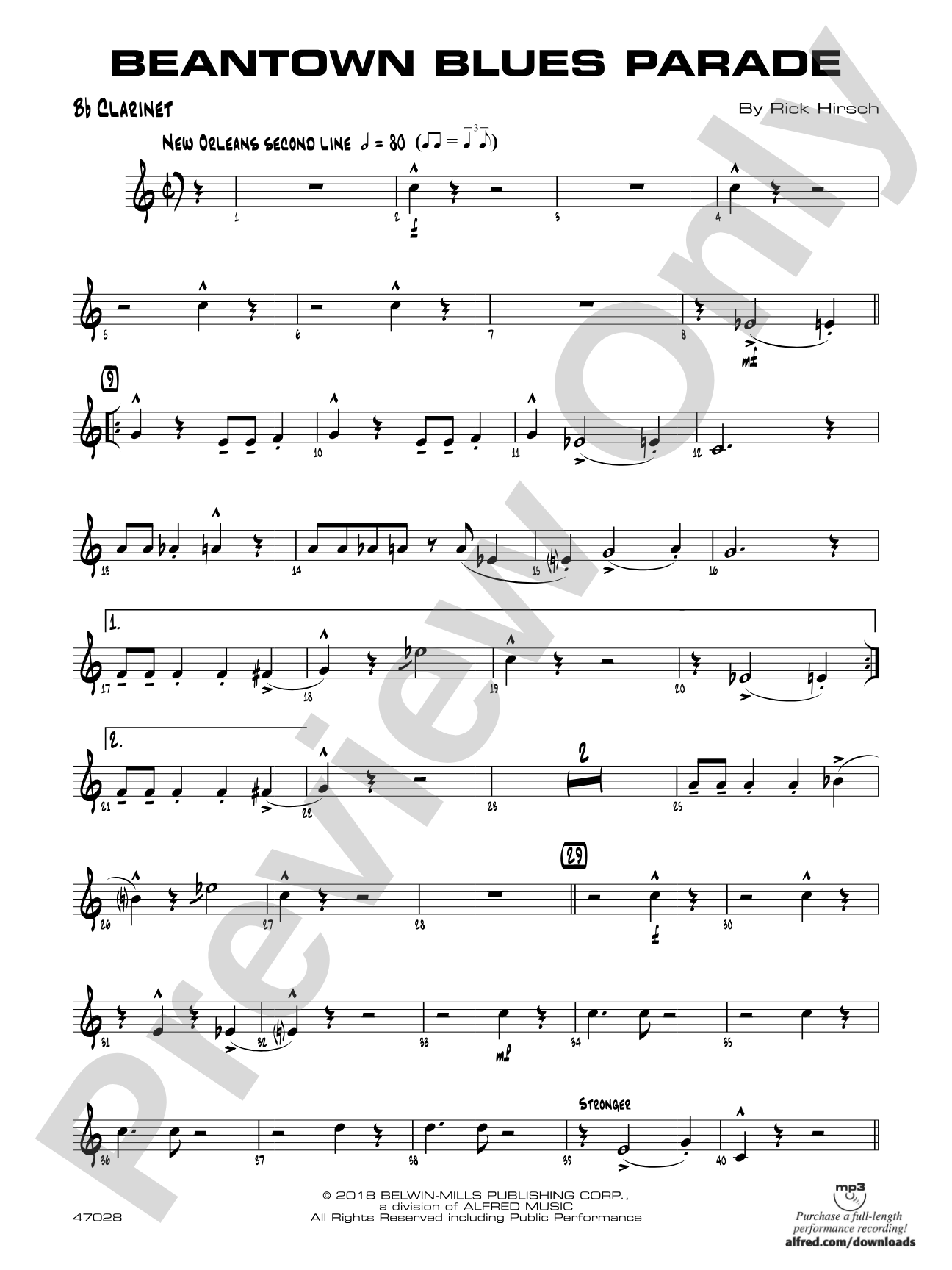

Beantown Blues Parade: 1st B-flat Clarinet
By Rick Hirsch
Grade: 1 (Easy)
Item: 00-PC-0017867_C1
$3.00
Pickup currently not available
Description
Beantown Blues Parade by Rick Hirsch is an upbeat New Orleans second-line groove for your young jazz band. Tempo is around 160 BPM, but it is very accessible. Written melodic solos for trumpet 1 (or section) and trombone 1 (or section) with easy brass ranges. A winner! (2:22)


Don't just read it, hear it, play along with it, and watch your students grow with it. In MakeMusic Cloud, Beantown Blues Parade: 1st B-flat Clarinet comes alive with professional accompaniment, adjustable tempo, and built-in practice tools that turn solo practice into real progress.
Open in the Player
Jump straight in and assign it today.
Start Your Free Trial
Open this title and explore the full library in minutes.
Sample Audio
1
Audio File
--:--
0:00
0:00
Sample Video
Additional Details
Series:
First Year Charts for Jazz Ensemble
Publisher:
Alfred Music
Page Count:
86
SKU:
00-PC-0017867_C1
More about this title
About the Composer: Rick Hirsch

Rick Hirsch studied composition at UMass-Amherst and Northern Illinois University, earning degrees that prepared him for a career bridging the worlds of classical and jazz. Early in his professional life, he worked as a personal music copyist for two jazz giants: Bob Mintzer and Toshiko Akiyoshi. This direct exposure to world-class compositional thinking shaped his own voice as a writer.
Hirsch has composed and arranged for respected soloists including Yusef Lateef and Eddie Henderson, as well as ensembles ranging from the Capitol Quartet to Penn State's Blue Band. He remains a sought-after guest conductor for All-State and District Jazz Bands and formerly taught at Penn State University. In 2017, his ensemble BIG OL' BAND released their debut album, Pocono Git-Down, a project that showcases the creative vitality of regional jazz communities beyond major metropolitan centers.
Why we love this
Hirsch understands what makes young jazz players engage with the style: a groove that swings hard at a tempo that doesn't punish early-stage reading skills, and written solos that sound like real jazz without requiring advanced improvisation chops. The New Orleans second-line tradition carries inherent joy, and this arrangement captures that feeling while staying firmly in Grade 1 technical territory.
What to expect
Beantown Blues Parade bounces with the festive spirit of a street parade, full of brass calls and rhythmic momentum. Even at 160 BPM, the piece never feels rushed; instead, it invites you into a groove that feels inevitable and celebratory, like the whole band is marching together down a familiar street.
Who it's for
This score and parts set serves Grade 1 jazz bands ready to explore swing styles beyond straight bebop head-solos-head formats. Directors looking to program a fun, high-energy feature that doesn't require improvisational maturity from their soloists will find exactly what they need here.
How to get the most out of it
- Lock the section into the eighth-note subdivision of the groove before adding any style or swing feel; once the rhythm is solid, layer in the bounce that makes second-line music distinctive.
- Have your trumpet 1 and trombone 1 soloists listen to classic second-line recordings to absorb phrasing and articulation choices; the written notes are only the starting point.
- Pay attention to the dynamic shape of the ensemble sections that frame the solos; the contrast between full energy and space makes the feature players shine.
- Emphasize the low-brass foundation; a tight bass and baritone sax will ground the tune and give the soloists something solid to play against.
How to use it
Open a concert with this tune to set an upbeat tone, or use it as a contrast in the middle of a setlist where you've programmed more contemplative pieces. It's ideal for jazz festivals where you want judges and audiences to hear your ensemble enjoying themselves while demonstrating solid fundamentals.
Skills your students will build
- Reading and executing swing eighth-note feel in a groove context
- Playing written melodic solos with articulation and phrasing appropriate to the jazz idiom
- Maintaining consistent tempo and groove as a full ensemble while featuring soloists
- Balancing individual voices within the section during full-ensemble passages
- Understanding and performing New Orleans second-line rhythmic traditions