
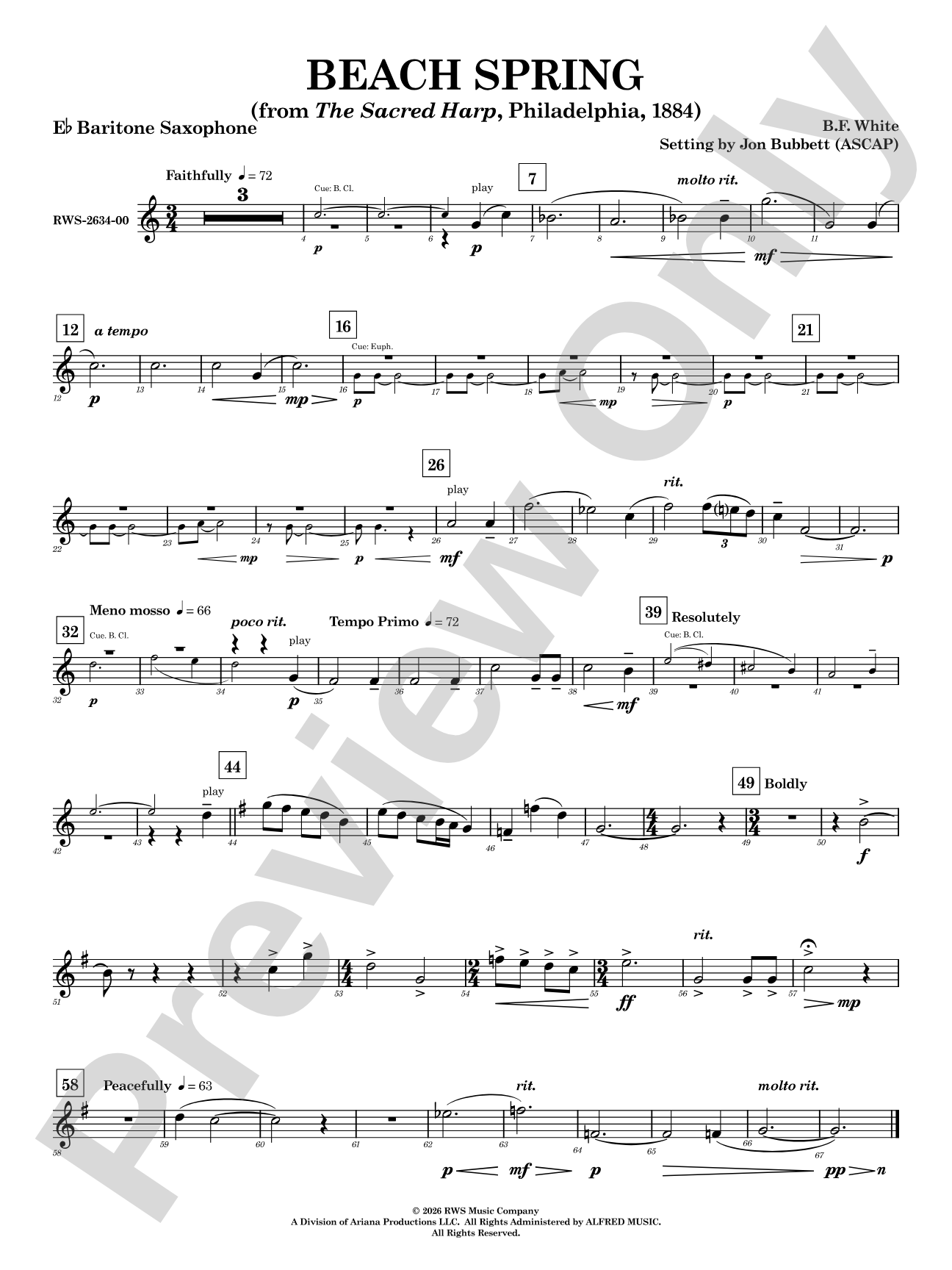

Beach Spring: E-flat Baritone Saxophone
(from The Sacred Harp, Philadelphia, 1884)
By B. F. White / Setting by Jon Bubbett
Grade: 3
Item: 98-PC-0000034_BTX
$3.00
Pickup currently not available
Description
Beach Spring is a beautifully scored setting of the beloved American hymn tune from The Sacred Harp (1844), offering ensembles a chance to explore the rich heritage of early American shape-note singing. With its warm harmonies, expressive lines, and opportunities for lyrical phrasing, this arrangement provides both musical depth and emotional connection for performers and audiences alike. Perfect for concert or festival performance, it allows developing musicians to experience the beauty of simplicity while cultivating blend, balance, and tone quality. Its timeless melody and heartfelt writing make it a meaningful addition to any concert program.


Beach Spring: E-flat Baritone Saxophone isn't in MakeMusic Cloud just yet...but it could be. Let us know you'd like to see it, and you'll help shape what comes next. In the meantime, start a free trial and dive into thousands of interactive titles your students can play along with today.
Request This Title
Tell us you want it.
Start Your Free Trial
Explore everything that's ready to play right now.
Sample Audio
1
Audio File
--:--
0:00
0:00
Sample Video
Additional Details
Series:
RWS - Concert Band
Publisher:
RWS Music Company
SKU:
98-PC-0000034_BTX
More about this title
About the Composer: B. F. White
B. F. White was a shape-note music pioneer and one of the compilers of The Sacred Harp, the 1844 hymnal that became foundational to American choral singing. His work preserved and developed the distinctive four-part harmonic practices of early American sacred music, blending folk sensibilities with rigorous voice-leading that made complex harmonies singable for everyday congregations.
White's influence extends far beyond his era. The melodies and settings that appeared in The Sacred Harp have shaped American musical identity for nearly two centuries, making his contributions essential to understanding how vernacular music and trained musicianship intersected in nineteenth-century America.
Why we love this
This arrangement honors the strengths of shape-note writing without requiring singers to read shape notation. Students encounter genuine four-part voice independence and harmonic sophistication that would challenge many advanced groups, yet the melody is intuitive enough that Grade 3 ensembles can grasp it quickly. The emotional payoff for performers is substantial: they experience how simplicity in melody becomes power through thoughtful harmonization.
What to expect
Unhurried and grounded, with a quiet dignity that fills a concert hall. The melody settles into you immediately, then the harmonies unfold beneath it like layers of texture, creating warmth that feels both reverent and intimate. There's no showiness here; just honest musicmaking that speaks directly to listeners.
Who it's for
Grade 3 concert bands looking to program something substantive that connects to American musical roots. Directors seeking repertoire that teaches harmonic awareness and voice-leading without requiring program notes to justify the choice to audiences.
How to get the most out of it
- Listen closely to balance the inner voices, especially when the alto and tenor lines move independently from the melody and bass. These inner parts carry harmonic color that disappears if they drop below the surrounding parts.
- Shape each phrase as singers would rather than as instrumental players might. The hymn tune suggests natural breath points and gentle arrival points; honor those in your conducting.
- Sustain the warmth in slower passages without letting the tempo drag. A steady, meditative pulse helps the harmonies bloom without rushing.
- Attend to the blend between woodwinds and brass in the upper register. The brightness can obscure the expressiveness if one choir overbalances the other.
How to use it
Pair this with contemporary works to create a program that spans American musical identity, or nest it between more virtuosic selections to give your audience a moment of reflection. It works equally well as a festival entry or as the emotional centerpiece of a pops concert themed around American traditions.
Skills your students will build
- Four-part harmonic independence and voice leading
- Balancing inner voices while supporting the principal melody
- Sustaining warm tone across woodwind and brass choirs
- Phrasing lyrical lines with textual sensitivity
- Understanding shape-note harmonic conventions and their modern application