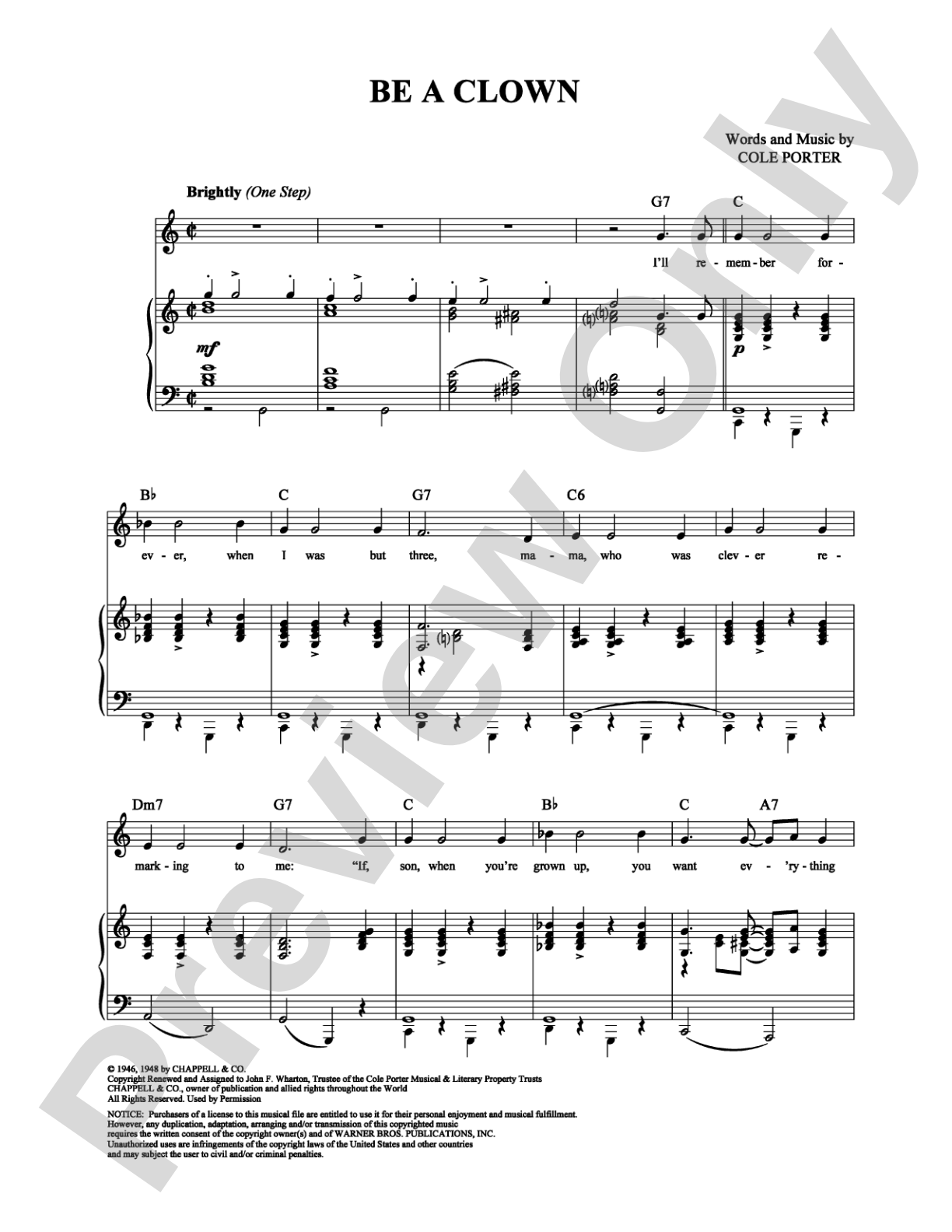
Be A Clown: Piano/Vocal/Chords Digital Sheet Music

Be A Clown: Piano/Vocal/Chords Digital Sheet Music

Cole Porter, Judy Garland, Gene Kelly

Item: 00-PS-0001059

Digital Download
$3.99
Description

Be A Clown: Piano/Vocal/Chords Digital Sheet Music isn't in MakeMusic Cloud just yet...but it could be. Let us know you'd like to see it, and you'll help shape what comes next. In the meantime, start a free trial and dive into thousands of interactive titles your students can play along with today.

Sample Audio
No sample audio found.
Sample Video
Additional Details
SKU: 00-PS-0001059

More about this title

About the Artist: Judy Garland

Judy Garland (1922-1969) was an American singer and actress whose powerful voice and emotional depth made her one of the most celebrated entertainers of the 20th century. Her work in film musicals, particularly The Wizard of Oz, established her as a master of song interpretation and a model for singers navigating both technical demands and storytelling through music.

Why we love this

This Cole Porter classic pairs perfectly with Gene Kelly's charm and Garland's vocal prowess, making it ideal for performers who want to explore comedic song interpretation. The arrangement offers accessible voicings that let singers focus on phrasing and character without getting lost in harmonic complexity. It's a genuine crowd-pleaser that teaches performers how to balance humor with musicality.

What to expect

Playful and theatrical, with a wink built into every phrase. The music bounces with vaudeville energy while maintaining the sophistication Porter brought to every lyric and harmonic turn.

Who it's for

Singers preparing audition material or recital selections who thrive on comedic character work will find this accessible and rewarding. Piano teachers and accompanists can use this to explore the relationship between harmonic support and vocal storytelling in a song that's genuinely fun to play.

How to get the most out of it

  • Lean into the comedic intent without sacrificing vocal control. The lyrics demand timing and clarity that rewards precise articulation and well-placed breath support.
  • Use the chord symbols to improvise light accompaniment variations that complement rather than overwhelm the vocal line. Piano players should feel free to voice chords distinctly so the humor reads clearly.
  • Shape the melody with conversational phrasing. Porter's wit lands hardest when the vocal line sounds natural and unforced, allowing the lyrical content to drive the interpretation.

How to use it

Program this alongside other American songbook standards to create a set that showcases both technical skill and interpretive personality. It works particularly well in recitals exploring the Golden Age of musical theater or in mixed programs where you want to shift the mood toward something lighter and more character-driven.

Skills your students will build

  • Comic timing and character interpretation in song
  • Phrasing and breathing for conversational vocal delivery
  • Reading and voicing chord symbols on piano
  • Coordination between vocal line and harmonic accompaniment

You May Also Like