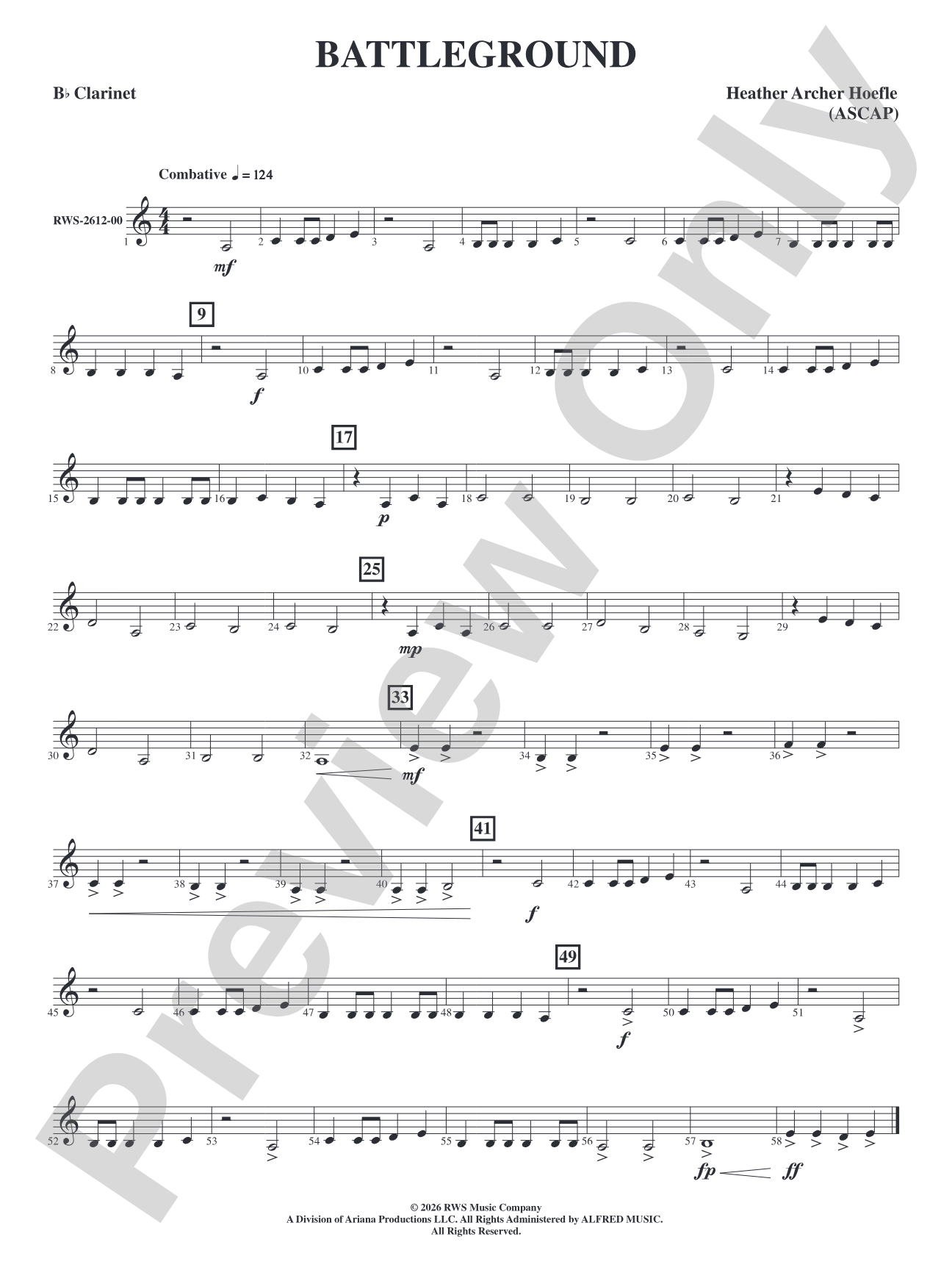
Battleground: 1st B-flat Clarinet Sheet Music Preview

Battleground: 1st B-flat Clarinet

By Heather Archer Hoefle

Grade: 1

Item: 98-PC-0000012_C1

Digital Download
$3.00
Description
Battleground is an accessible, powerful piece your beginners will love! Work on dynamics and accents with this exciting concert piece. Its blocked rhythms make it an ideal tool for developing musical expression.

Battleground: 1st B-flat Clarinet isn't in MakeMusic Cloud just yet...but it could be. Let us know you'd like to see it, and you'll help shape what comes next. In the meantime, start a free trial and dive into thousands of interactive titles your students can play along with today.

Sample Audio
0:00
0:00
Sample Video
Additional Details
Series: RWS - Beginning Band
Publisher: RWS Music Company
SKU: 98-PC-0000012_C1

More about this title

Why we love this

Hoefle understands what beginning bands need: immediate access to expressive playing without requiring complex rhythmic decoding. The blocked rhythms free students' mental energy so they can focus on dynamics and articulation, making this an unusually effective teaching tool that never feels like one.

What to expect

Energetic and assured. The piece projects confidence without bombast, with a martial character that feels purposeful rather than frantic. There's genuine musicality packed into straightforward writing.

Who it's for

Beginning concert bands working on dynamic control and accent clarity. This piece fits groups ready to move beyond unison playing into textured arrangements, but not yet managing complex rhythmic independence.

How to get the most out of it

  • Establish a clear dynamic hierarchy before rehearsal. Mark your score to show where the band should aim for forte versus mezzo-forte, then let the students find those levels with your conducting.
  • Shape the accents as punctuation, not as sudden volume spikes. Encourage players to think of them as emphatic but controlled.
  • Use the blocked rhythms to your advantage by alternating which sections drive the texture. This keeps the band engaged and teaches musical independence.
  • Record a run-through early and play it back. Students hear their own dynamic work reflected immediately, which builds ownership of the expressive choices.

How to use it

Launch this in the fall or winter when you're building foundational expressive skills alongside technique work. It's substantial enough for a festival or concert opening, but conversational enough that it won't exhaust a young ensemble.

Skills your students will build

  • Dynamic control across the full spectrum (ppp to fff)
  • Articulating and balancing accents within a full ensemble
  • Maintaining rhythmic precision while interpreting expression
  • Reading and executing blocked rhythm patterns accurately
  • Listening for balance across sections with the same rhythmic content

You May Also Like