
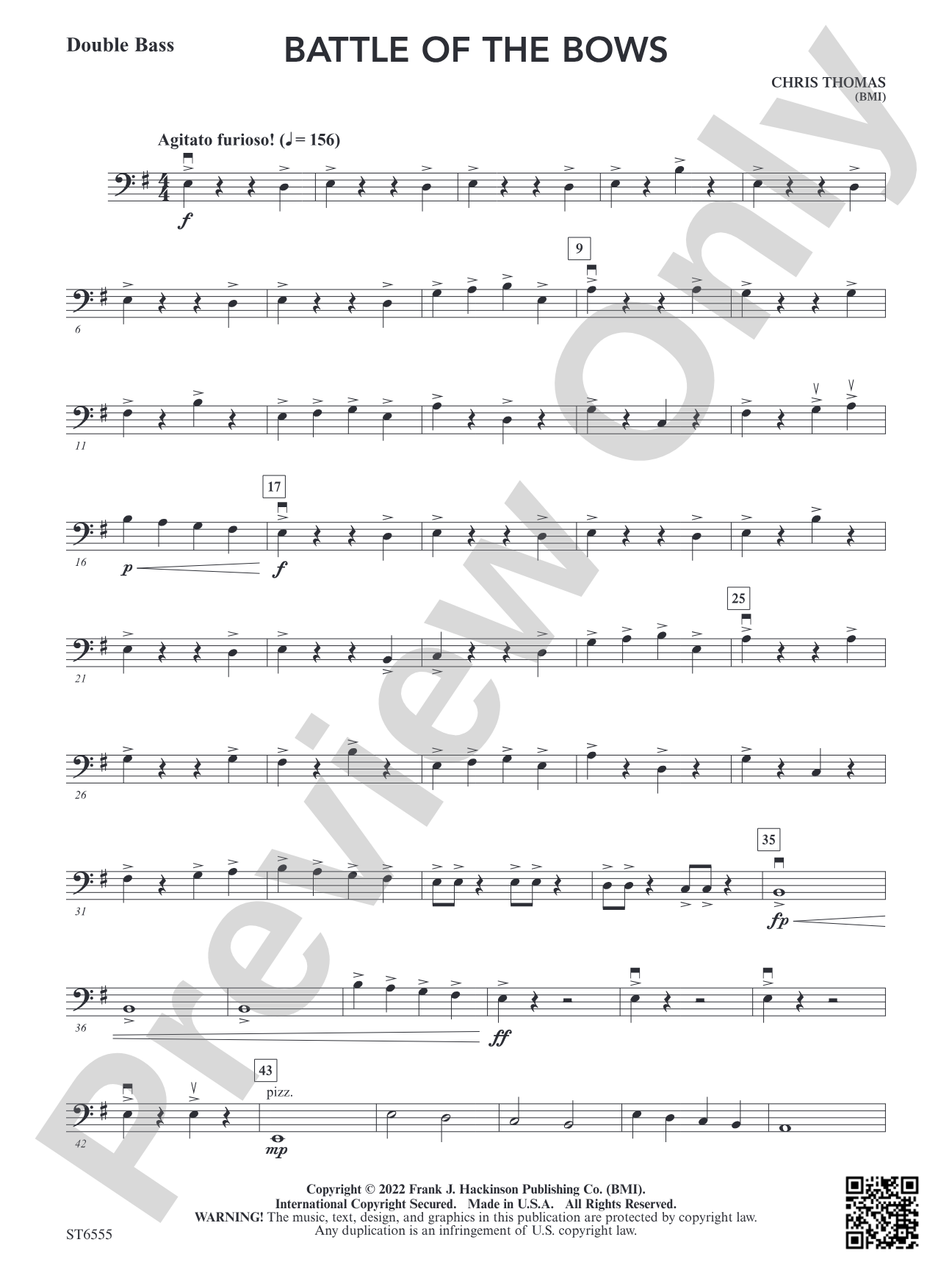

Battle of the Bows: Double Bass
By Chris Thomas
Grade: 2.5
Item: 98-PC-DST6555_SB
$7.00
Pickup currently not available
Description
Experience a contest of strength, bravery, and determination. With constant momentum and energy, the music explores a range of articulations and dynamics as each section competes for supremacy. Bravado, dynamic contrast, independence, and excitement---it is all here and ready to showcase your orchestra! (2:30)


Don't just read it, hear it, play along with it, and watch your students grow with it. In MakeMusic Cloud, Battle of the Bows: Double Bass comes alive with professional accompaniment, adjustable tempo, and built-in practice tools that turn solo practice into real progress.
Open in the Player
Jump straight in and assign it today.
Start Your Free Trial
Open this title and explore the full library in minutes.
Sample Audio
1
Audio File
--:--
0:00
0:00
Sample Video
Additional Details
Series:
FJH Developing Strings
Publisher:
The FJH Music Company, Inc.
SKU:
98-PC-DST6555_SB
More about this title
About the Composer: Chris Thomas

Chris Thomas brings a composer's sensibility shaped by decades of film, television, and theme park work to the concert hall. His music has been performed at Carnegie Hall, the Sydney Opera House, and the Hollywood Bowl, and he has earned recognition including a Hollywood Music in Media Award, two American Prize placements in composition, and a Gold Medal at the Park City Film Music Festival.
Thomas's creative reach spans multiple media: he orchestrates and conducts for major studios including Sony, ABC, FOX, CBS, and HBO; his compositions for Emmy-nominated films and Academy Award-shortlisted features demonstrate his skill at writing music that serves narrative and emotional purpose; and his concert works, including his Malheur Symphony (the subject of his 2019 TED Talk), have established him as a composer of serious artistic ambition. Theme parks worldwide feature his music, from Evermore Adventure Park to Knott's Berry Farm to international venues.
Why we love this
Thomas writes with the orchestrator's understanding of how individual sections interact and compete musically. The constant momentum and clear articulation choices make this piece ideal for teaching string players how to balance independence with ensemble unity, and the competitive energy keeps young musicians engaged without requiring advanced technical facility.
What to expect
Propulsive and athletic, like watching rivals test their abilities in real time. The music crackles with energy and personality as sections take turns proving themselves, creating moments of genuine dramatic tension alongside moments of pure fun. There's an undercurrent of theatrical swagger throughout, driven by the compositional choices that keep one group just ahead of another.
Who it's for
String orchestras at the Grade 2.5 level who are ready for pieces with rhythmic independence and dynamic sophistication but don't yet need complex bowing techniques or extended ranges. This work rewards ensembles comfortable with basic shifting and multiple articulations and looking for a contest or festival piece with real theatrical appeal.
How to get the most out of it
- Shape the dynamic contrasts with intention; this piece thrives on clear transitions between forte sections and lighter passages. Coach students to hear the difference between bravado and restraint rather than playing at one volume throughout.
- Establish a consistent tempo and stick with it. The constant momentum is the piece's backbone; if the pulse wavers, the sense of contest falls apart.
- Isolate sectional moments where one group has the musical lead. Rehearse with one section playing while others listen, then reverse roles, so players understand when they're the "winners" and when they're providing support.
- Balance articulation across the full ensemble. If pizzicato passages lack clarity or bow strokes lack unity, the competition concept loses its punch.
How to use it
This is a natural choice for festival or contest programming, where its two-and-a-half-minute runtime and high entertainment value make an impact on any adjudication. It also works well as a concert opener with other pieces in similar Grade 2-3 range, or as a secondary work that showcases different strengths than your primary contest selection.
Skills your students will build
- Dynamic contrast and control across full orchestra
- Sectional independence while maintaining ensemble cohesion
- Articulation clarity (bow strokes, pizzicato, mixed articulations)
- Sustaining rhythmic precision and tempo consistency under competitive musical phrasing
- Balance between multiple simultaneous melodic ideas