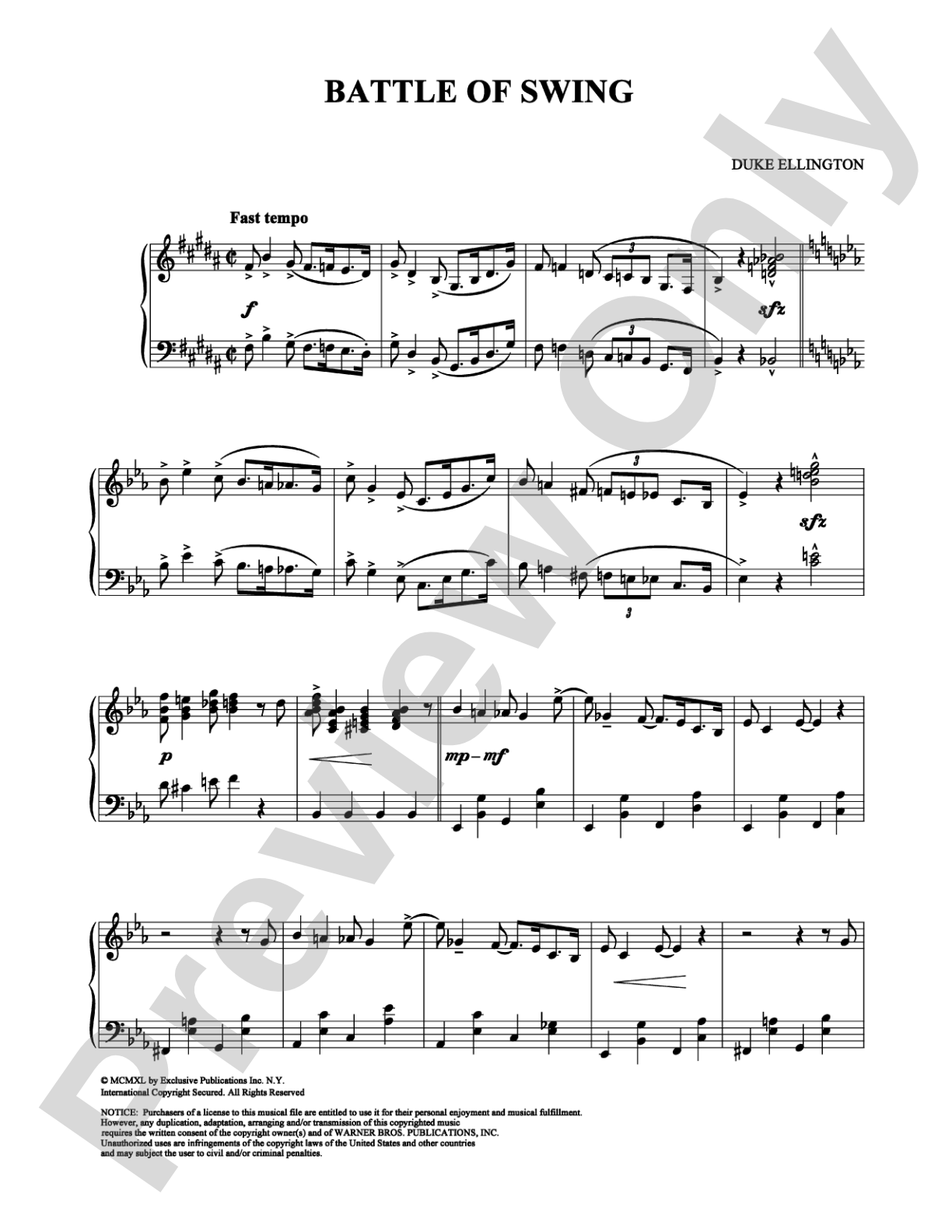
Battle of Swing: Piano Digital Sheet Music

Battle of Swing: Piano Digital Sheet Music

Duke Ellington

Item: 00-PS-0008183

Digital Download
$3.99
Description

Battle of Swing: Piano Digital Sheet Music isn't in MakeMusic Cloud just yet...but it could be. Let us know you'd like to see it, and you'll help shape what comes next. In the meantime, start a free trial and dive into thousands of interactive titles your students can play along with today.

Sample Audio
No sample audio found.
Sample Video
Additional Details
SKU: 00-PS-0008183

More about this title

About the Artist: Duke Ellington

Duke Ellington (1899–1974) transformed jazz from dance music into an art form worthy of concert halls and serious study. His prolific output—over 1,000 compositions—demonstrated that jazz was capable of structural sophistication, harmonic innovation, and emotional depth equal to any classical tradition. Ellington's piano playing was inseparable from his compositional voice; he used the keyboard to voice ideas, test orchestrations, and create the distinctive Ellington sound that defined big band jazz.

As a bandleader, composer, and pianist, Ellington reshaped American music by refusing to accept the boundaries between popular and concert music. His work remains central to jazz history and continues to challenge performers and educators to think seriously about improvisation, arrangement, and what jazz can express.

Why we love this

Ellington's compositions demand serious pianists engage with jazz harmony and stride technique in a setting that rewards both precision and interpretation. The Battle of Swing sits at the intersection of swing-era sophistication and pianistic virtuosity, making it an excellent vehicle for advanced students ready to move beyond lead sheets into Ellington's fully realized voicings.

What to expect

Swinging with purpose and sophistication. The Battle of Swing pulses with the energy of 1930s–40s big band jazz while showcasing Ellington's gift for melody and harmonic invention. There's swagger and wit in the writing, along with moments of lyrical elegance that remind you why Ellington's music endures.

Who it's for

Advanced pianists with jazz experience or strong classical technique who are ready to tackle Ellington's harmonic language. This works well for conservatory students, private studio learners preparing for jazz competitions, or recitalists building a jazz standards repertoire.

How to get the most out of it

  • Pay attention to Ellington's specific chord voicings and shell voicings rather than simplifying them; they define the harmonic color and should be heard clearly.
  • Lock into the swing pulse early in rehearsal; the groove here depends on understanding jazz time feel at the piano level, not just knowing the notes.
  • Balance the melody with accompaniment carefully so that walking bass lines or rhythmic figures in the left hand stay supportive rather than overwhelming the top voice.
  • Study recordings of Ellington performing his own work to hear how he approached tempo, rubato, and the dialogue between strict time and subtle flexibility.

How to use it

Feature this in a jazz-focused recital or as part of a program pairing American composers with European traditions. It also makes an excellent encore following more classical work, demonstrating the artistic legitimacy of the jazz canon. Consider programming it alongside other Ellington piano works to build a deeper portrait of his compositional voice.

Skills your students will build

  • Jazz chord voicing and shell voicing construction
  • Swing rhythmic feel and jazz time signature interpretation
  • Left-hand independence and stride technique
  • Improvisation within a structured harmonic framework
  • Interpreting Ellington's specific orchestrational language on a single instrument

You May Also Like