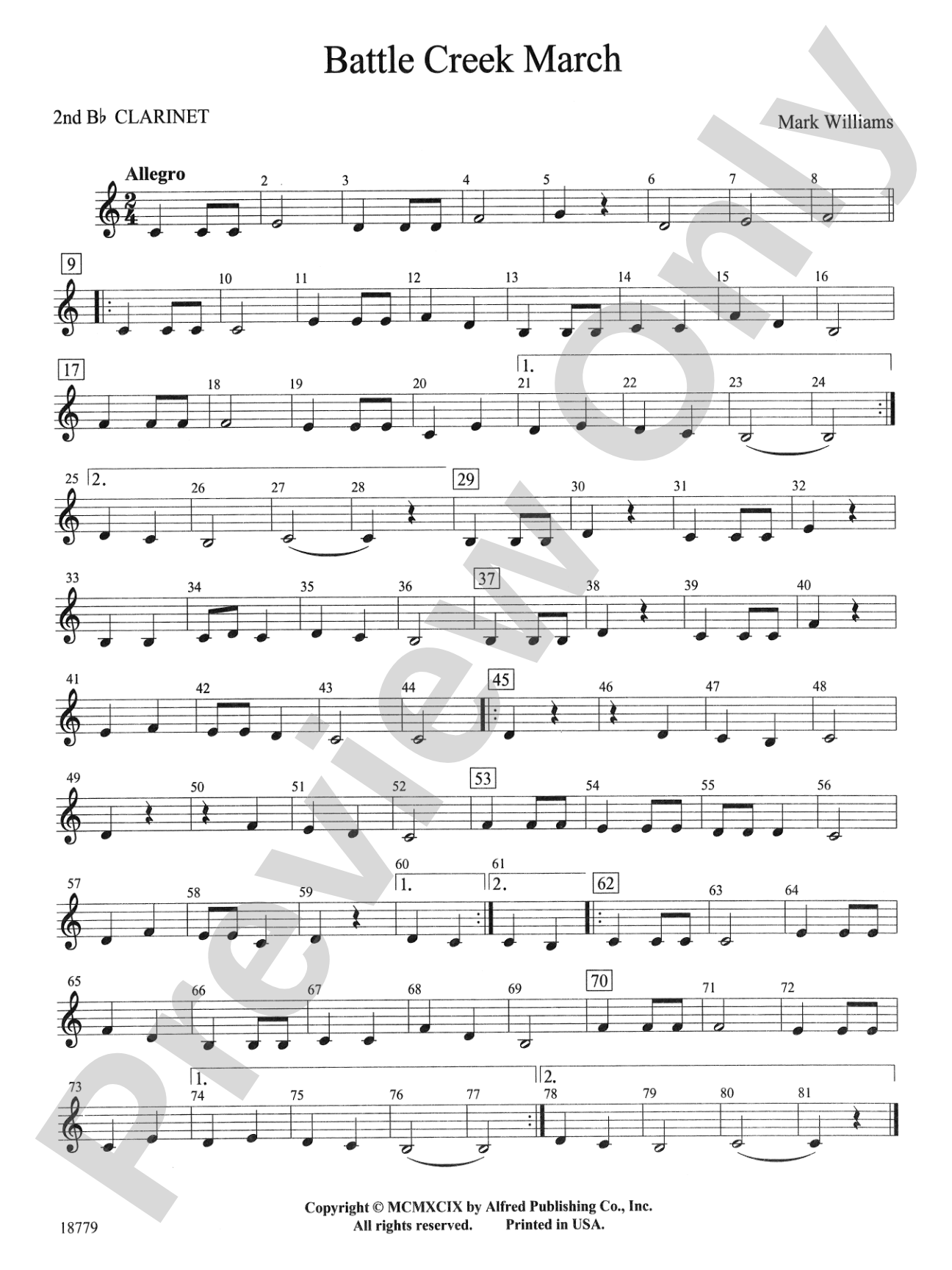
Battle Creek March: 2nd B-flat Clarinet Sheet Music Preview

Battle Creek March: 2nd B-flat Clarinet

By Mark Williams

Grade: 1 (Very Easy)

Item: 00-PC-0000277_C2

Digital Download
$3.00
Description
Your beginning band will sound great in its first concert performing this easy 2/4 march by Mark Williams. This piece is a fantastic confidence builder and uses only seven notes. Correlated with Accent on Achievement, Book 1, page 13, you'll want to use this one again and again! (2:00)

Don't just read it, hear it, play along with it, and watch your students grow with it. In MakeMusic Cloud, Battle Creek March: 2nd B-flat Clarinet comes alive with professional accompaniment, adjustable tempo, and built-in practice tools that turn solo practice into real progress.

Sample Audio
0:00
0:00
Sample Video
Additional Details
Series: Accent on Achievement
Publisher: Alfred Music
Page Count: 116
SKU: 00-PC-0000277_C2

More about this title

About the Composer: Mark Williams

Mark Williams

Mark Williams built his reputation as a composer who understood exactly what beginning band students needed to succeed. With over 200 published works and co-authorship of the Accent on Achievement method series, he shaped how generations of young musicians developed their skills. His expertise came from decades teaching elementary band in Washington state, combined with clinical work across 34 states, five Canadian provinces, and Australia.

Beyond the classroom, Williams was an accomplished performer and arranger. He served as woodwind performer and arranger for the 560th Air Force Band and conducted the Spokane British Brass Band as both conductor and artistic director. His contributions to school music earned him recognition including the Western International Band Clinic's Gralia Competition and multiple ASCAP Special Awards. Williams held degrees from Eastern Washington University in education and earned his Master of Education there as well.

Why we love this

Williams wrote this march specifically for students still mastering fundamental skills, and it sounds entirely like real music, not a training exercise. The restriction to seven notes feels invisible when students perform it; they hear themselves playing something with genuine march character and forward momentum. Directors return to this piece repeatedly because it delivers an authentic concert experience while keeping technical demands manageable for first-year players.

What to expect

A spirited, straightforward march with bright character and accessibility. The seven-note palette creates an almost hymnal clarity, allowing students to focus on phrasing, balance, and ensemble togetherness rather than technical complexity.

Who it's for

Beginning concert bands ready for their first public performance or festival appearance. This piece works perfectly for bands using Accent on Achievement Book 1 who have reached page 13 and want immediate application of fundamental skills in a musical context.

How to get the most out of it

  • Establish a crisp, even eighth-note pulse from the opening. Marches live or die on rhythmic precision, and early success here builds the foundation for cleaner articulation across the entire band.
  • Balance the melody between sections so no single voice overwhelms the harmony. With limited note variety, every voice line has presence; make sure they blend rather than compete.
  • Keep the tempo steady and march-like without rushing. This piece works best when it feels confident and measured, not hurried.

How to use it

Feature this on your first concert of the year to build confidence and demonstrate that beginning musicians can already perform something substantial. It also serves as an excellent festival or contest selection for Grade 1 bands, giving students an achievable, rewarding performance experience early in their musical journey.

Skills your students will build

  • Sustaining steady tempo in 2/4 time
  • Balancing melody and harmony with limited range
  • Ensemble articulation and rhythmic precision
  • Phrasing and musical shaping within a simple note set
  • Reading and performing music notation in a concert setting

You May Also Like