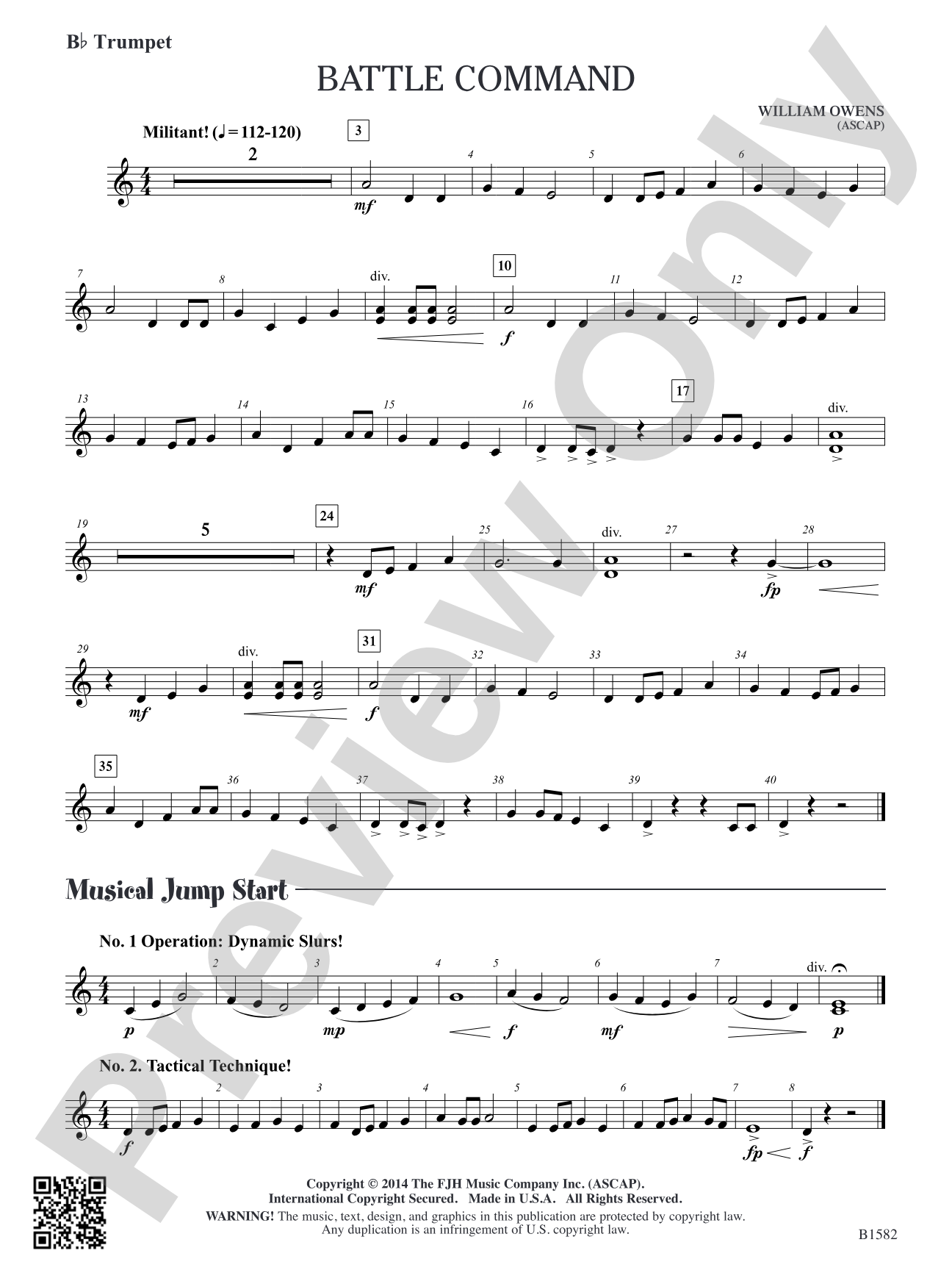
Battle Command: B-flat Trumpet Sheet Music Preview

Battle Command: B-flat Trumpet

By William Owens

Level:.5

Item: 98-PC-DB1582_T1

Digital Download
$7.00
Description
Take the battle to the gate with this tenacious, take-no-prisoners work for beginning bands! Your students will sound mature beyond their years with this strategically scored work that uses only six notes. The military, cadence-like percussion parts add to the drama. Intense and exciting!

Don't just read it, hear it, play along with it, and watch your students grow with it. In MakeMusic Cloud, Battle Command: B-flat Trumpet comes alive with professional accompaniment, adjustable tempo, and built-in practice tools that turn solo practice into real progress.

Sample Audio
0:00
0:00
Sample Video
Additional Details
Series: FJH Starter Series
Publisher: The FJH Music Company, Inc.
SKU: 98-PC-DB1582_T1

More about this title

About the Composer: William Owens

William Owens

William Owens has spent decades composing music that speaks directly to the needs of young band directors. A graduate of VanderCook College of Music and a band director himself for 30 years in Texas, Owens understands what beginning ensembles can accomplish when given strategically constructed material. His catalogue now includes over 300 works for concert band, string orchestra, and small ensembles, many of which have become foundational repertoire in music education.

Owens's contributions to the field extend beyond composition. He has served as a clinician and conductor throughout North America, earned recognition from the American Bandmasters Association and Texas Bandmasters Association, and maintains membership in ASCAP and Phi Beta Mu International. His music appears on required lists across the country and has been studied in educational texts, cementing his reputation as a leader in accessible, musically sound writing for developing musicians.

Why we love this

Owens designs this work to make young bands sound accomplished immediately. By limiting the material to six pitches and using strategic scoring, he removes the technical barriers that typically frustrate beginners while maintaining genuine musical drama through energetic rhythms and percussion writing that mimics military cadence.

What to expect

Relentless and driven, like a march advancing purposefully forward. The limited note set creates a focused, almost hypnotic quality while military percussion keeps the energy tight and controlled. Despite the beginner-friendly construction, the piece carries genuine dramatic weight and excitement.

Who it's for

Beginning band directors working with Grade 1/2 students who want immediate success and maturity of sound. This work serves ensembles with limited technical facility but full appetite for musical expression and confidence-building repertoire.

How to get the most out of it

  • Shape the melodic phrases with long-term breath planning rather than playing note to note. Even with limited pitch material, phrasing will transform the ensemble sound from mechanical to musical.
  • Let the percussion section drive the rhythmic energy. The cadence-like drum parts anchor the entire work, so lock this section in first before balancing against winds.
  • Maintain consistent articulation across the band, particularly in repeated rhythmic figures. This uniformity amplifies the military character without requiring advanced technical execution.
  • Build dynamics gradually rather than jumping between extremes. The strategic scoring gives you room to shape intensity throughout the piece, creating the sense of escalating drama without jumpy contrasts.

How to use it

Open a concert with this piece to establish energy and draw the audience immediately into the performance. Its brief scope and high impact also make it ideal for festival or contest settings where you want to showcase ensemble growth without over-reaching technically.

Skills your students will build

  • Sustained phrase shaping across repeated melodies
  • Rhythmic precision in steady-state tempo
  • Listening to and locking with percussion leadership
  • Dynamic contrast and control within a limited range
  • Consistent articulation across wind and percussion sections

You May Also Like