
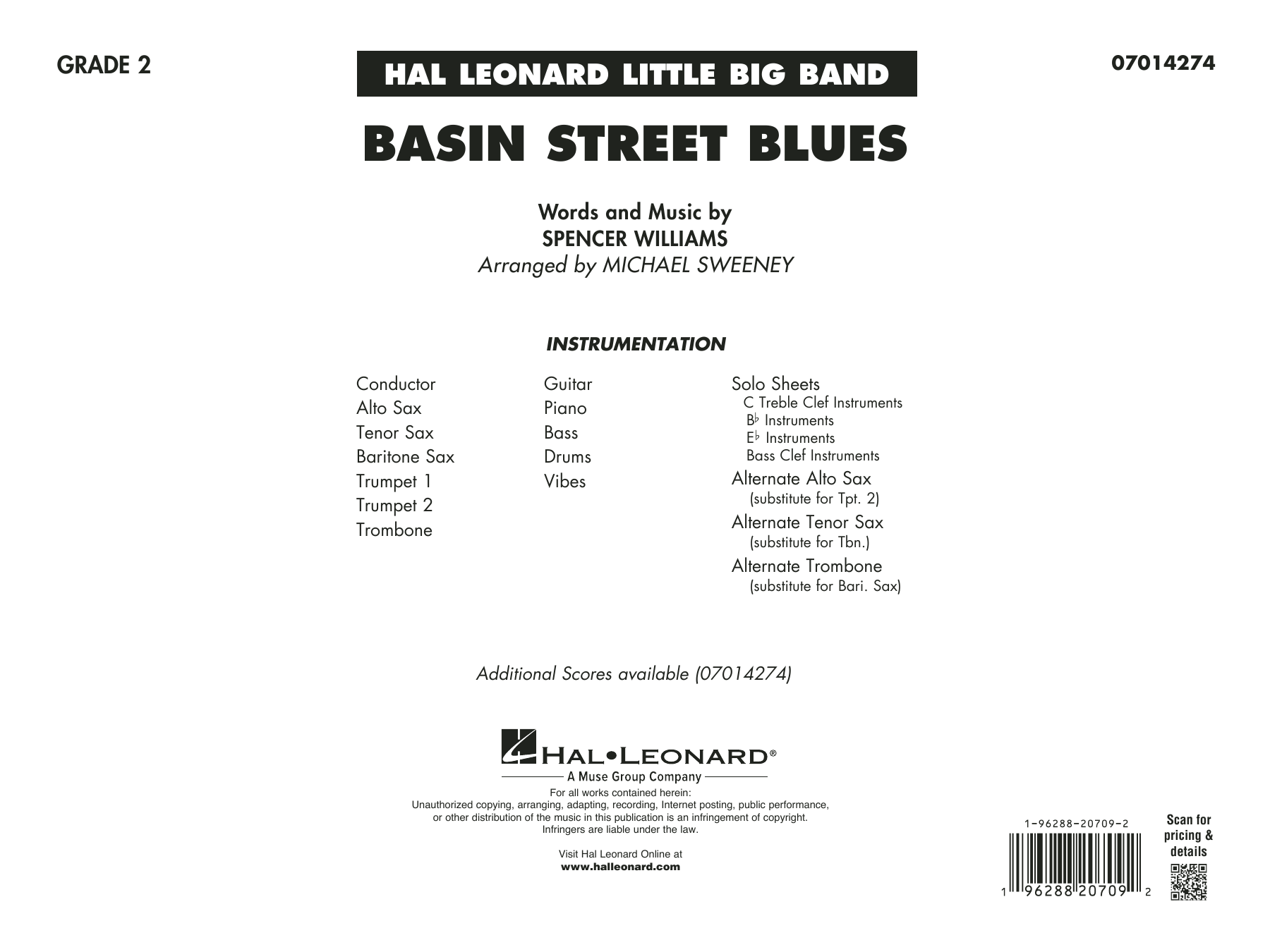

Basin Street Blues (arr. Michael Sweeney): Jazz Ensemble Conductor Score & Parts
By Spencer Williams / Arranged by Michael Sweeney
Grade: 2
Item: 35-PK01516342
$45.00
Pickup currently not available
Buy Extra Parts (Digital PDF Download)
Parts Added to Cart!
Description
With its roots in early jazz, "Basin Street Blues" is a great way to introduce the concept of "call and response" to your young players. This arrangement scored for 6 horns features solid ensemble scoring and a stop-time accompaniment for the solo section. Easy to learn, yet very effective.


Basin Street Blues (arr. Michael Sweeney): Jazz Ensemble Conductor Score & Parts isn't in MakeMusic Cloud just yet...but it could be. Let us know you'd like to see it, and you'll help shape what comes next. In the meantime, start a free trial and dive into thousands of interactive titles your students can play along with today.
Request This Title
Tell us you want it.
Start Your Free Trial
Explore everything that's ready to play right now.
Sample Audio
No sample audio found.
Sample Video
No sample videos found.
Additional Details
Publisher:
Hal Leonard
SKU:
35-PK01516342
More about this title
About the Composer: Spencer Williams
Spencer Williams was a prolific composer and pianist in the early 20th century, contributing significantly to the development of jazz and blues standards. His melodies became foundational to the jazz repertoire, performed and reinterpreted by generations of musicians from Louis Armstrong to contemporary jazz ensembles.
Williams understood how to write memorable, singable lines that captured the spirit of New Orleans jazz. His work remains essential to jazz education because it embodies the harmonic language and melodic sensibility that defined the genre's formative years.
Why we love this
Michael Sweeney's arrangement strips away nothing essential from the original while giving young ensembles genuine pedagogical wins. The stop-time accompaniment during solos creates a natural teaching moment for discussing texture and ensemble roles, and the call-and-response structure gives section leaders real responsibility without overwhelming less experienced players.
What to expect
Basin Street comes alive with the warmth of early jazz, unpretentious and full of swing. There's a conversational quality to the writing that invites soloists to tell their own story within the form, while the ensemble support feels like good friends playing together at the source.
Who it's for
Jazz ensemble directors building young players' foundational skills and seeking material that teaches historical context without sacrificing musicality. This works equally well for groups stepping into jazz for the first time and for more experienced ensembles seeking accessible material that rehearses cleanly.
How to get the most out of it
- Balance the ensemble scoring so that solo voices cut through the horns without sacrificing the richness of the harmonic backdrop.
- Lock the stop-time sections with your rhythm section before adding the full ensemble; this gives soloists the pocket they need to swing freely.
- Encourage your soloists to shape phrases conversationally, treating their solo as an answer to the ensemble's "call" rather than a display of technical facility.
- Work dynamics carefully in the final ensemble statements. The arrangement builds naturally if players bring energy without forcing the volume.
How to use it
Include this in a jazz curriculum unit on blues history and form, or program it as an opening number on a concert where you're introducing jazz repertoire to an audience unfamiliar with the genre. Its accessibility and historical significance make it perfect for a school assembly or combined jazz festival that features multiple groups at varying levels.
Skills your students will build
- Call-and-response phrasing and ensemble dialogue
- Stop-time rhythm playing and rhythmic precision
- Blues form and harmonic vocabulary
- Swing feel and jazz articulation
- Solo construction and melodic phrasing over changes