
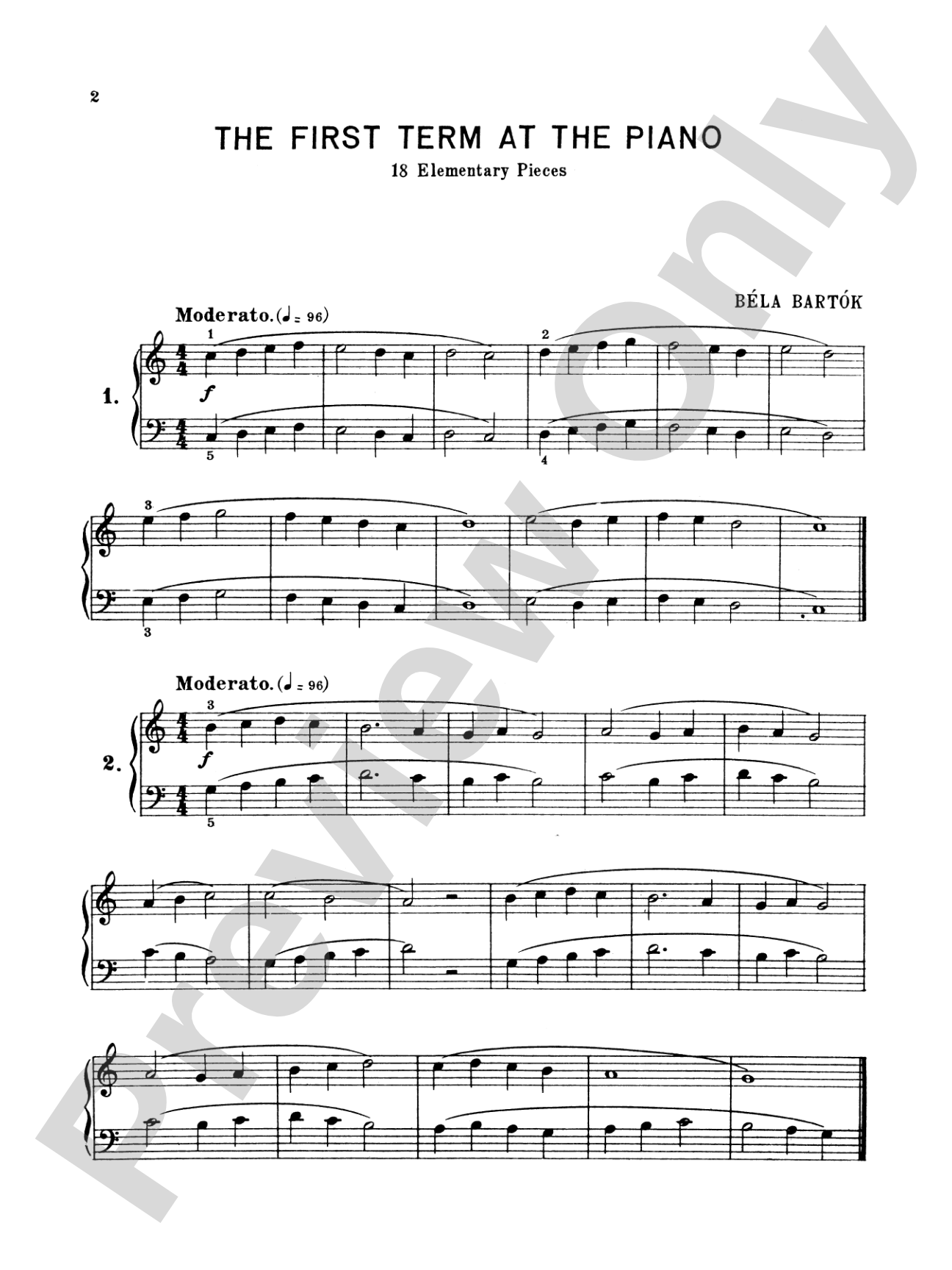

Bartók: The First Term: Piano Book
By Béla Bartók
Item: 00-PK-0002892

$6.99
Pickup currently not available
Buy Extra Parts (Digital PDF Download)
| Product | Price | Quantity |
|---|---|---|
| Bartók: The First Term | $0.99 | |
| Bartók: The First Term | $0.99 | |
| Bartók: The First Term | $0.99 | |
| Bartók: The First Term | $0.99 | |
| Bartók: The First Term | $0.99 | |
| Bartók: The First Term | $0.99 | |
| Bartók: The First Term | $0.99 | |
| Bartók: The First Term | $0.99 | |
| Bartók: The First Term | $0.99 | |
| Bartók: The First Term | $0.99 | |
| Bartók: The First Term | $0.99 | |
| Bartók: The First Term | $0.99 | |
| Bartók: The First Term | $0.99 | |
| Bartók: The First Term | $0.99 | |
| Bartók: The First Term | $0.99 | |
| Bartók: The First Term | $0.99 | |
| Bartók: The First Term | $0.99 | |
| Bartók: The First Term | $0.99 |
Parts Added to Cart!
Related Items
The First Term at the Piano: Eighteen Elementary Pieces: Piano Book |
$6.95
|
View |
Description
These 18 progressive elementary level pieces by Bela Bartok provide excellent technical and artistic repertoire for the beginning piano student.


Don't just read it, hear it, play along with it, and watch your students grow with it. In MakeMusic Cloud, Bartók: The First Term: Piano Book comes alive with professional accompaniment, adjustable tempo, and built-in practice tools that turn solo practice into real progress.
Open in the Player
Jump straight in and assign it today.
Start Your Free Trial
Open this title and explore the full library in minutes.
Sample Audio
No sample audio found.
Sample Video
No sample videos found.
Additional Details
Series:
Kalmus Edition
Publisher:
Alfred Music
Page Count:
12
SKU:
00-PK-0002892
More about this title
About the Composer: Béla Bartók
Béla Bartók (1881, 1945) was a Hungarian composer and pianist whose compositional voice emerged from deep study of folk music across Eastern Europe. He believed that understanding authentic folk traditions was essential to modern music making, and this philosophy shaped everything he wrote, from large orchestral works to intimate teaching pieces.
Bartók's approach to music education was inseparable from his artistic vision. He created pedagogical works not as simplified versions of "real" music, but as genuine compositions that introduced young pianists to 20th-century harmonic thinking, rhythmic complexity, and the raw materials of folk melody. His teaching pieces remain some of the most intellectually honest introductions to contemporary classical music.
Why we love this
Bartók refuses to compromise on musical integrity even at the elementary level. These 18 pieces anchor students in twentieth-century idioms without sacrificing melody or clarity, making them essential reading for any young pianist who will encounter modern repertoire later. The collection balances technical progression with genuine artistry, giving students something truly worth memorizing.
What to expect
These pieces breathe with the character of folk music—direct, rhythmically vital, and sometimes quirky—while employing contemporary harmonic language that feels fresh without being harsh. Each piece reveals Bartók's gift for writing melodies that lodge themselves in the ear, even when harmonies surprise you.
Who it's for
Beginning piano students ready to move beyond method books and encounter real twentieth-century composition. Teachers seeking repertoire that builds technique while expanding musical literacy will find these pieces invaluable for students in their first two years of lessons.
How to get the most out of it
- Attend closely to Bartók's articulation markings and dynamic shaping; these pieces use silence and accent to shape phrasing rather than relying on legato alone.
- Approach folk-inspired melodies with clarity and directness; allow the modal and pentatonic elements to speak without added sentimentality.
- Work rhythmic patterns slowly and deliberately, especially in pieces with syncopation or mixed meters, so the hand internalizes the pattern before tempo increases.
- Use the pedal sparingly and intentionally; Bartók's harmonic language often clarifies better without it, letting the fingers do the work of color and texture.
How to use it
Weave individual pieces from this collection throughout a student recital to demonstrate range and contemporary fluency without overwhelming the audience. A selection of contrasting pieces from The First Term makes an excellent program segment for young pianists at competition or festival, as each piece presents distinct technical and interpretive challenges within a manageable scope.
Skills your students will build
- Reading accidentals and modal/pentatonic pitch collections
- Playing with crisp articulation and rhythmic precision
- Navigating syncopation and rhythmic displacement
- Independent hand coordination across contrasting textures
- Sight-reading twentieth-century notation and idioms
- Developing interpretive choices within modernist harmony