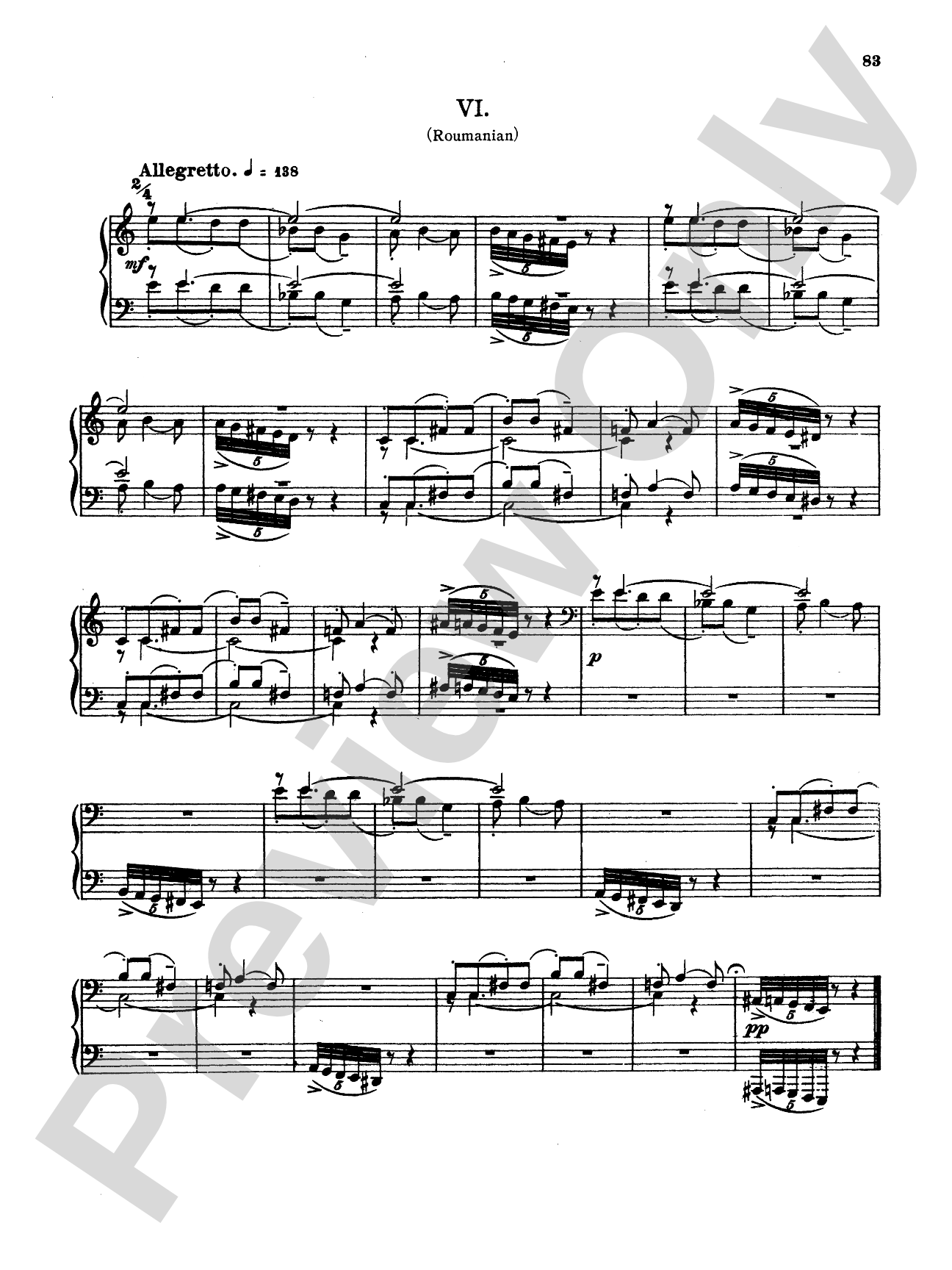
Bartók: Sketches, Op. 9 Sheet Music Preview

Bartók: Sketches, Op. 9

By Béla Bartók

Item: 00-PC-0005099

Digital Download
$0.99
Description
Expertly arranged piano solo from our Kalmus Edition.

Don't just read it, hear it, play along with it, and watch your students grow with it. In MakeMusic Cloud, Bartók: Sketches, Op. 9 comes alive with professional accompaniment, adjustable tempo, and built-in practice tools that turn solo practice into real progress.

Sample Audio
No sample audio found.
Sample Video
Additional Details
Series: Kalmus Edition
Publisher: Alfred Music
Page Count: 16
SKU: 00-PC-0005099

More about this title

About the Composer: Béla Bartók

Béla Bartók (1881-1945) was a Hungarian composer and pianist whose restless innovation transformed twentieth-century music. He synthesized European modernism with folk melodies collected across Eastern Europe, creating a language that felt simultaneously rooted and radical. His approach to harmony, rhythm, and form influenced generations of composers and remains central to the concert piano repertoire.

Bartók's pedagogical instinct shaped his entire output. He believed music education should develop both technical mastery and artistic independence, evident in works ranging from his Mikrokosmos to major concert pieces. His compositions challenge pianists to think beyond the Romantic tradition while building genuine musical depth.

Why we love this

Sketches, Op. 9 sits at a crucial crossroads in Bartók's development, where he was dismantling nineteenth-century harmony and building new structural approaches. These pieces reward careful study because they're genuinely modern without sacrificing lyricism. Teaching or performing them sends a clear signal that the pianist is ready for twentieth-century thinking.

What to expect

These sketches possess an urgent, searching quality. Lyrical passages emerge from sparse, almost austere harmonic terrain, then dissolve into rhythmic momentum. The writing feels intimate yet intellectually rigorous, never sentimental but never cold either.

Who it's for

Advanced intermediate to advanced pianists preparing for conservatory-level study or developing a contemporary classical recital. Musicians comfortable with twentieth-century tonality and interested in bridging early modernism with folk-influenced material will find sustained engagement here.

How to get the most out of it

  • Attend closely to Bartók's articulation markings and dynamic shapes; they are structural, not decorative. Each marking guides the ear toward the phrase's architecture.
  • Explore the relationship between rhythmic precision and rubato. Bartók's rhythmic cells often benefit from slight flexibility within their own integrity, not loose phrasing.
  • Balance the folk-influenced melodies against the modern harmonic language. Neither should overwhelm; both are essential to the work's identity.
  • Use the sustain pedal sparingly and purposefully. These sketches often need clarity; resonance should serve the writing, not obscure it.

How to use it

Pair these sketches with later Bartók works to trace his evolution, or program them alongside other early twentieth-century piano works by Stravinsky or Prokofiev to highlight how composers were reclaiming folk material for concert music. They work equally well in a solo recital as a substantial middle section that signals artistic seriousness.

Skills your students will build

  • Reading and executing twentieth-century harmonic language and atonal pitch collections
  • Coordinating irregular rhythmic patterns with sustained melodic lines
  • Interpreting dynamic and articulation markings as structural elements, not ornaments
  • Balancing modal and folk-derived melodies within modern harmonic contexts
  • Developing interpretive independence in music without a conventional tonal center

You May Also Like